Shulph Ink
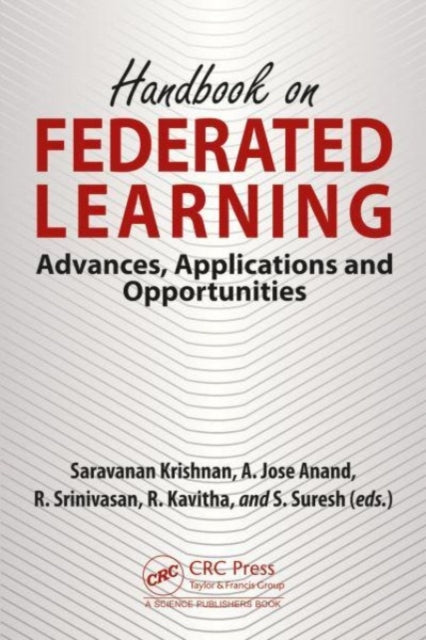
Handbook on Federated Learning: Advances, Applications and Opportunities
Handbook on Federated Learning: Advances, Applications and Opportunities
💎 Earn 811 Points (£8.11) on this item.
We can order this item for you. Delivery usually takes about 4 to 6 weeks.
This item is not held in our immediate stock. We will order it for you after checkout.
Estimated delivery: About 4 to 6 weeks
YOU SAVE £9.63
- Condition: Brand new
- UK Delivery times: Usually arrives within 2 - 3 working days
- UK Shipping: Fee starts at £2.39. Subject to product weight & dimension
Bulk ordering. Want 15 or more copies? Get a personalised quote and bigger discounts. Learn more about bulk orders.
Couldn't load pickup availability
- More about Handbook on Federated Learning: Advances, Applications and Opportunities
Mobile, wearable, and self-driving telephones generate enormous amounts of information daily, and federated learning (FL) is an expert form of decentralized machine learning (ML) that is essential in these areas. It works without problems when the predictions can be served by a central server, but user data is aggregated at a central location, making it more vulnerable to data violation. This book provides a comprehensive approach to federated learning for various aspects.
Format: Hardback
Length: 356 pages
Publication date: 15 December 2023
Publisher: Taylor & Francis Ltd
Mobile, wearable, and self-driving telephones are just a few examples of modern distributed networks that generate enormous amounts of information every day. Due to the growing computing capacity of these devices as well as concerns over the transfer of private information, it has become important to process the part of the data locally by moving the learning methods and computing to the border of devices. Federated learning has developed as a model of education in these situations. Federated learning (FL) is an expert form of decentralized machine learning (ML). It is essential in areas like privacy, large-scale machine education, and distribution. It is also based on the current stage of ICT and new hardware technology and is the next generation of artificial intelligence (AI). In FL, a central ML model is built with all the data available in a centralized environment in the traditional machine learning. It works without problems when the predictions can be served by a central server. Users require fast responses in mobile computing, but the model processing happens at the sight of the server, taking too long. The model can be placed in the end-user device, but continuous learning is a challenge to overcome, as models are programmed in a complete dataset and the end-user device lacks access to the entire data package. Another challenge with traditional machine learning is that user data is aggregated at a central location, where it violates local privacy policies laws and makes the data more vulnerable to data violation. This book provides a comprehensive approach to federated learning for various aspects.
Mobile, wearable, and self-driving telephones are just a few examples of modern distributed networks that generate enormous amounts of information every day. Due to the growing computing capacity of these devices as well as concerns over the transfer of private information, it has become important to process the part of the data locally by moving the learning methods and computing to the border of devices. Federated learning has developed as a model of education in these situations. Federated learning (FL) is an expert form of decentralized machine learning (ML). It is essential in areas like privacy, large-scale machine education, and distribution. It is also based on the current stage of ICT and new hardware technology and is the next generation of artificial intelligence (AI). In FL, a central ML model is built with all the data available in a centralized environment in the traditional machine learning. It works without problems when the predictions can be served by a central server. Users require fast responses in mobile computing, but the model processing happens at the sight of the server, taking too long. The model can be placed in the end-user device, but continuous learning is a challenge to overcome, as models are programmed in a complete dataset and the end-user device lacks access to the entire data package. Another challenge with traditional machine learning is that user data is aggregated at a central location, where it violates local privacy policies laws and makes the data more vulnerable to data violation. This book provides a comprehensive approach to federated learning for various aspects.
Mobile, wearable, and self-driving telephones are just a few examples of modern distributed networks that generate enormous amounts of information every day. Due to the growing computing capacity of these devices as well as concerns over the transfer of private information, it has become important to process the part of the data locally by moving the learning methods and computing to the border of devices. Federated learning has developed as a model of education in these situations. Federated learning (FL) is an expert form of decentralized machine learning (ML). It is essential in areas like privacy, large-scale machine education, and distribution. It is also based on the current stage of ICT and new hardware technology and is the next generation of artificial intelligence (AI). In FL, a central ML model is built with all the data available in a centralized environment in the traditional machine learning. It works without problems when the predictions can be served by a central server. Users require fast responses in mobile computing, but the model processing happens at the sight of the server, taking too long. The model can be placed in the end-user device, but continuous learning is a challenge to overcome, as models are programmed in a complete dataset and the end-user device lacks access to the entire data package. Another challenge with traditional machine learning is that user data is aggregated at a central location, where it violates local privacy policies laws and makes the data more vulnerable to data violation. This book provides a comprehensive approach to federated learning for various aspects.
Mobile, wearable, and self-driving telephones are just a few examples of modern distributed networks that generate enormous amounts of information every day. Due to the growing computing capacity of these devices as well as concerns over the transfer of private information, it has become important to process the part of the data locally by moving the learning methods and computing to the border of devices. Federated learning has developed as a model of education in these situations. Federated learning (FL) is an expert form of decentralized machine learning (ML). It is essential in areas like privacy, large-scale machine education, and distribution. It is also based on the current stage of ICT and new hardware technology and is the next generation of artificial intelligence (AI). In FL, a central ML model is built with all the data available in a centralized environment in the traditional machine learning. It works without problems when the predictions can be served by a central server. Users require fast responses in mobile computing, but the model processing happens at the sight of the server, taking too long. The model can be placed in the end-user device, but continuous learning is a challenge to overcome, as models are programmed in a complete dataset and the end-user device lacks access to the entire data package. Another challenge with traditional machine learning is that user data is aggregated at a central location, where it violates local privacy policies laws and makes the data more vulnerable to data violation. This book provides a comprehensive approach to federated learning for various aspects.
Weight: 830g
Dimension: 234 x 156 (mm)
ISBN-13: 9781032471624
UK and International shipping information
UK and International shipping information
UK Delivery and returns information:
- Delivery within 2 - 3 days when ordering in the UK.
- Shipping fee for UK customers from £2.39. Fully tracked shipping service available.
- Returns policy: Return within 30 days of receipt for full refund.
International deliveries:
Shulph Ink now ships to Australia, Belgium, Canada, France, Germany, Ireland, Italy, India, Luxembourg Saudi Arabia, Singapore, Spain, Netherlands, New Zealand, United Arab Emirates, United States of America.
- Delivery times: within 5 - 10 days for international orders.
- Shipping fee: charges vary for overseas orders. Only tracked services are available for most international orders. Some countries have untracked shipping options.
- Customs charges: If ordering to addresses outside the United Kingdom, you may or may not incur additional customs and duties fees during local delivery.