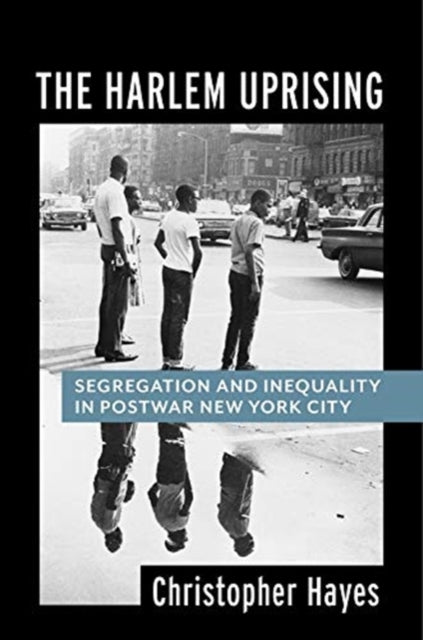
Christopher Hayes
Harlem Uprising: Segregation and Inequality in Postwar New York City
Harlem Uprising: Segregation and Inequality in Postwar New York City
💎 Earn 121 Points (£1.21) on this item.
YOU SAVE £5.72
- Condition: Brand new
- UK Delivery times: Usually arrives within 2 - 3 working days
- UK Shipping: Fee starts at £2.39. Subject to product weight & dimension
Bulk ordering. Want 15 or more copies? Get a personalised quote and bigger discounts. Learn more about bulk orders.
Couldn't load pickup availability
- More about Harlem Uprising: Segregation and Inequality in Postwar New York City
In July 1964, Harlem and Bedford-Stuyvesant erupted in protests after a white police officer killed an African American teenage boy. Protests demanded an end to police brutality and unequal treatment of Black people. The uprisings were the first of the 1960s urban uprisings, marked by looting, property damage, and widespread police violence. Christopher Hayes examines the causes and consequences of the uprisings, including the city's history of racial segregation and the police's neglect and exploitation of Black neighborhoods. The book reveals the white backlash against civil rights in the north and highlights the limits of liberalism.
Format: Paperback / softback
Length: 352 pages
Publication date: 26 October 2021
Publisher: Columbia University Press
In July 1964, a tragic incident unfolded in Harlem and Bedford-Stuyvesant, sparking widespread unrest and protests. The death of an African American teenage boy at the hands of a white police officer ignited a fervent demand for justice and an end to police brutality. The protests, which erupted a week after the incident, were a testament to the growing frustration and disillusionment of Black New Yorkers with the city's perceived liberal ideals.
The uprisings were a culmination of several factors, including the city's history of racial segregation in education, housing, and employment. Black New Yorkers faced pervasive discrimination, limited economic opportunities, and deteriorating quality of life. They felt a growing sense of disenchantment with the promises of city leaders, who had failed to address the systemic issues affecting their communities.
While the national civil rights movement achieved significant victories in the 1950s and 1960s, Black New Yorkers witnessed little or uneven progress. They saw little change in the face of pervasive discrimination, economic inequality, and inadequate public services. The uprisings were a cry for action and a demand for their voices to be heard.
The aftermath of the uprisings was marked by a fierce backlash from white citizens, who saw the protests as a threat to their way of life. The NYPD's rank and file fought vehemently against calls for civilian review of complaints against the police, further inflaming racial tensions. The uprisings also exposed the limits of liberalism, as the city's power structure refused to address the root causes of racial inequality.
Christopher Hayes' book, "The Rise of Black New York," delves into the causes and consequences of the uprisings. He examines the city's history of racial segregation, the neglect and exploitation of Black neighborhoods by the police, and the growing sense of disenchantment among Black New Yorkers. Hayes also highlights the white backlash against civil rights in the north and the limitations of liberalism in addressing racial inequality.
Drawing on a wide range of archives, Hayes provides a vivid portrait of postwar New York City, offering a fresh perspective on the civil rights era. He sheds light on the experiences of Black New Yorkers, their struggles, and their resilience in the face of adversity. The book also provides a timely analysis of deeply entrenched racial inequalities, highlighting the need for systemic change and the ongoing fight for justice.
The uprisings of 1964 in Harlem and Bedford-Stuyvesant were a defining moment in the history of Black America. They marked a turning point in the fight for civil rights and exposed the deep-seated systemic issues that plagued Black communities. The legacy of these uprisings continues to inspire and motivate activists and policymakers today, as we work towards a more equitable and just society.
Weight: 518g
Dimension: 156 x 235 x 22 (mm)
ISBN-13: 9780231181877
This item can be found in:
UK and International shipping information
UK and International shipping information
UK Delivery and returns information:
- Delivery within 2 - 3 days when ordering in the UK.
- Shipping fee for UK customers from £2.39. Fully tracked shipping service available.
- Returns policy: Return within 30 days of receipt for full refund.
International deliveries:
Shulph Ink now ships to Australia, Belgium, Canada, France, Germany, Ireland, Italy, India, Luxembourg Saudi Arabia, Singapore, Spain, Netherlands, New Zealand, United Arab Emirates, United States of America.
- Delivery times: within 5 - 10 days for international orders.
- Shipping fee: charges vary for overseas orders. Only tracked services are available for most international orders. Some countries have untracked shipping options.
- Customs charges: If ordering to addresses outside the United Kingdom, you may or may not incur additional customs and duties fees during local delivery.