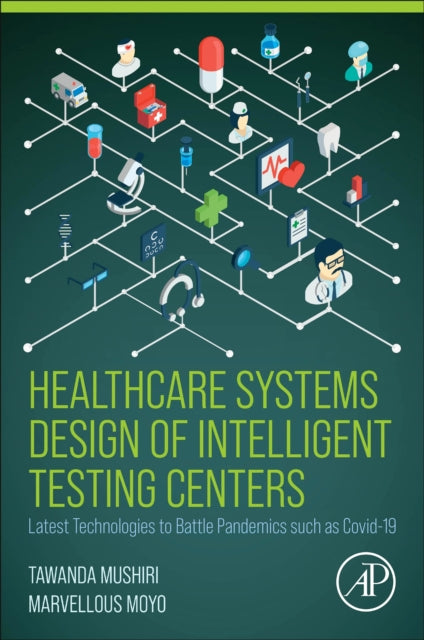
TawandaMushiri,MarvellousMoyo
Healthcare Systems Design of Intelligent Testing Centers: Latest Technologies to Battle Pandemics such as Covid-19
Healthcare Systems Design of Intelligent Testing Centers: Latest Technologies to Battle Pandemics such as Covid-19
💎 Earn 508 Points (£5.08) on this item.
YOU SAVE £13.22
- Condition: Brand new
- UK Delivery times: Usually arrives within 2 - 3 working days
- UK Shipping: Fee starts at £2.39. Subject to product weight & dimension
Bulk ordering. Want 15 or more copies? Get a personalised quote and bigger discounts. Learn more about bulk orders.
Couldn't load pickup availability
- More about Healthcare Systems Design of Intelligent Testing Centers: Latest Technologies to Battle Pandemics such as Covid-19
The book emphasizes the importance of designing intelligent testing centers that require no human intervention for sample collection and testing of the Covid-19 virus and similar viruses. It introduces the background, medical requirements, and new research on medical robotics applications, including general Covid-19 testing techniques, development considerations for intelligent testing booths, kinematic and dynamic modeling, design specifications and optimization, numerical verifications, actuators, and sensors in medical applications of artificial intelligence and robotics systems.
Format: Paperback / softback
Length: 250 pages
Publication date: 25 January 2023
Publisher: Elsevier Science & Technology
The design of intelligent testing centers is crucial in combating pandemics like Covid-19, emphasizing the need for automated and human-free processes. This book delves into the background, medical requirements, and emerging research on medical robotics applications, specifically focusing on Covid-19 testing techniques, development considerations for intelligent testing booths, kinematic and dynamic modeling, design specifications and optimization, numerical verifications, actuators, and sensors in the field of artificial intelligence and robotics systems.
The emergence of Covid-19 has underscored the critical need for efficient and effective healthcare systems. In response, the design of intelligent testing centers has gained significant attention. These centers aim to automate the process of sample collection and testing for the Covid-19 virus and other similar viruses, minimizing human intervention and reducing the risk of infection.
The book "Healthcare Systems Design of Intelligent Testing Centers: Latest Technologies to Battle Pandemics such as Covid-19" explores the importance of designing intelligent testing centers that require no human intervention during sample collection and testing. It provides a comprehensive overview of the background, medical requirements, and emerging research on medical robotics applications, particularly in the context of Covid-19 testing.
The book begins by introducing the background of intelligent testing centers, including their historical development and the challenges they face in combating pandemics. It then delves into the medical requirements for such centers, emphasizing the need for accurate and rapid testing capabilities. The authors discuss the various technologies and techniques used in intelligent testing centers, such as automated sample collection systems, robotic testing booths, and advanced imaging technologies.
One of the key aspects of intelligent testing centers is the development of medical robotics applications. The book explores the background, medical requirements, and emerging research on medical robotics applications, including general Covid-19 testing techniques, development considerations for intelligent testing booths, kinematic and dynamic modeling, design specifications and optimization, numerical verifications, actuators, and sensors in medical applications of artificial intelligence and robotics systems.
The authors provide detailed explanations of these topics, covering the theoretical foundations, practical applications, and potential benefits of medical robotics in healthcare. They also discuss the challenges and limitations associated with the implementation of medical robotics, such as ethical considerations, regulatory requirements, and the need for interdisciplinary collaboration.
In addition to the technical aspects, the book also emphasizes the importance of design specifications and optimization in intelligent testing centers. The authors discuss the criteria for designing efficient and effective testing booths, including factors such as space requirements, workflow efficiency, and patient comfort. They also explore the use of numerical simulations and optimization algorithms to improve the design and performance of intelligent testing centers.
Numerical verifications are another critical component of intelligent testing centers. The authors discuss the use of numerical simulations and modeling techniques to validate the design and performance of medical robotics systems. They also discuss the importance of testing and validation in ensuring the safety and efficacy of medical devices and systems.
Actuators and sensors are essential components of medical robotics systems, and the book provides a comprehensive overview of their applications in healthcare. The authors discuss the different types of actuators and sensors used in medical applications, including mechanical actuators, electrical actuators, and sensory systems. They also discuss the design and implementation of actuators and sensors in medical robotics systems, including their integration with other components and their impact on patient care.
The book concludes by highlighting the potential benefits of intelligent testing centers in combating pandemics like Covid-19. It emphasizes the need for continuous innovation and research in the field of medical robotics to improve the efficiency, accuracy, and safety of healthcare systems. The authors also call for interdisciplinary collaboration and policy support to ensure the successful implementation of intelligent testing centers and the development of medical robotics applications in healthcare.
In conclusion, the design of intelligent testing centers is crucial in combating pandemics like Covid-19. This book provides a comprehensive overview of the background, medical requirements, and emerging research on medical robotics applications, particularly in the context of Covid-19 testing. It highlights the importance of automated and human-free processes, the development of medical robotics applications, design specifications and optimization, numerical verifications, actuators, and sensors in medical applications of artificial intelligence and robotics systems. By leveraging these technologies, healthcare systems can improve their efficiency, accuracy, and safety, ultimately contributing to the betterment of public health.
Weight: 430g
Dimension: 151 x 229 x 18 (mm)
ISBN-13: 9780323994439
This item can be found in:
UK and International shipping information
UK and International shipping information
UK Delivery and returns information:
- Delivery within 2 - 3 days when ordering in the UK.
- Shipping fee for UK customers from £2.39. Fully tracked shipping service available.
- Returns policy: Return within 30 days of receipt for full refund.
International deliveries:
Shulph Ink now ships to Australia, Belgium, Canada, France, Germany, Ireland, Italy, India, Luxembourg Saudi Arabia, Singapore, Spain, Netherlands, New Zealand, United Arab Emirates, United States of America.
- Delivery times: within 5 - 10 days for international orders.
- Shipping fee: charges vary for overseas orders. Only tracked services are available for most international orders. Some countries have untracked shipping options.
- Customs charges: If ordering to addresses outside the United Kingdom, you may or may not incur additional customs and duties fees during local delivery.