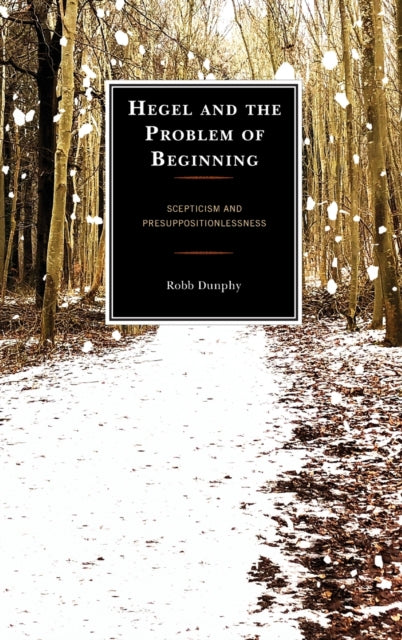
Robb Dunphy
Hegel and the Problem of Beginning: Scepticism and Presuppositionlessness
Hegel and the Problem of Beginning: Scepticism and Presuppositionlessness
💎 Earn 451 Points (£4.51) on this item.
We can order this item for you. Delivery usually takes about 4 to 6 weeks.
This item is not held in our immediate stock. We will order it for you after checkout.
Estimated delivery: About 4 to 6 weeks
- Condition: Brand new
- UK Delivery times: Usually arrives within 2 - 3 working days
- UK Shipping: Fee starts at £3.89. Subject to product weight & dimension
Bulk ordering. Want 15 or more copies? Get a personalised quote and bigger discounts. Learn more about bulk orders.
Couldn't load pickup availability
- More about Hegel and the Problem of Beginning: Scepticism and Presuppositionlessness
Hegel's Science of Logic opens with the statement of a problem, which Robert Dunphy discusses in his book. He offers a critical engagement with Hegel's problem and proposes original interventions into discussions concerning his wider logical project, the relationship between his Logic and Phenomenology, and his engagement with the Pyrrhonian skeptical tradition.
Format: Hardback
Length: 224 pages
Publication date: 12 January 2023
Publisher: Rowman & Littlefield
Hegel begins his renowned Science of Logic with a thought-provoking statement that sets the stage for his philosophical exploration. He states, "The beginning of philosophy must be either something mediated or something immediate, and it is easy to show that it can be neither the one nor the other, so either way of beginning runs into a rebuttal." Despite the importance of this opening statement, the exact meaning and the solution Hegel proposes remain somewhat unclear.
In order to delve deeper into this problem and explore Hegel's potential solutions, Robert Dunphy has authored a comprehensive and critical examination. This book offers a detailed analysis of Hegel's problem of beginning, as well as the various interpretations and proposed solutions that scholars have offered. Furthermore, it provides original insights into broader discussions surrounding Hegel's logical project, the relationship between his Logic and his Phenomenology, and his engagement with the Pyrrhonian skeptical tradition.
Dunphy begins by providing a clear and concise overview of Hegel's problem of beginning. He explains that Hegel's aim is to establish a philosophical system that encompasses both the rational and the irrational aspects of human experience. However, Hegel faces a dilemma as to how to begin this endeavor. On the one hand, he recognizes the need for a mediated beginning, which would involve the use of concepts and ideas to establish a foundation for further inquiry. On the other hand, he also believes that an immediate beginning, which would rely on direct experience and intuition, is necessary to fully understand the nature of reality.
Dunphy argues that Hegel's solution to this problem lies in his concept of dialectic. He suggests that philosophy should not attempt to start from a fixed point or a predetermined conclusion but rather should engage in a continuous process of dialogue and debate. This process involves the clash of opposing ideas and the search for a synthesis that reconciles them. By engaging in this dialectic, philosophy can move beyond the limitations of immediate experience and gain a deeper understanding of the underlying structures of reality.
In addition to his analysis of Hegel's dialectic, Dunphy also offers original interventions into discussions concerning Hegel's wider logical project. He explores the relationship between Hegel's Logic and his Phenomenology, which are often seen as separate and distinct aspects of his philosophy. Dunphy argues that these two aspects are interconnected and that Hegel's Logic provides the framework for understanding the structures of reality that are experienced in the Phenomenology.
Furthermore, Dunphy engages with the Pyrrhonian skeptical tradition, which challenges the idea of a fixed and universal truth. Hegel, in contrast, believes that truth is not absolute but is rather relative to the perspective and context in which it is perceived. Dunphy argues that Hegel's approach to skepticism is nuanced and that he does not reject the possibility of knowledge but rather seeks to establish a method for achieving it that is based on dialectic and the recognition of the inherent limitations of human understanding.
Overall, Robert Dunphy's book provides a valuable contribution to the study of Hegel's philosophy. It offers a detailed and critical engagement with Hegel's problem of beginning, as well as the various interpretations and solutions that scholars have proposed. Through his original interventions into discussions concerning Hegel's wider logical project and his engagement with the Pyrrhonian skeptical tradition, Dunphy provides new insights into the complexities of Hegel's thought. This book is an essential read for anyone interested in Hegel's philosophy or in the broader field of philosophical inquiry.
Weight: 490g
Dimension: 157 x 236 x 21 (mm)
ISBN-13: 9781538147559
UK and International shipping information
UK and International shipping information
We deliver throughout the United Kingdom and to 128 countries and territories worldwide, including the United States, Australia, Canada, Germany, Spain and France.