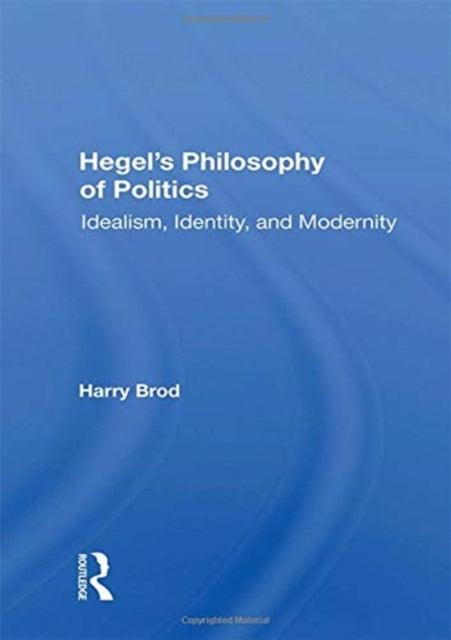
Harry Brod
Hegel's Philosophy Of Politics: Idealism, Identity, And Modernity
Hegel's Philosophy Of Politics: Idealism, Identity, And Modernity
💎 Earn 207 Points (£2.07) on this item.
We can order this item for you. Delivery usually takes about 4 to 6 weeks.
This item is not held in our immediate stock. We will order it for you after checkout.
Estimated delivery: About 4 to 6 weeks
YOU SAVE £2.47
- Condition: Brand new
- UK Delivery times: Usually arrives within 2 - 3 working days
- UK Shipping: Fee starts at £2.39. Subject to product weight & dimension
Bulk ordering. Want 15 or more copies? Get a personalised quote and bigger discounts. Learn more about bulk orders.
Couldn't load pickup availability
- More about Hegel's Philosophy Of Politics: Idealism, Identity, And Modernity
This book delves into Hegel's tripartite division of the political realm, idealism, logic, identity, and difference, and the contradictions of modernity.
Format: Paperback / softback
Length: 216 pages
Publication date: 23 December 2022
Publisher: Taylor & Francis Ltd
This book delves into the core essence of Hegel's tripartite division of the political realm, encompassing the spheres of family, civil society, and the state. It also explores Hegel's distinctive form of idealism, his intricate logic system, the concept of identity and difference, and the profound contradictions inherent in modernity.
Within the framework of Hegel's political philosophy, the family occupies a central position, representing the initial stage of social existence. According to Hegel, the family is not merely a private entity but rather the foundation upon which broader social structures and institutions are built. The family, he argues, is characterized by its intimate relationships and the interdependence of its members, which form the basis for the development of individual consciousness and self-awareness.
The family, in Hegel's view, is not just a mere social unit but rather a dynamic entity that undergoes constant transformation and evolution. Hegel sees the family as a site of emotional and psychological development, where individuals learn to express and regulate their emotions, form attachments, and develop a sense of self. Through the interactions within the family, individuals acquire the necessary skills and values that will shape their interactions with others in the broader social context.
However, Hegel also recognizes the limitations and challenges associated with the family as a social institution. He argues that the family can be subject to patriarchal structures and power dynamics, which can perpetuate inequality and discrimination. Hegel emphasizes the need for a more egalitarian and inclusive approach to family relations, which recognizes the diverse needs and perspectives of all family members.
Beyond the family, Hegel's political philosophy extends to the broader realm of civil society. Civil society, according to Hegel, is a complex and multifaceted entity that encompasses a wide range of institutions and organizations, such as schools, churches, trade unions, and political parties. Hegel sees civil society as a vital component of the political realm, as it provides the space for individuals to engage in social and political activities, express their opinions and ideas, and participate in the democratic process.
However, Hegel also recognizes the potential for conflict and division within civil society. He argues that different social classes, interests, and ideologies can lead to tensions and conflicts that can undermine the stability and cohesion of society. Hegel emphasizes the need for social harmony and balance, which can be achieved through the promotion of social justice, equality, and the common good.
Finally, Hegel's political philosophy extends to the state, which is considered the highest form of social organization. Hegel sees the state as a rational entity that is responsible for the governance and regulation of society. The state, according to Hegel, is not just a mechanism of power but also a vehicle for the realization of individual and social freedom.
Hegel's concept of the state is based on the idea of the "spirit of law," which he defines as the rational and universal principle that governs the behavior of individuals and institutions. The state, according to Hegel, is not just a means of enforcing order but also a means of promoting the common good and the realization of human potential.
However, Hegel also recognizes the potential for abuse and corruption within the state. He argues that the state can become dominated by powerful individuals or groups who use their power for personal gain or to undermine democratic processes. Hegel emphasizes the need for democratic governance, transparency, and accountability, which can ensure that the state serves the interests of all its citizens.
Weight: 420g
ISBN-13: 9780367162313
This item can be found in:
UK and International shipping information
UK and International shipping information
UK Delivery and returns information:
- Delivery within 2 - 3 days when ordering in the UK.
- Shipping fee for UK customers from £2.39. Fully tracked shipping service available.
- Returns policy: Return within 30 days of receipt for full refund.
International deliveries:
Shulph Ink now ships to Australia, Belgium, Canada, France, Germany, Ireland, Italy, India, Luxembourg Saudi Arabia, Singapore, Spain, Netherlands, New Zealand, United Arab Emirates, United States of America.
- Delivery times: within 5 - 10 days for international orders.
- Shipping fee: charges vary for overseas orders. Only tracked services are available for most international orders. Some countries have untracked shipping options.
- Customs charges: If ordering to addresses outside the United Kingdom, you may or may not incur additional customs and duties fees during local delivery.