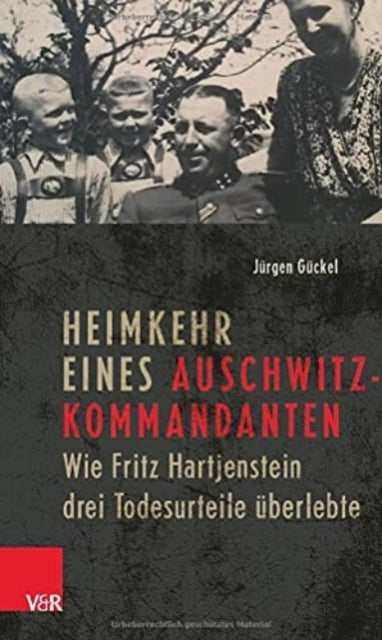
Jurgen Guckel
Heimkehr eines Auschwitz-Kommandanten: Wie Fritz Hartjenstein drei Todesurteile uberlebte
Heimkehr eines Auschwitz-Kommandanten: Wie Fritz Hartjenstein drei Todesurteile uberlebte
💎 Earn 137 Points (£1.37) on this item.
YOU SAVE £0.45
- Condition: Brand new
- UK Delivery times: Usually arrives within 2 - 3 working days
- UK Shipping: Fee starts at £2.39. Subject to product weight & dimension
Bulk ordering. Want 15 or more copies? Get a personalised quote and bigger discounts. Learn more about bulk orders.
Couldn't load pickup availability
- More about Heimkehr eines Auschwitz-Kommandanten: Wie Fritz Hartjenstein drei Todesurteile uberlebte
Uncle Fritz, a German SS officer and Auschwitz commander, was sentenced to death three times and pardoned shortly before his death. His great-nephew Werner H. has been researching his life and involvement in National Socialist crimes for decades. Jürgen Gückel reconstructs his unique life in a report.
Format: Hardback
Length: 303 pages
Publication date: 06 September 2021
Publisher: Vandenhoeck & Ruprecht GmbH & Co KG
Uncle Fritz has returned from France, resting in a zinc coffin! The captivating biography of German SS officer and Auschwitz commander Friedrich Fritz Hartjenstein begins with this dramatic scene from October 1954. He faced three death sentences for his actions. After spending nine years in prison, he received a pardon just before his passing. In his hometown of Peine in Lower Saxony, Hartjenstein's fate remains a mystery to this day. However, his great-nephew Werner H. has dedicated decades to researching the remarkable life of his great-uncle and his involvement in National Socialist crimes. In a compelling report, Jürgen Gückel delves into the unique life of the concentration camp commandant Friedrich Hartjenstein.
Hartjenstein's journey began in his hometown of Peine, where he grew up in a middle-class family. Despite his privileged upbringing, he was drawn to the **** party and its ideology. He joined the SS in 1933 and quickly rose through the ranks, becoming a commander at Auschwitz in 1943.
At Auschwitz, Hartjenstein was responsible for the brutal treatment of thousands of Jewish prisoners. He implemented cruel policies, such as the use of gas chambers and forced labor, that led to the deaths of millions of people. His actions were widely condemned and he faced multiple trials and convictions for his crimes.
Despite his notoriety, Hartjenstein managed to evade capture for several years. He fled to South America, where he lived in hiding for several decades. However, his past eventually caught up with him, and he was extradited to Germany in 1954 to face justice.
During his trial, Hartjenstein claimed that he was only following orders and that he had no choice but to carry out the atrocities he had committed. However, the court rejected his defense and sentenced him to death three times.
After spending nine years in prison, Hartjenstein was pardoned shortly before his death. His pardon was controversial, with many people arguing that he should have been executed for his crimes. However, his great-nephew Werner H. believed that his great-uncle deserved a second chance and worked tirelessly to advocate for his pardon.
In his final years, Hartjenstein lived in obscurity, largely forgotten by the world. He died in 1960, at the age of 63, without ever fully acknowledging the gravity of his actions.
Hartjenstein's life is a chilling reminder of the horrors of the Holocaust and the devastating consequences of hate and prejudice. His story serves as a testament to the resilience of the human spirit and the importance of seeking justice and accountability for the crimes of the past.
Despite the controversy surrounding his pardon, Hartjenstein's great-nephew Werner H. remains committed to researching his great-uncle's life and his involvement in National Socialist crimes. He believes that it is essential to remember the past and to learn from it to prevent similar atrocities from happening in the future.
In conclusion, the life of Friedrich Fritz Hartjenstein is a complex and controversial tale. He was a German SS officer and Auschwitz commander who faced three death sentences for his actions during the Holocaust. Despite his notoriety, he managed to evade capture for several years and lived in obscurity until his death. His pardon was controversial, but his great-nephew Werner H. believes that it is essential to remember the past and to learn from it to prevent similar atrocities from happening in the future.
Dimension: 210 x 130 (mm)
ISBN-13: 9783525311370
This item can be found in:
UK and International shipping information
UK and International shipping information
UK Delivery and returns information:
- Delivery within 2 - 3 days when ordering in the UK.
- Shipping fee for UK customers from £2.39. Fully tracked shipping service available.
- Returns policy: Return within 30 days of receipt for full refund.
International deliveries:
Shulph Ink now ships to Australia, Belgium, Canada, France, Germany, Ireland, Italy, India, Luxembourg Saudi Arabia, Singapore, Spain, Netherlands, New Zealand, United Arab Emirates, United States of America.
- Delivery times: within 5 - 10 days for international orders.
- Shipping fee: charges vary for overseas orders. Only tracked services are available for most international orders. Some countries have untracked shipping options.
- Customs charges: If ordering to addresses outside the United Kingdom, you may or may not incur additional customs and duties fees during local delivery.