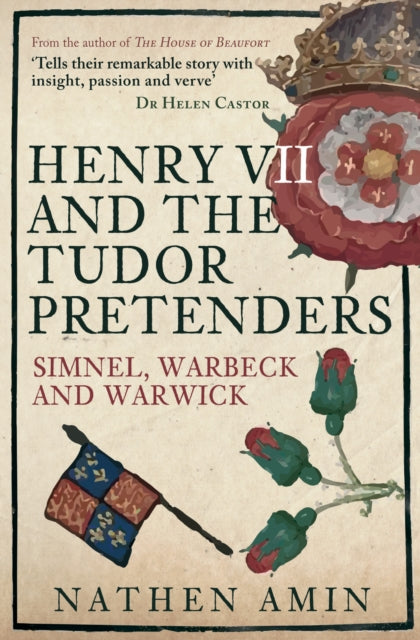
Nathen Amin
Henry VII and the Tudor Pretenders: Simnel, Warbeck, and Warwick
Henry VII and the Tudor Pretenders: Simnel, Warbeck, and Warwick
💎 Earn 45 Points (£0.45) on this item.
YOU SAVE £3.80
- Condition: Brand new
- UK Delivery times: Usually arrives within 2 - 3 working days
- UK Shipping: Fee starts at £2.39. Subject to product weight & dimension
Bulk ordering. Want 15 or more copies? Get a personalised quote and bigger discounts. Learn more about bulk orders.
Couldn't load pickup availability
- More about Henry VII and the Tudor Pretenders: Simnel, Warbeck, and Warwick
On August 22, 1485, Henry Tudor defeated Richard III in the Battle of Bosworth, bringing "smooth-faced peace" to England. However, the kingdom was not settled, and there were conspiracies and plots to depose the Tudor usurper. Nathen Amin looks at the three pretenders, Lambert Simnel, Perkin Warbeck, and Edward, Earl of Warwick, who were advanced by Yorkist dissidents. How close did the Tudors come to overthrow long before the myth of their greatness took hold?
Format: Paperback / softback
Length: 384 pages
Publication date: 15 October 2022
Publisher: Amberley Publishing
On August 22, 1485, Henry Tudor emerged victorious from the Battle of Bosworth, defeating Richard III's forces. Shakespeare later portrayed this event as bringing about "smooth-faced peace, with smiling aplenty and fair prosperous days back to England." However, the Tudor reign was not without its challenges. Despite attempts to portray Henry VII as the sole unifier of a war-torn England after three decades of conflict, the kingdom was far from settled. The two-year period preceding Henry's reign was marked by significant turmoil, including the untimely death of one king, the mysterious disappearance of another, and the brutal slaughter of a third on the battlefield.
In this captivating and comprehensive account, Nathan Amin delves into the myriad of shadowy conspiracies and murky plots that sought to depose the Tudor usurper early in his reign, with a particular emphasis on the three pretenders whose causes were fervently advanced by Yorkist dissidents: Lambert Simnel, Perkin Warbeck, and Edward, Earl of Warwick. The question arises: How close did the Tudors come to overthrow long before the myth of their greatness took hold in our public consciousness?
The Tudor dynasty was not without its detractors, even during its early years. The Earl of Surrey, a prominent nobleman, was one of the first to raise concerns about Henry VII's legitimacy. Surrey believed that Richard III had rightfully claimed the throne and that Henry VII's ascent to power was illegitimate. He supported Lambert Simnel, a young man who claimed to be Richard III's son, in an attempt to overthrow the Tudor regime.
Simnel's cause was widely supported by Yorkist dissidents, who saw him as a symbol of their resistance against the Tudor rule. They believed that Simnel was the true heir to the throne and that he deserved to be king. However, their efforts to raise support for Simnel were met with fierce opposition from the Tudor government, which saw Simnel as a fraud and a threat to the stability of the kingdom.
Despite these obstacles, Simnel's cause gained momentum, and he was able to gather a large army of supporters. In May 1485, Simnel led his army into England, hoping to capture London and force the Tudor government to recognize him as the rightful king. However, his army was defeated at the Battle of Tewkesbury, and Simnel was captured and executed.
Perkin Warbeck, another claimant to the throne, also attempted to overthrow the Tudor regime. Warbeck was a charismatic and popular figure who claimed to be Richard III's younger brother. He gathered a large army of supporters, particularly in the north of England, and posed a significant threat to the Tudor government.
However, Warbeck's cause was not without its flaws. He was known for his erratic behavior and his tendency to make rash decisions, which often led to his downfall. In 1491, Warbeck's army was defeated at the Battle of Barnet, and he was captured and executed.
Edward, Earl of Warwick, was the third and final claimant to the throne who sought to depose the Tudor usurper. Warwick was a powerful nobleman who had been a loyal supporter of Richard III during the Wars of the Roses. He believed that Richard III had been unjustly executed and that he deserved to be king.
Warwick's cause was supported by a significant number of Yorkist dissidents, who saw him as the best candidate to restore the rightful king to the throne. However, Warwick's ambitions were not without their flaws. He was known for his ruthlessness and his willingness to use any means necessary to achieve his goals.
In 1492, Warwick led his army into England, hoping to capture London and force the Tudor government to recognize him as the rightful king. However, his army was defeated at the Battle of Edgehill, and Warwick was captured and executed.
Despite these attempts to depose the Tudor usurper, the Tudor dynasty remained in power for over 300 years. Henry VII's reign was marked by significant reforms and advancements in English society, including the establishment of the Church of England and the establishment of the Royal Navy. The Tudor dynasty also played a significant role in the English Renaissance, which saw a cultural and artistic revival in England.
In conclusion, the Tudor dynasty faced numerous challenges and threats during its early years, including attempts to depose the Tudor usurper by three pretenders: Lambert Simnel, Perkin Warbeck, and Edward, Earl of Warwick. While these attempts were unsuccessful, the Tudor dynasty remained in power for over 300 years, marking significant reforms and advancements in English society. The legacy of the Tudor dynasty continues to be felt today, and their reign remains a fascinating and important period in English history.
Weight: 304g
Dimension: 130 x 196 x 27 (mm)
ISBN-13: 9781398112469
UK and International shipping information
UK and International shipping information
UK Delivery and returns information:
- Delivery within 2 - 3 days when ordering in the UK.
- Shipping fee for UK customers from £2.39. Fully tracked shipping service available.
- Returns policy: Return within 30 days of receipt for full refund.
International deliveries:
Shulph Ink now ships to Australia, Belgium, Canada, France, Germany, Ireland, Italy, India, Luxembourg Saudi Arabia, Singapore, Spain, Netherlands, New Zealand, United Arab Emirates, United States of America.
- Delivery times: within 5 - 10 days for international orders.
- Shipping fee: charges vary for overseas orders. Only tracked services are available for most international orders. Some countries have untracked shipping options.
- Customs charges: If ordering to addresses outside the United Kingdom, you may or may not incur additional customs and duties fees during local delivery.