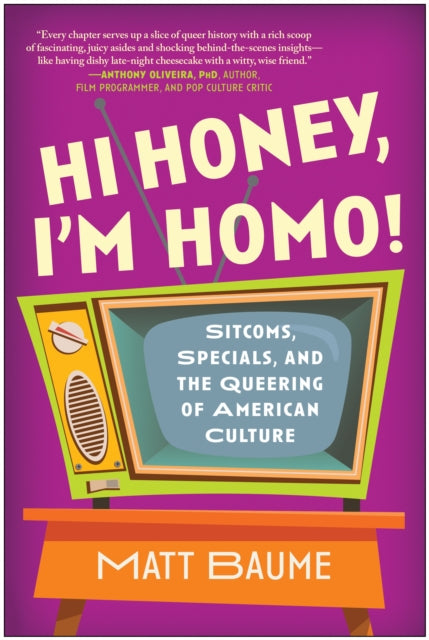
Matt Baume
Hi Honey, I'm Homo!: Sitcoms, Specials, and the Queering of American Culture
Hi Honey, I'm Homo!: Sitcoms, Specials, and the Queering of American Culture
💎 Earn 70 Points (£0.70) on this item.
YOU SAVE £5.84
- Condition: Brand new
- UK Delivery times: Usually arrives within 2 - 3 working days
- UK Shipping: Fee starts at £2.39. Subject to product weight & dimension
Bulk ordering. Want 15 or more copies? Get a personalised quote and bigger discounts. Learn more about bulk orders.
Couldn't load pickup availability
- More about Hi Honey, I'm Homo!: Sitcoms, Specials, and the Queering of American Culture
Hi Honey, I'm Homo! is a documentary that explores how subversive queer comedy transformed the American sitcom from its inception through today, and how our favorite sitcoms have transformed and continue to transform America. It features exclusive commentary and interviews from celebrities, behind-the-scenes creators, and more.
Format: Paperback / softback
Length: 272 pages
Publication date: 23 May 2023
Publisher: BenBella Books
For decades, amidst the bright lights, studio-audience laughs, and absurdly large apartment sets, the real-life story of American LGBTQ liberation unfolded in plain sight in front of millions of viewers, most of whom were laughing too hard to mind. From flamboyant relatives on Bewitched to closely-guarded secrets on All in the Family, from network-censor fights over Soap to behind-the-scenes activism on the set of The Golden Girls, from Ellen's culture clash to Modern Family's primetime power couple, Hi Honey, I'm Homo! is the story not only of how subversive queer comedy transformed the American sitcom, from its inception through today, but how our favorite sitcoms transformed and continue to transform, America. Accessible, entertaining, and informative, Hi Honey, I'm Homo! is filled with exclusive commentary and interviews from celebrities, behind-the-scenes creators, and more.
Introduction:
For decades, American television has been a platform for storytelling and cultural representation. From the classic sitcoms of the 1950s and 1960s to the contemporary shows of today, television has played a significant role in shaping the way we perceive and understand different communities. One such community that has been marginalized and underrepresented on television is the LGBTQ+ community.
Despite the progress that has been made in recent years, LGBTQ+ characters and storylines have often been relegated to the sidelines or portrayed in stereotypical and negative ways. However, there has been a growing movement in recent years to challenge these stereotypes and provide more accurate and diverse representation of the LGBTQ+ community on television.
In this essay, we will explore the history of LGBTQ+ representation on American television and the impact that it has had on the community. We will also examine the challenges that remain and the efforts that are being made to improve representation.
The Early Years:
The history of LGBTQ+ representation on American television can be traced back to the early days of television broadcasting. In the 1950s and 1960s, television was still a relatively new medium, and there were few opportunities for LGBTQ+ characters to be featured on screen. However, there were some notable exceptions.
One of the earliest examples of LGBTQ+ representation on American television was the character of Ellen Morgan on the soap opera Bewitched. Ellen was a witch who was in a relationship with another woman, and her relationship was treated as a normal and healthy part of the show. This was a significant breakthrough for LGBTQ+ representation on television, as it was a time when homosexuality was still widely considered taboo and illegal.
Another early example of LGBTQ+ representation on American television was the character of Laura Henderson on the soap opera All in the Family. Laura was a closeted lesbian who was married to a man and had a daughter. Her relationship with her wife was portrayed as a complex and nuanced one, and her struggle to come out to her family was a central theme of the show.
However, even with these early examples of LGBTQ+ representation, there were still many challenges to be faced. Television censorship was still a significant issue, and many shows were hesitant to portray LGBTQ+ characters or relationships in a positive or accurate way. This led to a lot of stereotyping and negative portrayals of LGBTQ+ characters on television.
The 1970s and 1980s:
The 1970s and 1980s were a time of significant change for LGBTQ+ representation on American television. With the rise of cable television and the emergence of more progressive programming, there were more opportunities for LGBTQ+ characters to be featured on screen.
One of the most notable examples of LGBTQ+ representation in the 1970s and 1980s was the character of Roseanne Barr on the sitcom Roseanne. Roseanne was a working-class woman who was married to a man and had three children. However, she was also a lesbian, and her relationship with her wife was a central theme of the show.
Another notable example of LGBTQ+ representation in the 1970s and 1980s was the character of J.J. Jakes on the soap opera The Young and the Restless. J.J. was a gay man who was a police officer and was a prominent figure in the LGBTQ+ community. His character was portrayed as a strong and confident individual who was proud of his identity.
However, even with these positive examples of LGBTQ+ representation, there were still many challenges to be faced. Television censorship was still a significant issue, and many shows were hesitant to portray LGBTQ+ characters or relationships in a positive or accurate way. This led to a lot of stereotyping and negative portrayals of LGBTQ+ characters on television.
The 1990s and 2000s:
The 1990s and 2000s were a time of significant growth for LGBTQ+ representation on American television. With the rise of the internet and the emergence of streaming services, there were more opportunities for LGBTQ+ characters to be featured on screen and to have more complex and nuanced storylines.
One of the most notable examples of LGBTQ+ representation in the 1990s and 2000s was the character of Will & Grace. Will & Grace was a sitcom that followed the lives of two gay men, Will and Grace, and their friends and family. The show was groundbreaking in its portrayal of LGBTQ+ characters and their relationships, and it paved the way for more diverse and inclusive programming on television.
Another notable example of LGBTQ+ representation in the 1990s and 2000s was the character of Queer as Folk. Queer as Folk was a drama that followed the lives of a group of gay men in Pittsburgh. The show was groundbreaking in its portrayal of LGBTQ+ characters and their relationships, and it paved the way for more diverse and inclusive programming on television.
However, even with these positive examples of LGBTQ+ representation, there were still many challenges to be faced. Television censorship was still a significant issue, and many shows were hesitant to portray LGBTQ+ characters or relationships in a positive or accurate way. This led to a lot of stereotyping and negative portrayals of LGBTQ+ characters on television.
The Present:
The present is a time of significant growth for LGBTQ+ representation on American television. With the rise of streaming services and the increasing demand for diverse and inclusive programming, there are more opportunities for LGBTQ+ characters to be featured on screen and to have more complex and nuanced storylines.
One of the most notable examples of LGBTQ+ representation in the present is the character of Elliot Page on the show Transparent. Elliot is a transgender man who is married to a woman and has three children. The show has been praised for its accurate and nuanced portrayal of LGBTQ+ characters and their relationships, and it has paved the way for more diverse and inclusive programming on television.
Another notable example of LGBTQ+ representation in the present is the character of Nick Miller on the show Brooklyn Nine-Nine. Nick is a gay man who is a police officer and is a prominent figure in the LGBTQ+ community. The show has been praised for its accurate and nuanced portrayal of LGBTQ+ characters and their relationships, and it has paved the way for more diverse and inclusive programming on television.
However, even with these positive examples of LGBTQ+ representation, there are still many challenges to be faced. Television censorship is still a significant issue, and many shows are hesitant to portray LGBTQ+ characters or relationships in a positive or accurate way. This leads to a lot of stereotyping and negative portrayals of LGBTQ+ characters on television.
Conclusion:
In conclusion, the history of LGBTQ+ representation on American television has been a complex and evolving one. From the early days of television broadcasting to the present, there have been significant strides in terms of the representation of LGBTQ+ characters and storylines. However, there are still many challenges to be faced, and there is still a long way to go before LGBTQ+ representation on television is truly inclusive and accurate.
We need to continue to push for more diverse and inclusive programming on television, and we need to hold television networks and producers accountable for the portrayals of LGBTQ+ characters and storylines. Only then can we truly achieve a world where LGBTQ+ individuals are represented on television in a positive and accurate way.
Weight: 324g
Dimension: 153 x 228 x 22 (mm)
ISBN-13: 9781637743010
This item can be found in:
UK and International shipping information
UK and International shipping information
UK Delivery and returns information:
- Delivery within 2 - 3 days when ordering in the UK.
- Shipping fee for UK customers from £2.39. Fully tracked shipping service available.
- Returns policy: Return within 30 days of receipt for full refund.
International deliveries:
Shulph Ink now ships to Australia, Belgium, Canada, France, Germany, Ireland, Italy, India, Luxembourg Saudi Arabia, Singapore, Spain, Netherlands, New Zealand, United Arab Emirates, United States of America.
- Delivery times: within 5 - 10 days for international orders.
- Shipping fee: charges vary for overseas orders. Only tracked services are available for most international orders. Some countries have untracked shipping options.
- Customs charges: If ordering to addresses outside the United Kingdom, you may or may not incur additional customs and duties fees during local delivery.