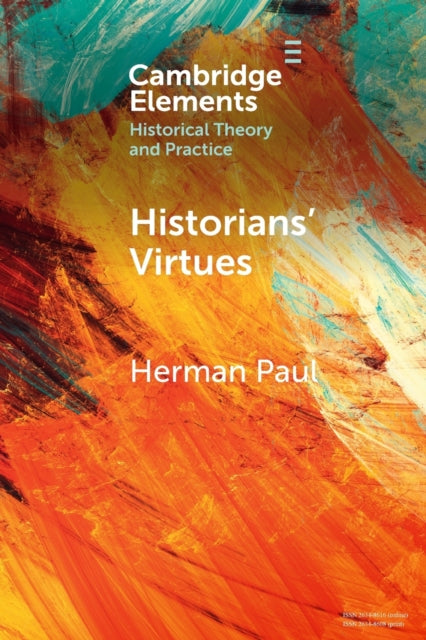
HermanPaul
Historians' Virtues: From Antiquity to the Twenty-First Century
Historians' Virtues: From Antiquity to the Twenty-First Century
💎 Earn 84 Points (£0.84) on this item.
We can order this item for you. Delivery usually takes about 4 to 6 weeks.
This item is not held in our immediate stock. We will order it for you after checkout.
Estimated delivery: About 4 to 6 weeks
YOU SAVE £1.01
- Condition: Brand new
- UK Delivery times: Usually arrives within 2 - 3 working days
- UK Shipping: Fee starts at £2.39. Subject to product weight & dimension
Bulk ordering. Want 15 or more copies? Get a personalised quote and bigger discounts. Learn more about bulk orders.
Couldn't load pickup availability
- More about Historians' Virtues: From Antiquity to the Twenty-First Century
Historians often talk about objectivity, empathy, and fair-mindedness because these qualities are important in historical studies. They help historians to understand the past better, to be more accurate in their interpretations, and to avoid bias. These virtues are not skills or habits, but rather qualities that require training and practice. The book "Virtues" explores these questions in depth and shows how historians have used these virtues in different contexts throughout history.
Format: Paperback / softback
Length: 75 pages
Publication date: 22 September 2022
Publisher: Cambridge University Press
Why do historians so often talk about objectivity, empathy, and fair-mindedness? What roles do such personal qualities play in historical studies? And why does it make sense to call them virtues rather than skills or habits?
Historians frequently emphasize the importance of objectivity, empathy, and fair-mindedness in their work, recognizing these qualities as essential for producing accurate and nuanced interpretations of the past. These personal qualities play a crucial role in historical studies as they enable historians to approach their subject matter with a critical and unbiased mindset, avoiding the biases and prejudices of their own time and culture.
Objectivity is particularly important in historical research as it allows historians to examine historical events and phenomena without being influenced by their personal beliefs, values, or opinions. By striving for objectivity, historians can provide a more accurate and balanced account of the past, avoiding the distortion of historical facts by personal biases.
Empathy is also crucial in historical studies as it enables historians to understand the experiences and perspectives of individuals who lived in different times and cultures. By developing empathy, historians can gain a deeper understanding of the motivations and actions of historical actors, which can help them to interpret events and phenomena more effectively.
Fair-mindedness is another important virtue for historians as it allows them to consider a wide range of evidence and perspectives when constructing their narratives. By being fair-minded, historians can avoid the trap of confirmation bias, where they seek out evidence that supports their pre-existing beliefs and ignore evidence that contradicts them.
In addition to their role in historical research, these personal qualities also play a significant role in the way that historians position themselves in relation to other disciplines and political systems. For example, historians may use their objectivity and empathy to challenge the narratives of political regimes or religious traditions that seek to rewrite the past. By calling attention to the biases and prejudices of these narratives, historians can help to promote a more inclusive and accurate understanding of the past.
Furthermore, the virtues of objectivity, empathy, and fair-mindedness are not just relevant to historical research but also to the broader field of academia. In an increasingly competitive and politicized academic environment, these qualities are essential for promoting academic integrity and ensuring that research is conducted in a rigorous and ethical manner.
In conclusion, historians emphasize the importance of objectivity, empathy, and fair-mindedness in their work because these qualities are essential for producing accurate and nuanced interpretations of the past. By striving for these virtues, historians can provide a more comprehensive and balanced account of the past, challenge the narratives of political regimes and religious traditions, and promote academic integrity in the broader field of academia.
Weight: 116g
ISBN-13: 9781108994972
UK and International shipping information
UK and International shipping information
UK Delivery and returns information:
- Delivery within 2 - 3 days when ordering in the UK.
- Shipping fee for UK customers from £2.39. Fully tracked shipping service available.
- Returns policy: Return within 30 days of receipt for full refund.
International deliveries:
Shulph Ink now ships to Australia, Belgium, Canada, France, Germany, Ireland, Italy, India, Luxembourg Saudi Arabia, Singapore, Spain, Netherlands, New Zealand, United Arab Emirates, United States of America.
- Delivery times: within 5 - 10 days for international orders.
- Shipping fee: charges vary for overseas orders. Only tracked services are available for most international orders. Some countries have untracked shipping options.
- Customs charges: If ordering to addresses outside the United Kingdom, you may or may not incur additional customs and duties fees during local delivery.