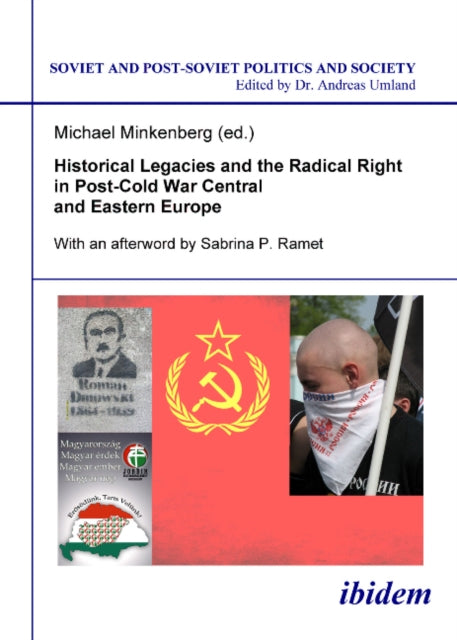
Michael Minkenberg,Sabrina P. Ramet
Historical Legacies and the Radical Right in Post-Cold War Central and Eastern Europe
Historical Legacies and the Radical Right in Post-Cold War Central and Eastern Europe
💎 Earn 123 Points (£1.23) on this item.
We can order this item for you. Delivery usually takes about 4 to 6 weeks.
This item is not held in our immediate stock. We will order it for you after checkout.
Estimated delivery: About 4 to 6 weeks
YOU SAVE £5.20
- Condition: Brand new
- UK Delivery times: Usually arrives within 2 - 3 working days
- UK Shipping: Fee starts at £2.39. Subject to product weight & dimension
Bulk ordering. Want 15 or more copies? Get a personalised quote and bigger discounts. Learn more about bulk orders.
Couldn't load pickup availability
- More about Historical Legacies and the Radical Right in Post-Cold War Central and Eastern Europe
The radical right in Central and Eastern Europe (CEE) after 1989 claims a prominent place in the politics of return, with studies suggesting historical analogies and the role of legacies. There are three lines of thought: the return of history, the return to Europe, and the sui generis phenomenon shaped by state socialism and the transformation process. This book provides insight into the role of historical forces in the shaping and performance of the current radical right in CEE, conceptualising legacies as both contextual and textual factors.
Format: Paperback / softback
Length: 208 pages
Publication date: 07 December 2021
Publisher: ibidem-Verlag, Jessica Haunschild u Christian Schon
The transformation process in Central and Eastern Europe (CEE) after 1989 is often characterized in historical and geographical terms, with interpretations ranging from a "return of history" to a "return to Europe," or even both. Regardless of the specific lens employed, the radical right plays a prominent role in this politics of return. Studies on the radical right echo broader concerns within regional analyses, exploring historical analogies and the role of legacies. Sometimes, parallels are drawn between the post-1989 radical right and inter-war fascism, suggesting a process of "Weimarization" in the transformation countries and a return to pre-socialist, ultranationalist, or even fascist past. Another interpretation argues that as some CEE party systems increasingly resemble their Western European counterparts, so does the radical right, particularly in cases of electoral success. A third line of thought posits that the radical right in CEE is a unique phenomenon shaped by the historical forces of state socialism and the transformation process. In contrast to Western Europe, it is ideologically more extreme and anti-democratic, while organizationally more of a movement than a party-based phenomenon.
This book aims to provide insights into the role of historical forces in shaping and performing the current radical right in CEE. It conceptualizes legacies as both contextual factors, encompassing structural and cultural opportunities for new movements and parties in the region, and as textual factors, representing the ideological baggage of the past that is revived and reinterpreted by the radical right. An introductory essay by Michael Minkenberg sets the topic and the concept of legacies within a broader context.
The radical right in CEE has its roots in the aftermath of World War II, when the region was devastated by conflict and the ideological vacuum left by the collapse of fascism. In the post-war period, the Soviet Union exerted a strong influence over CEE countries, implementing a socialist regime that aimed to eradicate capitalism and promote social equality. However, the Soviet model was characterized by authoritarianism, repression, and economic stagnation, leading to widespread dissatisfaction and opposition among the population.
As the Soviet Union began to collapse in the late 1980s, CEE countries began to experiment with democratic reforms and market-oriented economic policies. This process, known as "transition," opened up opportunities for new political movements and parties to emerge. The radical right capitalized on these opportunities, using nostalgia, anti-immigration rhetoric, and a rejection of liberal democracy to appeal to disillusioned and marginalized segments of the population.
One of the key features of the radical right in CEE is its anti-immigration stance. Many radical right parties argue that immigration threatens the cultural and social identity of the native population and poses a threat to national security. They often promote policies that restrict immigration, including border controls, deportations, and the denial of citizenship rights to immigrants. This stance has been particularly popular in countries that have experienced high levels of immigration in recent years, such as Germany, Hungary, and Poland.
Another hallmark of the radical right in CEE is its anti-liberal democratic ideology. Many radical right parties reject the notion of universal human rights, democracy, and the rule of law. They often advocate for a return to traditional values, authoritarianism, and the suppression of dissent. This ideology has been particularly prevalent in countries that have experienced political instability or social unrest in recent years, such as Ukraine, Romania, and Bulgaria.
The radical right in CEE also has a strong nationalist element. Many radical right parties promote a vision of a unified and ethnically homogenous nation-state, often at the expense of minority groups and other marginalized communities. This nationalism has been particularly evident in countries that have experienced historical conflicts or ethnic tensions, such as Serbia, Croatia, and Bosnia and Herzegovina.
The radical right in CEE has been successful in gaining political power in several countries, particularly in the aftermath of the global financial crisis of 2008. In countries such as Hungary, Poland, and Slovakia, the radical right has won elections, gained control of government institutions, and implemented policies that have been criticized for their authoritarianism, anti-democratic nature, and disregard for human rights.
However, the radical right in CEE also faces significant challenges. One of the biggest challenges is the rise of populism and the decline of traditional political parties. Many voters are increasingly dissatisfied with the established political system and are seeking alternatives that promise to address their concerns directly. This has led to the rise of parties that adopt a more populist approach, which often combines elements of the radical right with a focus on issues such as economic inequality, social welfare, and national identity.
Another challenge for the radical right in CEE is the growing influence of civil society organizations and human rights groups. These organizations have been critical of the radical right's policies and practices, and have mobilized public support against them. This has led to increased scrutiny and pressure on the radical right, and has forced it to adopt more moderate positions on issues such as immigration and human rights.
In conclusion, the transformation process in Central and Eastern Europe after 1989 has been characterized by a complex interplay of historical, geographical, and social factors. The radical right has played a prominent role in this process, using nostalgia, anti-immigration rhetoric, and a rejection of liberal democracy to appeal to disillusioned and marginalized segments of the population. While the radical right has been successful in gaining political power in several countries, it faces significant challenges from the rise of populism, the decline of traditional political parties, and the growing influence of civil society organizations and human rights groups. As the political landscape in CEE continues to evolve, it will be important to monitor the role of the radical right and its impact on the region's social, economic, and political future.
Weight: 272g
Dimension: 146 x 209 x 12 (mm)
ISBN-13: 9783838201245
This item can be found in:
UK and International shipping information
UK and International shipping information
UK Delivery and returns information:
- Delivery within 2 - 3 days when ordering in the UK.
- Shipping fee for UK customers from £2.39. Fully tracked shipping service available.
- Returns policy: Return within 30 days of receipt for full refund.
International deliveries:
Shulph Ink now ships to Australia, Belgium, Canada, France, Germany, Ireland, Italy, India, Luxembourg Saudi Arabia, Singapore, Spain, Netherlands, New Zealand, United Arab Emirates, United States of America.
- Delivery times: within 5 - 10 days for international orders.
- Shipping fee: charges vary for overseas orders. Only tracked services are available for most international orders. Some countries have untracked shipping options.
- Customs charges: If ordering to addresses outside the United Kingdom, you may or may not incur additional customs and duties fees during local delivery.