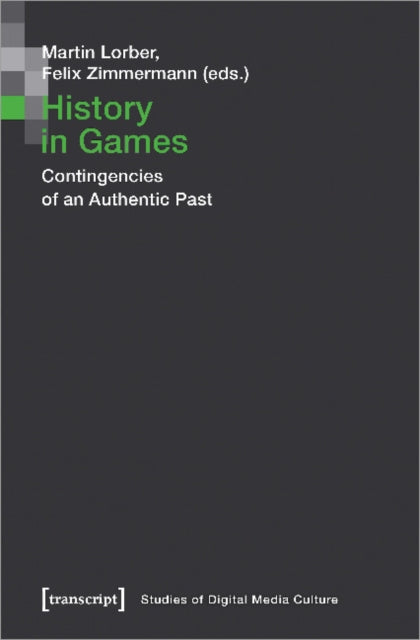
Martin Lorber,Felix Zimmermann
History in Games - Contingencies of an Authentic Past
History in Games - Contingencies of an Authentic Past
💎 Earn 161 Points (£1.61) on this item.
We can order this item for you. Delivery usually takes about 4 to 6 weeks.
This item is not held in our immediate stock. We will order it for you after checkout.
Estimated delivery: About 4 to 6 weeks
YOU SAVE £6.79
- Condition: Brand new
- UK Delivery times: Usually arrives within 2 - 3 working days
- UK Shipping: Fee starts at £2.39. Subject to product weight & dimension
Bulk ordering. Want 15 or more copies? Get a personalised quote and bigger discounts. Learn more about bulk orders.
Couldn't load pickup availability
- More about History in Games - Contingencies of an Authentic Past
The book explores the concept of authenticity in historical games, discussing how it can feel real in the virtual world and the challenges of defining it. It also considers the political implications of authenticity and how it is shaped by historical research.
Format: Paperback / softback
Length: 284 pages
Publication date: 20 December 2021
Publisher: Transcript Verlag
One fundamental principle of historical inquiry is that the past is an elusive realm of time and space that remains beyond human control. Consequently, every account of the past is merely an approximation. However, the experience of walking through ancient Alexandria in a virtual world can be remarkably authentic. Authenticity claims are a central theme in discussions surrounding contemporary digital games. What exactly is historical authenticity, and does it hold any significance? When does the question of authenticity become politically charged? By exploring these questions, the book sheds light on the pervasive concept of authenticity from the perspective of historical game studies.
The concept of authenticity in historical games is a complex and multifaceted issue. On the one hand, authenticity is often seen as a key selling point for these games, as it allows players to immerse themselves in the historical context and experience the events of the past as they occurred. This can be particularly valuable for educational purposes, as it allows students to learn about history in a more engaging and interactive way.
On the other hand, authenticity can also be a source of controversy in historical games. Some critics argue that these games can perpetuate historical myths and stereotypes, or that they can oversimplify complex historical events and narratives. This can lead to a distorted understanding of the past and can undermine the educational value of these games.
Another issue related to authenticity is the question of whether or not it is possible to recreate the historical context of a particular period in a digital game. While technology has made significant advances in recent years, there are still many limitations to the ability to accurately reproduce the visual, auditory, and sensory experiences of the past. This can lead to a sense of disconnection between the player and the historical context, which can undermine the immersive experience of the game.
Despite these challenges, there are many examples of historical games that successfully capture the essence of the historical context and provide players with a meaningful and immersive experience. These games often rely on a combination of historical research, storytelling, and technology to create a sense of authenticity that can engage and educate players.
One example of a successful historical game is "Civilization IV," a strategy game that allows players to build and manage their own civilization from the dawn of human history to the modern era. The game is based on extensive historical research and provides players with a detailed and accurate portrayal of the political, economic, and social developments of different civilizations throughout history.
Another example is "Assassin's Creed," a series of action-adventure games that take place. Players take on the role of historical figures such as Ezio Auditore da Firenze and Altair Ibn-La'Ahad, and explore the historical context of the Renaissance and the Middle Ages. The games use a combination of historical research, storytelling, and technology to create a sense of authenticity that can engage and educate players about the history of these periods.
In conclusion, the concept of authenticity in historical games is a complex and multifaceted issue that requires careful consideration. While authenticity can be a valuable tool for education and engagement, it can also be a source of controversy and distortion. By combining historical research, storytelling, and technology, developers can create historical games that capture the essence of the historical context and provide players with a meaningful and immersive experience.
Weight: 454g
Dimension: 148 x 224 x 26 (mm)
ISBN-13: 9783837654202
UK and International shipping information
UK and International shipping information
UK Delivery and returns information:
- Delivery within 2 - 3 days when ordering in the UK.
- Shipping fee for UK customers from £2.39. Fully tracked shipping service available.
- Returns policy: Return within 30 days of receipt for full refund.
International deliveries:
Shulph Ink now ships to Australia, Belgium, Canada, France, Germany, Ireland, Italy, India, Luxembourg Saudi Arabia, Singapore, Spain, Netherlands, New Zealand, United Arab Emirates, United States of America.
- Delivery times: within 5 - 10 days for international orders.
- Shipping fee: charges vary for overseas orders. Only tracked services are available for most international orders. Some countries have untracked shipping options.
- Customs charges: If ordering to addresses outside the United Kingdom, you may or may not incur additional customs and duties fees during local delivery.