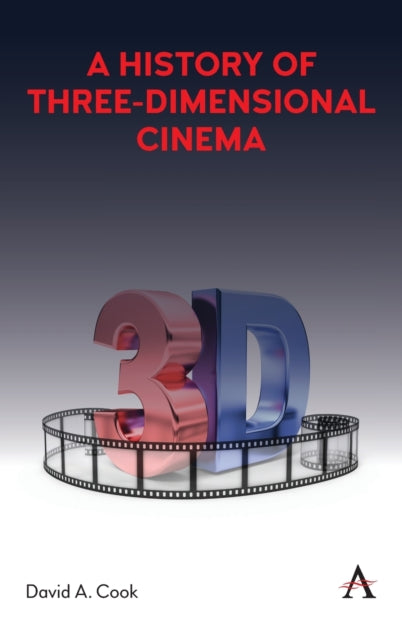
David A. Cook
History of Three-Dimensional Cinema
History of Three-Dimensional Cinema
💎 Earn 448 Points (£4.48) on this item.
We can order this item for you. Delivery usually takes about 4 to 6 weeks.
This item is not held in our immediate stock. We will order it for you after checkout.
Estimated delivery: About 4 to 6 weeks
- Condition: Brand new
- UK Delivery times: Usually arrives within 2 - 3 working days
- UK Shipping: Fee starts at £3.89. Subject to product weight & dimension
Bulk ordering. Want 15 or more copies? Get a personalised quote and bigger discounts. Learn more about bulk orders.
Couldn't load pickup availability
- More about History of Three-Dimensional Cinema
A History of Three-Dimensional Cinema chronicles 3-D cinema as a single, continuous, and coherent medium, from 19th-century experiments to Hollywood booms, revivals, IMAX, and digital 3-D, with Avatar's promise of Virtual Reality.
\n Format: Hardback
\n Length: 208 pages
\n Publication date: 14 September 2021
\n Publisher: Anthem Press
\n
A History of Three-Dimensional Cinema delves into the evolution of 3-D cinema as a unified and continuous medium, spanning from the early 19th-century experiments in stereoscopic photography and lantern projection (1839–1892) to the era of stereoscopic cinemas known as the "long novelty period" (1893–1952). It then explores the initial Hollywood boom in anaglyphic stereo (1953–1955), during which the mainstream industry produced a significant number of 3-D features, primarily focusing on action films that capitalized on the depth illusion. This period also witnessed the emergence of a few high-budget films, such as Kiss Me, Kate (1953) and Dial M for Murder (1954), although audiences eventually grew tired of the novelty. The anaglyphic revival of 1970–1985 marked a resurgence of 3-D as a novelty feature in genres like soft-core pornography and horror. This era was followed by the era of IMAX 3-D (1986–2008), during which the technology reached its peak and became a popular choice for immersive cinematic experiences. The current era of digital 3-D cinema commenced in 2009 with the release of James Cameron's Avatar, which became the highest-grossing feature of all time and sparked a renewed interest in 3-D production among studios. Finally, the text looks forward to the potential of Virtual Reality as the next frontier in cinematic technology.
A History of Three-Dimensional Cinema delves into the evolution of 3-D cinema as a unified and continuous medium, spanning from the early 19th-century experiments in stereoscopic photography and lantern projection (1839–1892) to the era of stereoscopic cinemas known as the "long novelty period" (1893–1952). It then explores the initial Hollywood boom in anaglyphic stereo (1953–1955), during which the mainstream industry produced a significant number of 3-D features, primarily focusing on action films that capitalized on the depth illusion. This period also witnessed the emergence of a few high-budget films, such as Kiss Me, Kate (1953) and Dial M for Murder (1954), although audiences eventually grew tired of the novelty. The anaglyphic revival of 1970–1985 marked a resurgence of 3-D as a novelty feature in genres like soft-core pornography and horror. This era was followed by the era of IMAX 3-D (1986–2008), during which the technology reached its peak and became a popular choice for immersive cinematic experiences. The current era of digital 3-D cinema commenced in 2009 with the release of James Cameron's Avatar, which became the highest-grossing feature of all time and sparked a renewed interest in 3-D production among studios. Finally, the text looks forward to the potential of Virtual Reality as the next frontier in cinematic technology.
\n Weight: 472g\n
Dimension: 158 x 237 x 19 (mm)\n
ISBN-13: 9781839980121\n \n
UK and International shipping information
UK and International shipping information
We deliver throughout the United Kingdom and to 128 countries and territories worldwide, including the United States, Australia, Canada, Germany, Spain and France.