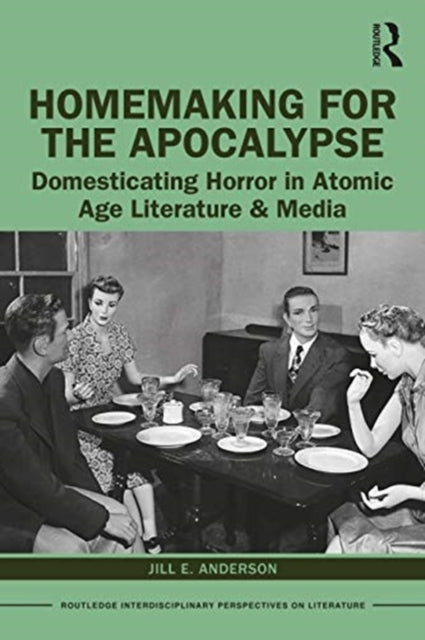
Jill E. Anderson
Homemaking for the Apocalypse: Domesticating Horror in Atomic Age Literature & Media
Homemaking for the Apocalypse: Domesticating Horror in Atomic Age Literature & Media
💎 Earn 245 Points (£2.45) on this item.
We can order this item for you. Delivery usually takes about 4 to 6 weeks.
This item is not held in our immediate stock. We will order it for you after checkout.
Estimated delivery: About 4 to 6 weeks
YOU SAVE £2.91
- Condition: Brand new
- UK Delivery times: Usually arrives within 2 - 3 working days
- UK Shipping: Fee starts at £2.39. Subject to product weight & dimension
Bulk ordering. Want 15 or more copies? Get a personalised quote and bigger discounts. Learn more about bulk orders.
Couldn't load pickup availability
- More about Homemaking for the Apocalypse: Domesticating Horror in Atomic Age Literature & Media
In Homemaking for the Apocalypse, Jill E. Anderson examines Atomic Age conformity and its impact on domestic practices and private activities in America. She explores how these narratives of domesticity were governed by compulsory normativity and upheld the idealization of homemaking within a white, middle-class nuclear family. By engaging with elements of horror, the book exposes the close connection between domestic practices and dread and anxiety. It challenges the acceptance of the conformity thesis and proposes new ways to critique the domestic imperative of the period.
\n Format: Paperback / softback
\n Length: 208 pages
\n Publication date: 21 April 2021
\n Publisher: Taylor & Francis Ltd
\n
In her book Homemaking for the Apocalypse, Jill E. Anderson delves into the pervasive patterns of conformity that shaped the domestic practices and private lives of Americans during the Atomic Age. These narratives, employed as a means to promote security amidst the anxieties surrounding nuclear annihilation and The Bomb, were governed by the ideals of compulsory normativity. Their widespread circulation perpetuated the idealization of homemaking within a white, middle-class nuclear family, encompassing unchecked reproduction, relentless consumerism, and a pervasive policing of practices deemed contrary to normative American life. Homemaking for the Apocalypse seeks to uncover the disruptions to these domestic ideals found in memoirs, Civil Defense literature, the fallout shelter debate, horror films, comics, and science fiction. By incorporating elements of horror, the book aims to expose the intimate connection between domestic practices and the dread and anxiety that permeated the era.
Anderson's exploration of the conformity thesis challenges the prevailing notion that the Atomic Age was characterized by a widespread embrace of uniformity and stability. She argues that rather than a homogenous society, the era was marked by a complex interplay of conflicting values and desires. Homemaking for the Apocalypse highlights the ways in which these conflicting ideals were expressed and reproduced within the domestic sphere. Through a close analysis of memoirs, Civil Defense literature, the fallout shelter debate, horror films, comics, and science fiction, Anderson uncovers the ways in which fear and anxiety were intertwined with the domestic realm. She demonstrates how the nuclear threat created a sense of urgency and vulnerability that shaped the everyday lives of individuals and families.
One of the key themes of Homemaking for the Apocalypse is the notion of compulsory normativity. Anderson argues that the domestic ideals of the Atomic Age were enforced through a series of social and cultural mechanisms, including government policies, media representations, and popular culture. The idealization of homemaking within a white, middle-class nuclear family was a central aspect of this normative framework, as it was seen as a means of maintaining social order and stability. However, Anderson also points out the ways in which these ideals were often contradictory and oppressive, particularly for women and marginalized communities. For example, the pressure to conform to gender roles and stereotypes limited women's opportunities and perpetuated gender inequality. Similarly, the emphasis on consumerism and materialism led to a wasteful and unsustainable economy, which negatively impacted the environment and marginalized communities.
In addition to exposing the disruptions to domestic ideals, Homemaking for the Apocalypse offers new methods for critiquing the domestic imperative of the Atomic Age. Anderson draws on the horror genre to explore the ways in which domestic practices are tied to dread and anxiety. By employing elements of horror, the book creates a sense of discomfort and unease that challenges the reader to think critically about the domestic sphere. For example, Anderson examines the fallout shelter debate, which was a prominent feature of Civil Defense literature and popular culture during the Atomic Age. She explores the ways in which the shelter was marketed as a means of protection and security, but also as a site of fear and anxiety. The shelter was seen as a place where individuals and families could retreat in the event of a nuclear attack, but it also represented a potential source of isolation and confinement.
Another important aspect of Homemaking for the Apocalypse is its engagement with popular memory. Anderson argues that the popular memory of the Atomic Age has often been shaped by a desire to sanitize and forget the darker aspects of the period. By acknowledging the connection between domestic practices and horror, the book challenges the sanitization of history and encourages a more nuanced and complex understanding of the past. Anderson also points out the ways in which the domestic sphere has been overlooked in historical narratives, particularly in the context of gender and race. She argues that the domestic realm was a site of intense struggle and resistance, particularly for women and marginalized communities, who were often forced to navigate contradictory ideals and oppressive practices.
In conclusion, Homemaking for the Apocalypse is a thought-provoking and innovative book that offers a fresh perspective on the domestic ideals of the Atomic Age. By delving into the disruptions to these ideals and the connections between domestic practices and horror, Anderson challenges the prevailing notion of conformity and proposes new methods for critiquing the domestic imperative of the period. The book's engagement with popular memory and its recognition of the domestic sphere as a site of intense struggle and resistance contribute to a more comprehensive understanding of the past and its impact on contemporary society.
\n Weight: 322g\n
Dimension: 151 x 227 x 17 (mm)\n
ISBN-13: 9781138304635\n \n
UK and International shipping information
UK and International shipping information
UK Delivery and returns information:
- Delivery within 2 - 3 days when ordering in the UK.
- Shipping fee for UK customers from £2.39. Fully tracked shipping service available.
- Returns policy: Return within 30 days of receipt for full refund.
International deliveries:
Shulph Ink now ships to Australia, Belgium, Canada, France, Germany, Ireland, Italy, India, Luxembourg Saudi Arabia, Singapore, Spain, Netherlands, New Zealand, United Arab Emirates, United States of America.
- Delivery times: within 5 - 10 days for international orders.
- Shipping fee: charges vary for overseas orders. Only tracked services are available for most international orders. Some countries have untracked shipping options.
- Customs charges: If ordering to addresses outside the United Kingdom, you may or may not incur additional customs and duties fees during local delivery.