
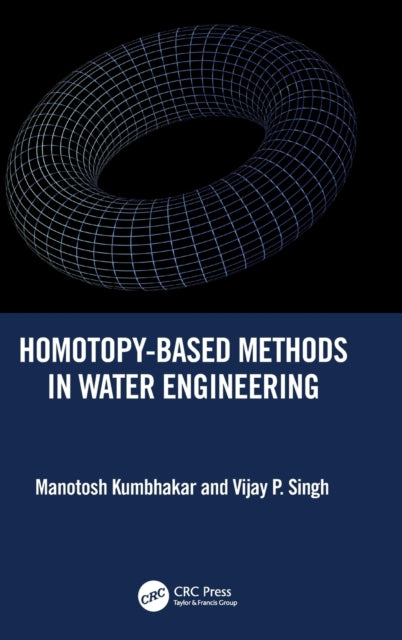
ManotoshKumbhakar,Vijay P.Singh
Homotopy-Based Methods in Water Engineering
Homotopy-Based Methods in Water Engineering
💎 Earn 589 Points (£5.89) on this item.
We can order this item for you. Delivery usually takes about 4 to 6 weeks.
This item is not held in our immediate stock. We will order it for you after checkout.
Estimated delivery: About 4 to 6 weeks
YOU SAVE £7.00
- Condition: Brand new
- UK Delivery times: Usually arrives within 2 - 3 working days
- UK Shipping: Fee starts at £3.89. Subject to product weight & dimension
Bulk ordering. Want 15 or more copies? Get a personalised quote and bigger discounts. Learn more about bulk orders.
Couldn't load pickup availability
- More about Homotopy-Based Methods in Water Engineering
Nonlinear differential equations are used to model physical processes in water engineering, and homotopy-based methods have been proposed to analytically solve these equations. This book discusses the wide applicability of these methods to water engineering problems, including hydraulics, groundwater hydrology, surface-water hydrology, the general Burgers equation, and water quality. It provides analytical treatments to some key problems and compares different approaches to dealing with nonlinearity.
Format: Hardback
Length: 450 pages
Publication date: 05 July 2023
Publisher: Taylor & Francis Ltd
Nonlinear equations, particularly differential equations, hold immense significance in describing the most intricate physical phenomena. In the realm of water engineering, nonlinear differential equations assume a pivotal role in modeling various physical processes. While analytical solutions to strong nonlinear problems can be challenging to obtain, existing techniques are often tailored to specific types of equations. However, there has been a growing interest in exploring alternative approaches, particularly those rooted in homotopy theory from topology. Homotopy-Based Methods in Water Engineering aims to showcase the broad applicability of these methods to water engineering problems. By employing homotopy-based techniques, the book tackles a wide range of nonlinear equations, including algebraic/transcendental equations, ordinary differential equations (ODEs), systems of ODEs, partial differential equations (PDEs), systems of PDEs, and integro-differential equations. The content of the book delves into selected problems in hydraulics of open-channel flow, groundwater hydrology, surface-water hydrology, the general Burgers equation, and water quality.
One of the key features of Homotopy-Based Methods in Water Engineering is its provision of analytical treatments for several critical problems in water engineering. These problems encompass various aspects of fluid dynamics, including the simulation of open-channel flow with or without sediment transport, groundwater hydrology, surface-water hydrology, and the solution of the general Burgers equation. By employing homotopy-based methods, the book offers a comprehensive framework for addressing these complex issues, providing researchers and practitioners with valuable tools for solving nonlinear differential equations.
Another notable aspect of Homotopy-Based Methods in Water Engineering is its discussion of the applicability of homotopy-based methods for solving nonlinear equations, particularly differential equations. The book highlights the advantages of these methods over traditional approaches, such as finite difference and finite element methods, in terms of their efficiency, accuracy, and versatility. Homotopy-based methods have shown promising results in solving a wide range of differential equations, including those arising in physics, chemistry, biology, and engineering.
In addition to its theoretical discussions, Homotopy-Based Methods in Water Engineering provides practical insights into the implementation of homotopy-based methods in water engineering problems. The book includes detailed examples and code snippets that demonstrate the step-by-step process of applying these methods to real-world scenarios. This hands-on approach allows readers to gain a deeper understanding of the theoretical concepts and apply them effectively in their research and engineering endeavors.
Overall, Homotopy-Based Methods in Water Engineering is a valuable resource for researchers, practitioners, and students interested in advancing their knowledge in the field of water engineering. The book offers a comprehensive and up-to-date treatment of homotopy-based methods, providing a solid foundation for understanding and solving complex nonlinear differential equations in water engineering applications.
Weight: 1030g
Dimension: 234 x 156 (mm)
ISBN-13: 9781032438214
UK and International shipping information
UK and International shipping information
We deliver throughout the United Kingdom and to 128 countries and territories worldwide, including the United States, Australia, Canada, Germany, Spain and France.
