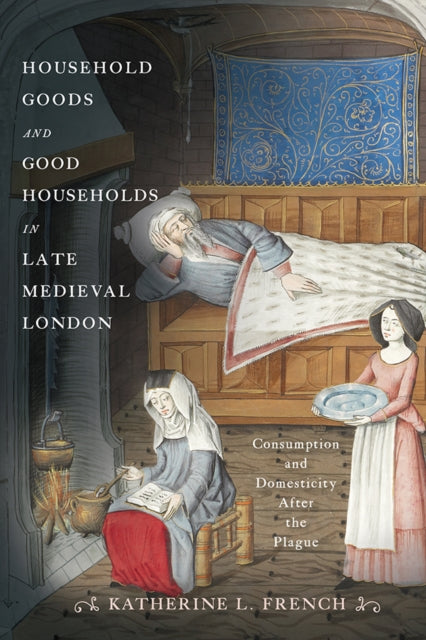
Katherine L. French
Household Goods and Good Households in Late Medieval London: Consumption and Domesticity After the Plague
Household Goods and Good Households in Late Medieval London: Consumption and Domesticity After the Plague
💎 Earn 283 Points (£2.83) on this item.
YOU SAVE £7.36
- Condition: Brand new
- UK Delivery times: Usually arrives within 2 - 3 working days
- UK Shipping: Fee starts at £2.39. Subject to product weight & dimension
Bulk ordering. Want 15 or more copies? Get a personalised quote and bigger discounts. Learn more about bulk orders.
Couldn't load pickup availability
- More about Household Goods and Good Households in Late Medieval London: Consumption and Domesticity After the Plague
The Black Death in 1348 caused labor shortages, leading to higher wages, survivors moving into larger quarters, and increased spending on food, clothing, and household furnishings. Household Goods and Good Households in Late Medieval London explores how this increased consumption reconfigured gender roles and changed the domestic lives of London's merchants and artisans. Katherine L. French examines the accommodations made to larger houses and the increasing number of possessions, highlighting a shift in women's household responsibilities to the arrival and gendering of new possessions and the creation of new household spaces.
Format: Hardback
Length: 416 pages
Publication date: 20 August 2021
Publisher: University of Pennsylvania Press
The Black Death, which struck in the spring of 1348, caused a devastating impact on England's population, resulting in the loss of nearly half of its inhabitants. The long-lasting consequences of this pandemic included a significant rise in wages in London due to labor shortages, as many survivors sought larger accommodations in the depopulated city. Additionally, people's spending on food, clothing, and household furnishings increased, surpassing their previous levels.
In her book, Household Goods and Good Households in Late Medieval London, Katherine L. French delves into the profound ways in which this increased consumption reconfigured long-held gender roles and transformed the domestic lives of London's merchants and artisans. Through a comprehensive analysis of surviving household artifacts and extensive archival research, French examines the accommodations made by Londoners to their larger houses, as well as the growing number of possessions these spaces contained. The changes in material circumstance not only reshaped domestic hierarchies but also introduced new routines and expectations within households.
Recognizing the challenges posed by the increased number of possessions, French centers her study on housework and gender, highlighting the historical shifts in women's household responsibilities. Traditionally, managing bodies and things, as well as the associated dirt and chaos, has been considered a domain of women's work. However, French demonstrates that housework is neither timeless nor ahistorical, and she traces a significant shift in women's household responsibilities to the arrival and gendering of new possessions and the creation of new household spaces in the decades following the plague.
This shift in responsibilities was facilitated by various factors, including the increasing availability of luxury goods, the expansion of trade networks, and the development of urban infrastructure. As households acquired more possessions, they required a different approach to management and care, leading to the emergence of new roles and responsibilities for women within the household. Women became responsible for organizing and maintaining these possessions, ensuring their cleanliness, and managing the daily routines that surrounded them.
Furthermore, the increased number of possessions and the creation of new household spaces led to the development of distinct gender roles within the home. Men took on the role of providers and protectors, while women became responsible for managing the household and caring for the family. This shift in gender roles not only impacted the daily lives of individuals but also had broader societal implications, as it reinforced the notion of women's inferiority and subordination within the household.
Despite these changes, French argues that the impact of the Black Death on household goods and gender was not entirely negative. It led to the emergence of new markets and industries, as people sought to acquire and display luxury goods. It also spurred innovation and creativity in the field of household goods, as artisans and merchants sought to meet the growing demand for new and unique products.
In conclusion, Household Goods and Good Households in Late Medieval London provides a valuable insight into the ways in which the Black Death reshaped the domestic lives of London's merchants and artisans. Through a comprehensive analysis of surviving household artifacts and archival research, French demonstrates how increased consumption reconfigured gender roles and introduced new routines and expectations within households. She highlights the historical shifts in women's household responsibilities and the challenges posed by the increased number of possessions. While the impact of the Black Death was not entirely positive, it did lead to the emergence of new markets and industries, as well as innovation and creativity in the field of household goods.
Weight: 704g
Dimension: 166 x 242 x 31 (mm)
ISBN-13: 9780812253054
This item can be found in:
UK and International shipping information
UK and International shipping information
UK Delivery and returns information:
- Delivery within 2 - 3 days when ordering in the UK.
- Shipping fee for UK customers from £2.39. Fully tracked shipping service available.
- Returns policy: Return within 30 days of receipt for full refund.
International deliveries:
Shulph Ink now ships to Australia, Belgium, Canada, France, Germany, Ireland, Italy, India, Luxembourg Saudi Arabia, Singapore, Spain, Netherlands, New Zealand, United Arab Emirates, United States of America.
- Delivery times: within 5 - 10 days for international orders.
- Shipping fee: charges vary for overseas orders. Only tracked services are available for most international orders. Some countries have untracked shipping options.
- Customs charges: If ordering to addresses outside the United Kingdom, you may or may not incur additional customs and duties fees during local delivery.