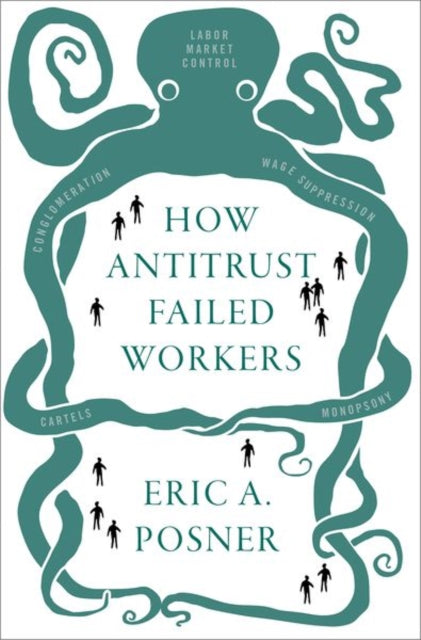
Eric A.Posner
How Antitrust Failed Workers
How Antitrust Failed Workers
We can order this item for you. Delivery usually takes about 4 to 6 weeks.
This item is not held in our immediate stock. We will order it for you after checkout.
Estimated delivery: About 4 to 6 weeks
YOU SAVE £2.37
- Condition: Brand new
- UK Delivery times: Usually arrives within 2 - 3 working days
- UK Shipping: Fee starts at £3.89. Subject to product weight & dimension
Bulk ordering. Want 15 or more copies? Get a personalised quote and bigger discounts. Learn more about bulk orders.
Couldn't load pickup availability
- More about How Antitrust Failed Workers
The decline of antitrust law has allowed corporations to combine into a smaller number of massive conglomerates, resulting in income and wealth inequality and job opportunities stagnation. Eric Posner's book "How Antitrust Law Failed Workers" documents the role of antitrust in our economy and why it failed, and suggests that reforming antitrust law is the only way to shield workers from employers' overwhelming market power.
Format: Hardback
Length: 256 pages
Publication date: 18 November 2021
Publisher: Oxford University Press Inc
The erosion of antitrust law in America has had a profound impact on inequality and wage stagnation, resulting in a dominant market structure that undermines workers' bargaining power. Since the 1970s, income and wealth inequality have skyrocketed, while job opportunities have stagnated, leading to a labor market that is no longer competitive. While various theories explain this phenomenon, such as the decline of organized labor and tax policies favoring the rich, the precipitous decline in antitrust enforcement during the Reagan administration is a crucial factor.
Antitrust law was established to protect the labor market by attacking monopolies and business cartels that could fix prices and suppress wages and output. However, with the increasing combination and consolidation of corporations, workers have fewer options to turn to. In his book "How Antitrust Law Failed Workers," Eric Posner documents the role of antitrust in our economy and why it has failed to protect workers.
Posner argues that antitrust laws were created to protect consumers from high prices and poor-quality services, but they have also been used to attack firms with market power that charge higher prices and suppress wages and output. Employers use anticompetitive devices such as covenants not to compete for workers and no-poaching agreements to advance their market power at the expense of workers.
Reforming antitrust law is essential to address these issues. Posner suggests that the law should be updated to focus on firms with market power, rather than just large corporations. He also proposes measures to strengthen the enforcement of antitrust laws, such as increasing the resources of the Federal Trade Commission and providing more incentives for private enforcement.
In conclusion, the erosion of antitrust law in America has had a devastating impact on inequality and wage stagnation. Only through reforming antitrust law can we protect workers from employers' overwhelming market power and ensure that the labor market is competitive and fair.
Weight: 480g
Dimension: 164 x 245 x 25 (mm)
ISBN-13: 9780197507629
UK and International shipping information
UK and International shipping information
We deliver throughout the United Kingdom and to 128 countries and territories worldwide, including the United States, Australia, Canada, Germany, Spain and France.