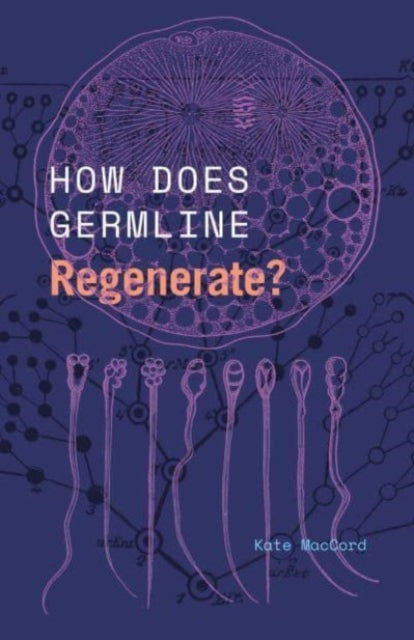
Kate MacCord
How Does Germline Regenerate?
How Does Germline Regenerate?
💎 Earn 99 Points (£0.99) on this item.
YOU SAVE £1.18
- Condition: Brand new
- UK Delivery times: Usually arrives within 2 - 3 working days
- UK Shipping: Fee starts at £2.39. Subject to product weight & dimension
Bulk ordering. Want 15 or more copies? Get a personalised quote and bigger discounts. Learn more about bulk orders.
Couldn't load pickup availability
- More about How Does Germline Regenerate?
The distinction between germ and somatic cells is a fundamental concept in biology with ethical and public policy ramifications. Scientists have long believed that changes made to germ cells will affect future generations, while changes to somatic cells will not. Kate MacCord's book explores how this concept was discovered and challenges the assumption that germ cells cannot regenerate from somatic cells, raising important questions about genome editing, stem cell research, and more.
Format: Paperback / softback
Length: 176 pages
Publication date: 09 January 2024
Publisher: The University of Chicago Press
Scientists have long believed that there are two types of cells in biology: germ and soma. However, a concise primer complicates this convenient truth with far-reaching ethical and public policy ramifications. The distinction between germ and somatic cells is based on the fact that changes made to germ cells can be passed down to future generations, while changes made to somatic cells do not affect the cells of future generations.
Scientists discovered the relationship between somatic and germ cells, known as the Weismann Barrier, in the late 19th century. The Weismann Barrier is a physical barrier that separates the germline from the soma, preventing germ cells from entering the somatic cell lineage.
While the Weismann Barrier is widely accepted as a scientific fact, some researchers have questioned its existence. Some argue that the barrier may not be as strict as previously thought, and that somatic cells may be able to transform into germ cells under certain conditions.
Historian and philosopher of science Kate MacCord explores the history of the Weismann Barrier and its implications for research and policy in her book "The Weismann Barrier: A Century of Science and the Myth of Immortal Life." MacCord argues that the concept of the Weismann Barrier has been used to justify a range of practices, including genome editing and stem cell research, that raise ethical and social concerns.
One of the key implications of the Weismann Barrier is that it allows for the potential for genetic engineering and immortality. By modifying germ cells, scientists could create genetically engineered individuals with desired traits or prevent genetic diseases from passing down to future generations. However, there are also ethical concerns about the potential for creating "designer babies" or for using genetic engineering to enhance human abilities beyond what is natural.
Another implication of the Weismann Barrier is that it limits the potential for stem cell research. Stem cells are undifferentiated cells that can be grown into any type of cell in the body. By definition, stem cells are not germ cells, and therefore, they cannot be used to create new generations of humans. However, some researchers argue that stem cells can be used to develop treatments for diseases and that the Weismann Barrier should not be a barrier to their research.
In conclusion, the distinction between germ and somatic cells has profound ethical and public policy ramifications. The Weismann Barrier, which separates the germline from the soma, has been widely accepted as a scientific fact for over a century. However, some researchers have questioned its existence and have argued that somatic cells may be able to transform into germ cells under certain conditions. The concept of the Weismann Barrier has been used to justify a range of practices, including genome editing and stem cell research, that raise ethical and social concerns. As science continues to advance, it will be important to carefully consider the implications of these practices and to ensure that they are conducted in a responsible and ethical manner.
Weight: 200g
Dimension: 216 x 140 x 13 (mm)
ISBN-13: 9780226830513
This item can be found in:
UK and International shipping information
UK and International shipping information
UK Delivery and returns information:
- Delivery within 2 - 3 days when ordering in the UK.
- Shipping fee for UK customers from £2.39. Fully tracked shipping service available.
- Returns policy: Return within 30 days of receipt for full refund.
International deliveries:
Shulph Ink now ships to Australia, Belgium, Canada, France, Germany, Ireland, Italy, India, Luxembourg Saudi Arabia, Singapore, Spain, Netherlands, New Zealand, United Arab Emirates, United States of America.
- Delivery times: within 5 - 10 days for international orders.
- Shipping fee: charges vary for overseas orders. Only tracked services are available for most international orders. Some countries have untracked shipping options.
- Customs charges: If ordering to addresses outside the United Kingdom, you may or may not incur additional customs and duties fees during local delivery.