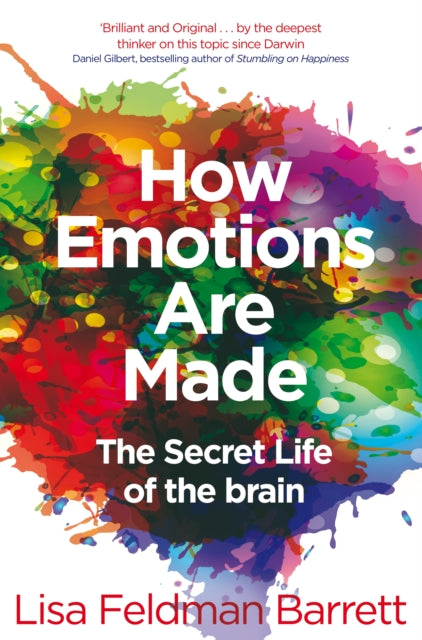
Lisa Feldman Barrett
How Emotions Are Made: The Secret Life of the Brain
How Emotions Are Made: The Secret Life of the Brain
💎 Earn 45 Points (£0.45) on this item.
YOU SAVE £3.80
- Condition: Brand new
- UK Delivery times: Usually arrives within 2 - 3 working days
- UK Shipping: Fee starts at £2.39. Subject to product weight & dimension
Bulk ordering. Want 15 or more copies? Get a personalised quote and bigger discounts. Learn more about bulk orders.
Couldn't load pickup availability
- More about How Emotions Are Made: The Secret Life of the Brain
The author of "The Tipping Point" Malcolm Gladwell said that "How Emotions Are Made" did what all great books do by taking a subject he thought he understood and turning it upside down. Lisa Feldman Barrett, a pioneering psychologist and neuroscientist, challenges the conventional view of emotions as universally pre-programmed in our brains and bodies and presents a new view that emotions are psychological experiences that each of us constructs based on our unique personal history, physiology, and environment. This has serious implications for how we understand and respond to emotions in various aspects of life, such as criminal justice, law enforcement, and healthcare.
\n Format: Paperback / softback
\n Length: 448 pages
\n Publication date: 08 February 2018
\n Publisher: Pan Macmillan
\n
Emotions are complex and multifaceted phenomena that have captivated the minds of scientists, philosophers, and psychologists for centuries. While the traditional view holds that emotions are pre-programmed in our brains and bodies, a growing body of evidence suggests that emotions are more nuanced and constructed than previously thought. In her groundbreaking book, "How Emotions Are Made," pioneering psychologist and neuroscientist Lisa Feldman Barrett challenges the conventional understanding of emotions and offers a new perspective that has the potential to transform our understanding of human nature.
The traditional view of emotions suggests that they are universal and pre-determined by our genetic makeup and physiological processes. According to this perspective, emotions are hardwired into our brains and bodies, and they arise automatically and uncontrollably in response to external stimuli. For example, when we see a loved one, we feel happy because our brains are programmed to release chemicals such as dopamine, which creates a positive emotional state. Similarly, when we fear danger, our brains activate the fight-or-flight response, which prepares us to respond to threats by increasing our heart rate and blood pressure.
However, Barrett argues that this view of emotions is outdated and dangerous. She draws on the latest scientific evidence to show that emotions are not universally pre-programmed in our brains and bodies. Instead, emotions are psychological experiences that each of us constructs based on our unique personal history, physiology, and environment.
One of the key insights of Barrett's book is that emotions are not fixed or universal but are shaped by our experiences and interactions with the world around us. Our emotions are influenced by a wide range of factors, including our upbringing, social interactions, and cultural norms. For example, a child who grows up in a supportive and loving family may develop a sense of security and trust, which can lead to feelings of happiness and contentment. On the other hand, a child who grows up in a violent or abusive household may develop a sense of fear and insecurity, which can lead to feelings of anxiety and depression.
Another important aspect of Barrett's book is that emotions are not solely the result of our brains and bodies but are also shaped by our cognitive processes. Our thoughts, beliefs, and expectations can influence how we interpret and respond to external stimuli, which can in turn shape our emotions. For example, if we believe that we are not good enough or worthy of love, we may develop feelings of insecurity and self-doubt, which can lead to feelings of anxiety and depression.
Barrett's new view of emotions has significant implications for a range of fields, including law, psychology, and medicine. In the legal system, for example, judges often rely on the assumption that emotions are hardwired into our brains and bodies when issuing sentences for crimes of passion. Barrett argues that this assumption is flawed and that emotions are not universal or pre-determined but are shaped by our experiences and interactions with the world around us. By recognizing the role of cognitive processes in shaping emotions, judges can be more nuanced and empathetic in their sentencing decisions, which can lead to more just and equitable outcomes.
In psychology, Barrett's new view of emotions has the potential to transform the way we approach therapy and mental health. Traditional psychological approaches often focus on reducing symptoms and managing emotions through medication or therapy. However, Barrett argues that by understanding the role of cognitive processes in shaping emotions, psychologists can help individuals develop more effective coping strategies and build resilience to stress and trauma.
In medicine, Barrett's new view of emotions has implications for diagnosing and treating mental health disorders. Traditional diagnostic criteria often rely on the presence of specific symptoms or behaviors, such as depression or anxiety. However, Barrett argues that by recognizing the role of cognitive processes in shaping emotions, doctors can develop more accurate diagnoses and develop more effective treatments for mental health disorders.
In conclusion, "How Emotions Are Made" by Lisa Feldman Barrett is a groundbreaking book that challenges the conventional understanding of emotions and offers a new perspective that has the potential to transform our understanding of human nature. By drawing on the latest scientific evidence, Barrett shows that emotions are not universal or pre-programmed but are psychological experiences that are shaped by our unique personal history, physiology, and environment. This new view of emotions has significant implications for a range of fields, including law, psychology, and medicine, and has the potential to lead to more just and equitable outcomes. As we continue to explore the complexities of emotions, it is clear that there is still much to be learned and discovered about this fascinating and complex phenomenon.
\n Weight: 316g\n
Dimension: 132 x 197 x 28 (mm)\n
ISBN-13: 9781509837526\n \n
UK and International shipping information
UK and International shipping information
UK Delivery and returns information:
- Delivery within 2 - 3 days when ordering in the UK.
- Shipping fee for UK customers from £2.39. Fully tracked shipping service available.
- Returns policy: Return within 30 days of receipt for full refund.
International deliveries:
Shulph Ink now ships to Australia, Belgium, Canada, France, Germany, Ireland, Italy, India, Luxembourg Saudi Arabia, Singapore, Spain, Netherlands, New Zealand, United Arab Emirates, United States of America.
- Delivery times: within 5 - 10 days for international orders.
- Shipping fee: charges vary for overseas orders. Only tracked services are available for most international orders. Some countries have untracked shipping options.
- Customs charges: If ordering to addresses outside the United Kingdom, you may or may not incur additional customs and duties fees during local delivery.