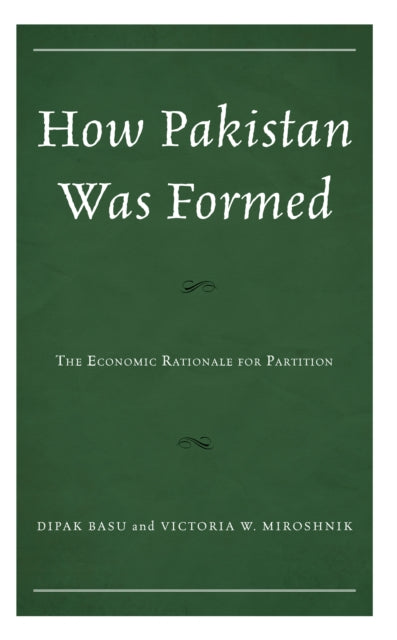
Dipak Basu,Victoria W. Miroshnik
How Pakistan Was Formed: The Economic Rationale for Partition
How Pakistan Was Formed: The Economic Rationale for Partition
💎 Earn 451 Points (£4.51) on this item.
We can order this item for you. Delivery usually takes about 4 to 6 weeks.
This item is not held in our immediate stock. We will order it for you after checkout.
Estimated delivery: About 4 to 6 weeks
- Condition: Brand new
- UK Delivery times: Usually arrives within 2 - 3 working days
- UK Shipping: Fee starts at £2.39. Subject to product weight & dimension
Bulk ordering. Want 15 or more copies? Get a personalised quote and bigger discounts. Learn more about bulk orders.
Couldn't load pickup availability
- More about How Pakistan Was Formed: The Economic Rationale for Partition
This book explores the creation of Pakistan, the economic rationale for partition, and the politics and influence of Muhammad Ali Jinnah, Mahatma Gandhi, and Jawaharlal Nehru.
Format: Hardback
Length: 256 pages
Publication date: 15 January 2023
Publisher: Lexington Books
This book delves into the intricate details of Pakistan's creation and the economic motivations behind its partition. The authors explore a wide range of factors, examining the political dynamics and influence of prominent figures such as Muhammad Ali Jinnah, Mahatma Gandhi, and Jawaharlal Nehru. They analyze these individuals' roles and strategies in shaping the nation's history and trajectory.
The authors begin by tracing the historical background leading up to the partition of India in 1947. They discuss the political tensions and conflicts between the Hindu and Muslim communities, as well as the British colonial policies that exacerbated these divisions. The book then delves into the economic considerations that drove the partition. The authors argue that the partition was necessary to address the economic disparities between the two regions and to promote economic growth and development.
They examine the economic policies implemented in both Pakistan and India after the partition and analyze their impact on the respective economies. The authors highlight the challenges faced by Pakistan in its early years, including poverty, infrastructure development, and political instability. However, they also note the country's resilience and progress in overcoming these obstacles, thanks to the leadership of individuals such as Jinnah and Nehru.
In addition to examining the economic rationale for partition, the book also explores the political and social implications of the partition. The authors discuss the impact of the partition on the lives of the millions of people who were displaced and the challenges they faced in adjusting to their new lives. They also examine the role of religion in shaping the identity of Pakistan and the conflicts that have arisen between different religious groups within the country.
The book also sheds light on the legacy of partition and its impact on the region's political and social landscape. The authors argue that the partition has created a complex web of relationships and tensions that continue to shape the region's politics and society today. They suggest that the lessons learned from the partition can be used to promote peace and stability in the region and to address the underlying social and economic issues that contribute to conflict.
Overall, this book provides a comprehensive and insightful analysis of Pakistan's creation and the economic rationale for partition. The authors' detailed research and analysis offer valuable insights into the complex political and social dynamics that shaped the nation's history. This book is a must-read for anyone interested in understanding the history and complexities of South Asia.
This book delves into the intricate details of Pakistan's creation and the economic motivations behind its partition. The authors explore a wide range of factors, examining the political dynamics and influence of prominent figures such as Muhammad Ali Jinnah, Mahatma Gandhi, and Jawaharlal Nehru. They analyze these individuals' roles and strategies in shaping the nation's history and trajectory.
The authors begin by tracing the historical background leading up to the partition of India in 1947. They discuss the political tensions and conflicts between the Hindu and Muslim communities, as well as the British colonial policies that exacerbated these divisions. The book then delves into the economic considerations that drove the partition. The authors argue that the partition was necessary to address the economic disparities between the two regions and to promote economic growth and development.
They examine the economic policies implemented in both Pakistan and India after the partition and analyze their impact on the respective economies. The authors highlight the challenges faced by Pakistan in its early years, including poverty, infrastructure development, and political instability. However, they also note the country's resilience and progress in overcoming these obstacles, thanks to the leadership of individuals such as Jinnah and Nehru.
In addition to examining the economic rationale. The book also explores the political and social implications of the partition. The authors discuss the impact of the partition on the lives of the millions of people who were displaced and the challenges they faced in adjusting to their new lives. They also examine the role of religion in shaping the identity of Pakistan and the conflicts that have arisen.
The book also sheds light on the legacy of partition and its impact on the region's political and social landscape. The authors argue that the partition has created a complex web of relationships and tensions that continue to shape the region's politics and society today. They suggest that the lessons learned from the partition can be used to promote peace and stability in the region and to address the underlying social and economic issues that contribute to conflict.
Overall, this book provides a comprehensive and insightful analysis of Pakistan's creation and the economic rationale. The authors' detailed research and analysis offer valuable insights into the complex political and social dynamics that shaped the nation's history. This book is a must-read for anyone interested in understanding the history and complexities of South Asia.
Dimension: 229 x 152 (mm)
ISBN-13: 9781666917444
UK and International shipping information
UK and International shipping information
UK Delivery and returns information:
- Delivery within 2 - 3 days when ordering in the UK.
- Shipping fee for UK customers from £2.39. Fully tracked shipping service available.
- Returns policy: Return within 30 days of receipt for full refund.
International deliveries:
Shulph Ink now ships to Australia, Belgium, Canada, France, Germany, Ireland, Italy, India, Luxembourg Saudi Arabia, Singapore, Spain, Netherlands, New Zealand, United Arab Emirates, United States of America.
- Delivery times: within 5 - 10 days for international orders.
- Shipping fee: charges vary for overseas orders. Only tracked services are available for most international orders. Some countries have untracked shipping options.
- Customs charges: If ordering to addresses outside the United Kingdom, you may or may not incur additional customs and duties fees during local delivery.