Douglas B Downey
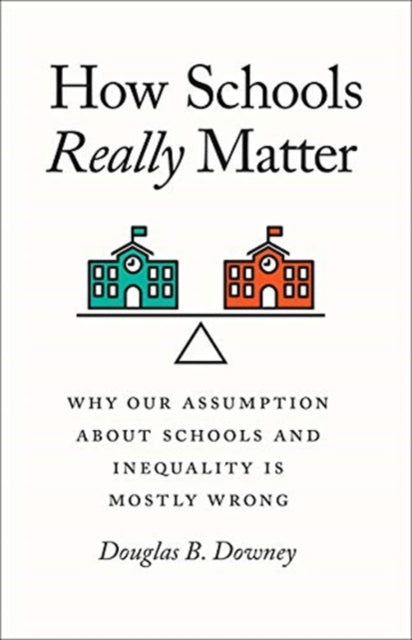
How Schools Really Matter: Why Our Assumption about Schools and Inequality Is Mostly Wrong
How Schools Really Matter: Why Our Assumption about Schools and Inequality Is Mostly Wrong
💎 Earn 34 Points (£0.34) on this item.
YOU SAVE £6.04
- Condition: Brand new
- UK Delivery times: Usually arrives within 2 - 3 working days
- UK Shipping: Fee starts at £2.39. Subject to product weight & dimension
Bulk ordering. Want 15 or more copies? Get a personalised quote and bigger discounts. Learn more about bulk orders.
Couldn't load pickup availability
- More about How Schools Really Matter: Why Our Assumption about Schools and Inequality Is Mostly Wrong
Public schools in America are not unequal, as achievement gaps have little to do with what goes on in our schools. Schools actually help to level the playing field, and the real sources of achievement gaps are elsewhere. Achievement gaps in reading skills between high- and low-income children are nearly entirely formed prior to kindergarten, and schools do more to reduce them than increase them. Both liberal and conservative politicians advocate for school reform, arguing that the poor quality of schools serving disadvantaged children is an important contributor to inequality. How Schools Really Matter offers a firm rebuke to those who find nothing but fault in our schools, and a call to arms for educators and policymakers to fight battles against the social inequality that is reflected within, rather than generated by, our public school system.
\n Format: Paperback / softback
\n Length: 176 pages
\n Publication date: 26 October 2020
\n Publisher: The University of Chicago Press
\n
Most of us assume that public schools in America are unequal, with the quality of education varying depending on the location of the school and the socioeconomic status of the students. We believe that children learn more in schools that serve mostly rich, white kids than in schools that serve mostly poor, black kids. However, this common assumption is misplaced. As Douglas B. Downey demonstrates in his book How Schools Really Matter, achievement gaps have very little to do with what happens in our schools. Schools do not exacerbate inequality in skills; rather, they help to level the playing field.
The real sources of achievement gaps are elsewhere. A close look at the testing data in seasonal patterns supports this conclusion. It turns out that achievement gaps in reading skills between high- and low-income children are nearly entirely formed prior to kindergarten. Schools do more to reduce these gaps than to increase them. And when gaps do increase, they tend to do so during summers, not during school periods.
So why do both liberal and conservative politicians strongly advocate for school reform, arguing that the poor quality of schools serving disadvantaged children is an important contributor to inequality? It's because discussing the broader social and economic reforms necessary for reducing inequality has become too challenging and polarizing. It's easier to talk about fixing schools.
Of course, schools can make differences. Downey outlines the kinds of reforms that make sense given what we know about inequality outside of schools, including more school exposure, increased standardization, and better and fairer school and teacher measurements. How Schools Really Matter offers a firm rebuke to those who find nothing but fault in our schools, which are doing a much better job than many of us realize.
In conclusion, the common assumption that public schools in America are unequal and that achievement gaps are caused by schools is misplaced. Schools do not exacerbate inequality in skills; rather, they help to level the playing field. The real sources of achievement gaps are elsewhere, and schools can make differences through reforms such as more school exposure, increased standardization, and better and fairer school and teacher measurements. However, discussing the broader social and economic reforms necessary for reducing inequality has become too challenging and polarizing, leading to the focus on school reform. It is important to recognize that schools are not the sole solution to inequality, but they can play a significant role in creating a more equitable education system.
\n Weight: 240g\n
Dimension: 219 x 456 x 12 (mm)\n
ISBN-13: 9780226733227\n \n
This item can be found in:
UK and International shipping information
UK and International shipping information
UK Delivery and returns information:
- Delivery within 2 - 3 days when ordering in the UK.
- Shipping fee for UK customers from £2.39. Fully tracked shipping service available.
- Returns policy: Return within 30 days of receipt for full refund.
International deliveries:
Shulph Ink now ships to Australia, Belgium, Canada, France, Germany, Ireland, Italy, India, Luxembourg Saudi Arabia, Singapore, Spain, Netherlands, New Zealand, United Arab Emirates, United States of America.
- Delivery times: within 5 - 10 days for international orders.
- Shipping fee: charges vary for overseas orders. Only tracked services are available for most international orders. Some countries have untracked shipping options.
- Customs charges: If ordering to addresses outside the United Kingdom, you may or may not incur additional customs and duties fees during local delivery.