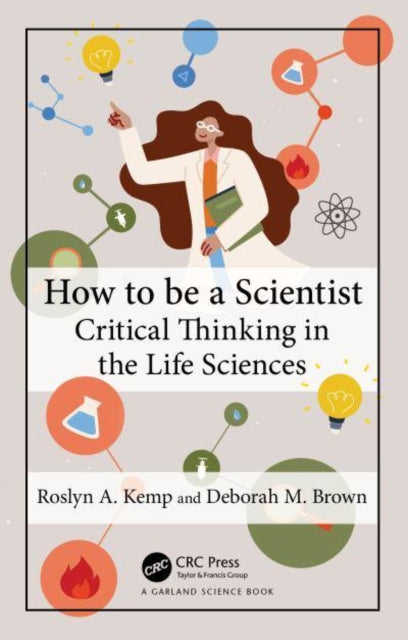
Roslyn A. Kemp,Deborah M. Brown
How to Be a Scientist: Critical Thinking in the Life Sciences
How to Be a Scientist: Critical Thinking in the Life Sciences
💎 Earn 198 Points (£1.98) on this item.
YOU SAVE £2.35
- Condition: Brand new
- UK Delivery times: Usually arrives within 2 - 3 working days
- UK Shipping: Fee starts at £2.39. Subject to product weight & dimension
Bulk ordering. Want 15 or more copies? Get a personalised quote and bigger discounts. Learn more about bulk orders.
Couldn't load pickup availability
- More about How to Be a Scientist: Critical Thinking in the Life Sciences
The textbook provides a comprehensive introduction to the study of science, encouraging discussion and critical thinking through exercises and real-world examples. It covers a range of career options and opportunities and allows students to advocate for science through research and advocacy.
Format: Paperback / softback
Length: 252 pages
Publication date: 01 October 2023
Publisher: Taylor & Francis Inc
Science education is crucial for developing a strong foundation of knowledge and understanding in the natural sciences. It encourages discussion and critical thinking, provides real-world examples and context for difficult concepts, allows students to assess their understanding with practical exercises and examples, documents a variety of career options and opportunities from studying science, and permits students to advocate for science with suggestions for creating and sharing research.
Science education is an essential component of developing a strong foundation of knowledge and understanding in the natural sciences. It fosters a rich environment for discussion and critical thinking, offering students the opportunity to engage with complex concepts and ideas in a hands-on manner. Through real-world examples and contextualization, science education helps students connect theoretical principles to practical applications, enabling them to grasp the relevance and significance of scientific knowledge in various fields.
One of the key advantages of science education is its ability to assess students' understanding and mastery of scientific concepts. Practical exercises, such as experiments, simulations, and data analysis, provide students with the opportunity to apply their knowledge and skills in a real-world setting. This hands-on approach not only enhances their comprehension of the material but also develops their problem-solving abilities and critical thinking skills.
Furthermore, science education offers a diverse range of career options and opportunities. Studying science can lead to careers in fields such as medicine, engineering, agriculture, environmental science, and research. By providing students with a comprehensive understanding of the natural world, science education equips them with the necessary skills and knowledge to pursue their desired professions and contribute to society.
In addition to its vocational benefits, science education also promotes scientific literacy and advocacy. By encouraging students to engage in scientific research and inquiry, science education empowers them to become informed citizens and advocates for science. It teaches students to question, analyze, and evaluate scientific information, enabling them to make informed decisions and contribute to the advancement of scientific knowledge.
To enhance the effectiveness of science education, teachers play a crucial role. They need to be well-versed in the subject matter, possess effective teaching strategies, and create a supportive learning environment. Teachers can incorporate interactive activities, visual aids, and real-world examples to engage students and make learning enjoyable. They can also encourage collaboration and peer-to-peer learning, fostering a sense of community and teamwork among students.
Furthermore, science education can be enhanced by incorporating technology and digital resources. Online platforms, interactive simulations, and virtual laboratories provide students with access to a wealth of scientific information and resources, enabling them to explore and learn at their own pace. Technology can also facilitate collaboration and communication among students, allowing them to share ideas and work on projects together, regardless of their geographical location.
In conclusion, science education is a vital component of developing a well-rounded education. It encourages discussion and critical thinking, provides real-world examples and context for difficult concepts, assesses students' understanding through practical exercises, documents a variety of career options and opportunities, and promotes scientific literacy and advocacy. By fostering a love for science and providing students with the necessary skills and knowledge, science education prepares them to become responsible and informed citizens who can contribute to the advancement of scientific knowledge and make a positive impact on the world.
Weight: 382g
Dimension: 137 x 215 x 17 (mm)
ISBN-13: 9780815346098
This item can be found in:
UK and International shipping information
UK and International shipping information
UK Delivery and returns information:
- Delivery within 2 - 3 days when ordering in the UK.
- Shipping fee for UK customers from £2.39. Fully tracked shipping service available.
- Returns policy: Return within 30 days of receipt for full refund.
International deliveries:
Shulph Ink now ships to Australia, Belgium, Canada, France, Germany, Ireland, Italy, India, Luxembourg Saudi Arabia, Singapore, Spain, Netherlands, New Zealand, United Arab Emirates, United States of America.
- Delivery times: within 5 - 10 days for international orders.
- Shipping fee: charges vary for overseas orders. Only tracked services are available for most international orders. Some countries have untracked shipping options.
- Customs charges: If ordering to addresses outside the United Kingdom, you may or may not incur additional customs and duties fees during local delivery.