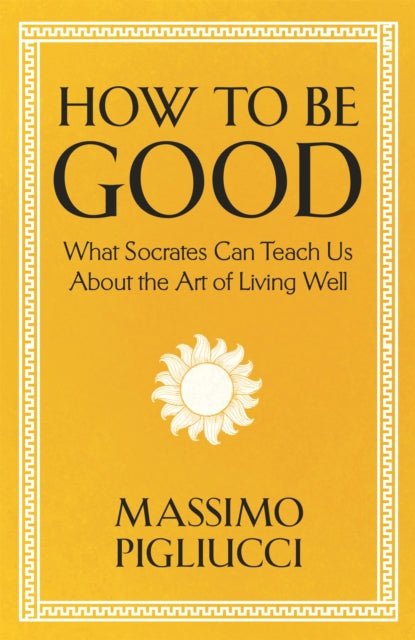
Massimo Pigliucci
How To Be Good: What Socrates Can Teach Us About the Art of Living Well
How To Be Good: What Socrates Can Teach Us About the Art of Living Well
💎 Earn 70 Points (£0.70) on this item.
YOU SAVE £5.84
- Condition: Brand new
- UK Delivery times: Usually arrives within 2 - 3 working days
- UK Shipping: Fee starts at £2.39. Subject to product weight & dimension
Bulk ordering. Want 15 or more copies? Get a personalised quote and bigger discounts. Learn more about bulk orders.
Couldn't load pickup availability
- More about How To Be Good: What Socrates Can Teach Us About the Art of Living Well
How to Be Good explores the question of whether it is possible to teach ourselves and others to become better people, using examples from philosophy and modern interpretations to show that with effort, we can all pursue the art of living well.
Format: Hardback
Length: 272 pages
Publication date: 29 September 2022
Publisher: John Murray Press
Can we make ourselves into better human beings? Can we help others do the same? And can we get the leaders of our society to care that humanity prospers, not just economically, but also spiritually? These questions have been asked for over two millennia, and attempting to answer them is crucial if we want to live a better life and build a more just society.
How to Be Good uses the story of Socrates and Alcibiades and examples from Aristotle, Marcus Aurelius, and Machiavelli, alongside modern interpretations, to explore what philosophy can teach us about the quest for virtue today. Whether we are statesmen or ordinary individuals, Pigliucci argues that with a little work day by day, we all have the power to pursue the timely and timeless art of living well.
Socrates' greatest failure, according to some, suggests that it is impossible to teach ourselves and others to become better people. This idea has been debated for centuries, with philosophers and thinkers offering different perspectives on the matter. While some argue that personal growth and improvement are solely the result of individual effort and determination, others believe that external factors, such as social and cultural norms, play a significant role in shaping our character and behavior.
One of the key questions that arises from this debate is whether it is possible to change someone's nature or inherent qualities. Some philosophers argue that our nature is fixed and unchangeable, while others suggest that we can develop and improve our character through conscious effort and self-awareness.
Another aspect of the debate is whether it is possible to teach others to become better people. Some argue that it is difficult to change someone's beliefs, values, and behavior without their willingness and participation. Others believe that education and socialization can play a significant role in promoting moral and ethical behavior.
In recent years, there has been a growing interest in the concept of "virtue ethics" and the role that philosophy can play in promoting virtuous behavior. Virtue ethics focuses on developing and promoting certain qualities, such as honesty, courage, and empathy, that are considered essential for living a good life and building a just society.
One of the key proponents of virtue ethics is Aristotle, who believed that the cultivation of virtue was essential for living a fulfilling and meaningful life. He argued that virtues are not just moral qualities, but also practical skills that can be developed through practice and habituation.
Aristotle's concept of virtue ethics has been influential in shaping modern ethical philosophy and has been applied to a wide range of fields, including business, politics, and education. For example, many companies now emphasize the importance of ethical behavior and sustainability, and many schools and universities incorporate character education into their curricula.
In addition to Aristotle, other philosophers have also contributed to the debate over the possibility of teaching ourselves and others to become better people. For example, Marcus Aurelius, a Roman emperor, believed that the cultivation of self-discipline and self-awareness was essential for living a virtuous life. He wrote extensively on the topic of Stoicism, a philosophy that emphasizes the importance of living in harmony with nature and with others.
Machiavelli, another influential philosopher, believed that the pursuit of power and success was the key to living a good life. He argued that individuals should be willing to do whatever it takes to achieve their goals, even if it means acting in morally questionable ways.
Despite these different perspectives, there is a common theme that emerges from the debate over the possibility of teaching ourselves and others to become better people. All of these philosophers agree that personal growth and improvement are essential for living a fulfilling and meaningful life and that we can develop and improve our character through conscious effort and self-awareness.
In conclusion, the debate over the possibility of teaching ourselves and others to become better people is a complex and multifaceted one. While some argue that personal growth and improvement are solely the result of individual effort and determination, others believe that external factors, such as social and cultural norms, play a significant role in shaping our character and behavior. Whether we can change someone's nature or inherent qualities, or whether it is possible to teach others to become better people, is a question that continues to be debated and explored by philosophers and thinkers today. However, all of these philosophers agree that personal growth and improvement are essential for living a fulfilling and meaningful life and that we can develop and improve our character through conscious effort and self-awareness.
Weight: 470g
Dimension: 162 x 242 x 29 (mm)
ISBN-13: 9781399804936
This item can be found in:
UK and International shipping information
UK and International shipping information
UK Delivery and returns information:
- Delivery within 2 - 3 days when ordering in the UK.
- Shipping fee for UK customers from £2.39. Fully tracked shipping service available.
- Returns policy: Return within 30 days of receipt for full refund.
International deliveries:
Shulph Ink now ships to Australia, Belgium, Canada, France, Germany, Ireland, Italy, India, Luxembourg Saudi Arabia, Singapore, Spain, Netherlands, New Zealand, United Arab Emirates, United States of America.
- Delivery times: within 5 - 10 days for international orders.
- Shipping fee: charges vary for overseas orders. Only tracked services are available for most international orders. Some countries have untracked shipping options.
- Customs charges: If ordering to addresses outside the United Kingdom, you may or may not incur additional customs and duties fees during local delivery.