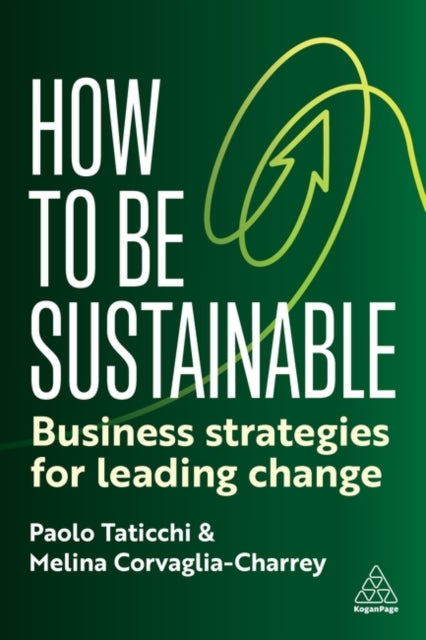
Paolo Taticchi,Melina Corvaglia-Charrey
How to Be Sustainable: Business Strategies for Leading Change
How to Be Sustainable: Business Strategies for Leading Change
💎 Earn 94 Points (£0.94) on this item.
YOU SAVE £1.12
- Condition: Brand new
- UK Delivery times: Usually arrives within 2 - 3 working days
- UK Shipping: Fee starts at £3.89. Subject to product weight & dimension
Bulk ordering. Want 15 or more copies? Get a personalised quote and bigger discounts. Learn more about bulk orders.
Couldn't load pickup availability
- More about How to Be Sustainable: Business Strategies for Leading Change
The book "How to Be Sustainable" provides practical guidance for senior leaders, CSOs, and board-level professionals to lead with purpose and deliver measurable change. It explores what sets high-impact sustainability strategies apart and how others can close the gap. It features real-world case studies, frameworks, and practical tools to help organizations become future-ready and environmentally responsible.
Format: Paperback / softback
Length: 224 pages
Publication date: 03 February 2025
Publisher: Kogan Page Ltd
Sustainability is a critical issue for businesses and organizations of all sizes. It involves making decisions that consider the environmental, social, and economic impact of our actions. A sustainable strategy is a plan that outlines how a company or organization will achieve its sustainability goals and objectives.
There are many different types of sustainability strategies, but they all share a common goal: to reduce the negative impact of our activities on the environment and to promote social and economic well-being. Some of the key elements of a sustainability strategy include:
Environmental Goals: These goals focus on reducing the company's carbon footprint, water usage, and waste production. They may also include initiatives to protect natural resources, such as forests and oceans.
Social Goals: These goals focus on improving the quality of life for employees, customers, and communities. They may include initiatives to promote diversity and inclusion, reduce poverty, and improve access to education and healthcare.
Economic Goals: These goals focus on improving the company's financial performance and competitiveness. They may include initiatives to reduce costs, increase revenue, and improve customer satisfaction.
Integrated Sustainability: Integrated sustainability is a strategy that combines environmental, social, and economic goals into a single plan. It is designed to ensure that all aspects of the company's operations are aligned with its sustainability goals.
Sustainability Leadership: Sustainability leadership is the ability to inspire and motivate others to take action on sustainability. It involves setting a clear vision and goals, communicating effectively, and leading by example.
ESG Strategy: ESG strategy is a strategy that focuses on environmental, social, and governance (ESG) factors. It is designed to help companies manage their risks and opportunities related to ESG issues.
Long-Term Value: Long-term value is the value that a company or organization creates for its stakeholders over the long term. It includes financial performance, social impact, and environmental impact.
Net Zero Commitments: Net zero commitments are commitments to reduce greenhouse gas emissions to zero by a specific date. They are designed to help companies achieve their sustainability goals and to mitigate the effects of climate change.
Carbon Targets: Carbon targets are commitments to reduce greenhouse gas emissions by a specific amount by a specific date. They are designed to help companies achieve their sustainability goals and to mitigate the effects of climate change.
Responsible Business: Responsible business is a business that operates in a socially and environmentally responsible manner. It includes initiatives to reduce waste, improve energy efficiency, and promote fair labor practices.
How to Be Sustainable is a practical guide for senior leaders, CSOs, and board-level professionals who want to lead with purpose and deliver measurable change. Written by renowned sustainability expert Paolo Taticchi with Melina Corvaglia-Charrey, this book draws on interviews with Chief Sustainability Officers from global organizations including Enel Group, Microsoft, Canon, and Sage. It explores what sets high-impact sustainability strategies apart and how others can close the gap.
One of the key themes of the book is sustainability leadership. Sustainability leaders are able to inspire and motivate others to take action on sustainability. They set a clear vision and goals, communicate effectively, and lead by example. Sustainability leaders also need to be able to manage their risks and opportunities related to ESG issues.
ESG strategy is another key theme of the book. ESG strategy is designed to help companies manage their risks and opportunities related to ESG issues. It includes initiatives to reduce greenhouse gas emissions, improve energy efficiency, and promote fair labor practices. ESG strategy is also designed to help companies achieve their sustainability goals and to mitigate the effects of climate change.
Long-term value is another key theme of the book. Long-term value is the value that a company or organization creates for its stakeholders over the long term. It includes financial performance, social impact, and environmental impact. Long-term value is important because it helps companies to remain competitive in the market and to attract and retain customers.
Net zero commitments and carbon targets are also key themes of the book. Net zero commitments are commitments to reduce greenhouse gas emissions to zero by a specific date. Carbon targets are commitments to reduce greenhouse gas emissions by a specific amount by a specific date. Net zero commitments and carbon targets are important because they help companies to achieve their sustainability goals and to mitigate the effects of climate change.
Responsible business is also a key theme of the book. Responsible business is a business that operates in a socially and environmentally responsible manner. It includes initiatives to reduce waste, improve energy efficiency, and promote fair labor practices. Responsible business is important because it helps to create a more sustainable and equitable world.
The book includes a number of real-world case studies, frameworks, and practical tools that can help companies to implement sustainability strategies. These case studies include companies such as Enel Group, Microsoft, Canon, and Sage. The frameworks include the Sustainable Development Goals (SDGs) and the Global Reporting Initiative (GRI). The practical tools include tools for measuring and reporting on sustainability performance, tools for developing sustainability strategies, and tools for engaging with stakeholders.
One of the challenges that companies face when implementing sustainability strategies is the lack of resources. Many companies do not have the resources to invest in sustainability initiatives, and this can make it difficult for them to achieve their sustainability goals. However, there are a number of ways that companies can overcome this challenge.
One way that companies can overcome this challenge is by partnering with other companies. Partnerships can help companies to share resources and to achieve their sustainability goals more quickly. For example, Enel Group has partnered with Microsoft to develop a cloud-based platform that helps companies to track and manage their sustainability performance.
Another way that companies can overcome this challenge is by investing in sustainability initiatives. Sustainability initiatives can include initiatives to reduce greenhouse gas emissions, improve energy efficiency, and promote fair labor practices. These initiatives can be expensive, but they can also provide long-term benefits.
In addition to these challenges, there are also a number of opportunities that companies can take advantage of when implementing sustainability strategies. For example, the increasing demand for sustainable products and services is creating a market for companies that are committed to sustainability. This market is growing rapidly, and companies that are not committed to sustainability may find it difficult to compete.
Another opportunity that companies can take advantage of is the increasing focus on ESG issues. ESG issues are becoming more important to investors, and companies that are not committed to ESG issues may find it difficult to attract and retain investors.
In conclusion, sustainability is a critical issue for businesses and organizations of all sizes. A sustainability strategy is a plan that outlines how a company or organization will achieve its sustainability goals and objectives. There are many different types of sustainability strategies, but they all share a common goal: to reduce the negative impact of our activities on the environment and to promote social and economic well-being. Sustainability leadership, ESG strategy, long-term value, net zero commitments, carbon targets, responsible business, and real-world case studies, frameworks, and practical tools are all key themes of the book. By implementing sustainability strategies, companies can create a more sustainable and equitable world.
Weight: 346g
Dimension: 233 x 157 x 15 (mm)
ISBN-13: 9781398618527
UK and International shipping information
UK and International shipping information
We deliver throughout the United Kingdom and to 128 countries and territories worldwide, including the United States, Australia, Canada, Germany, Spain and France.