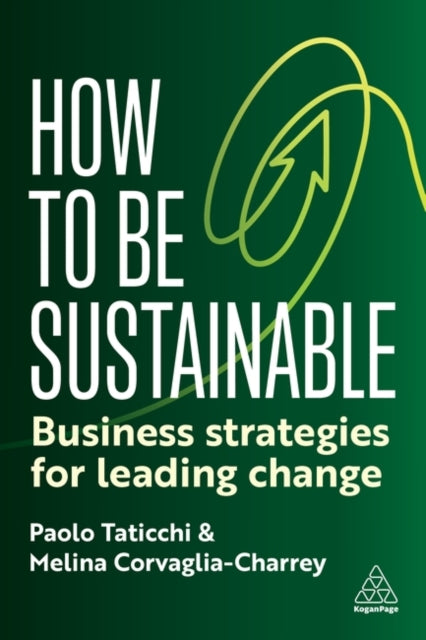
Paolo Taticchi,Melina Corvaglia-Charrey
How to Be Sustainable: Business Strategies for Leading Change
How to Be Sustainable: Business Strategies for Leading Change
💎 Earn 237 Points (£2.37) on this item.
We can order this item for you. Delivery usually takes about 4 to 6 weeks.
This item is not held in our immediate stock. We will order it for you after checkout.
Estimated delivery: About 4 to 6 weeks
YOU SAVE £19.56
- Condition: Brand new
- UK Delivery times: Usually arrives within 2 - 3 working days
- UK Shipping: Fee starts at £2.39. Subject to product weight & dimension
Bulk ordering. Want 15 or more copies? Get a personalised quote and bigger discounts. Learn more about bulk orders.
Couldn't load pickup availability
- More about How to Be Sustainable: Business Strategies for Leading Change
The book "How to Be Sustainable" provides practical guidance for senior leaders, CSOs, and board-level professionals to lead with purpose and deliver measurable change. It explores what sets high-impact sustainability strategies apart and how others can close the gap. It features real-world case studies, frameworks, and practical tools to help organizations become future-ready and environmentally responsible.
Format: Hardback
Length: 224 pages
Publication date: 03 February 2025
Publisher: Kogan Page Ltd
Sustainability is a critical issue for businesses and organizations of all sizes. It involves making decisions that consider the environmental, social, and economic impact of our actions. A sustainable strategy is a plan that outlines how a company will achieve its sustainability goals and measure its progress.
There are many different types of sustainability strategies, but they all share the same goal: to reduce the negative impact of our activities on the environment and society. Some strategies focus on reducing greenhouse gas emissions, while others focus on improving water quality or reducing waste.
One of the key challenges of sustainability is aligning environmental goals with commercial performance, governance, and stakeholder demands. This can be difficult, as different stakeholders may have different priorities and interests. However, there are several strategies that can help to achieve this alignment.
One strategy is to integrate net zero commitments and carbon targets into strategy and reporting. This means that a company sets a goal to reduce its greenhouse gas emissions to zero by a certain date and then tracks its progress towards that goal. This can help to reduce the company's carbon footprint and improve its reputation as a responsible business.
Another strategy is to elevate the CSO role while building leadership accountability and internal engagement. The CSO is responsible for overseeing the company's sustainability strategy and ensuring that it is implemented effectively. However, many CSOs are not given the resources and support that they need to be successful. By elevating the CSO role and building leadership accountability, a company can ensure that its sustainability strategy is implemented effectively and that it is aligned with its commercial goals.
In addition to these strategies, there are many other factors that can impact sustainability. For example, climate change is a major threat to sustainability, and it is important for companies to take action to reduce their carbon footprint. This can include investing in renewable energy, reducing waste, and improving energy efficiency.
Another factor that can impact sustainability is social responsibility. Companies should be responsible for the impact that their actions have on society, and they should work to improve the lives of their employees, customers, and communities. This can include providing fair wages, promoting diversity and inclusion, and reducing environmental pollution.
Finally, sustainability is also important for financial performance. Companies that are sustainable are often more profitable than those that are not. This is because they are able to reduce their costs and improve their efficiency.
However, sustainability is not without its challenges. One of the biggest challenges is the lack of data and information. Many companies do not have the data that they need to make informed decisions about sustainability. This can be a major barrier to achieving sustainability goals.
To address this challenge, there are many organizations that are working to collect and analyze data on sustainability. These organizations include the World Resources Institute, the Carbon Disclosure Project, and the Global Reporting Initiative. These organizations provide data and information to companies and other organizations so that they can make informed decisions about sustainability.
In addition to these organizations, there are many other strategies that can help to achieve sustainability. For example, companies can invest in sustainable technologies, such as renewable energy and energy-efficient buildings. They can also reduce their waste and improve their energy efficiency.
Finally, sustainability is also important for consumers. Consumers should be aware of the impact that their actions have on the environment and society. They should choose products and services that are sustainable and that are produced in a responsible manner.
In conclusion, sustainability is a critical issue for businesses and organizations of all sizes. It involves making decisions that consider the environmental, social, and economic impact of our actions. A sustainable strategy is a plan that outlines how a company will achieve its sustainability goals and measure its progress. There are many different types of sustainability strategies, but they all share the same goal: to reduce the negative impact of our activities on the environment and society. By integrating net zero commitments and carbon targets into strategy and reporting, elevating the CSO role while building leadership accountability and internal engagement, investing in sustainable technologies, reducing waste, and improving energy efficiency, companies can achieve sustainability and be successful in the long term.
Dimension: 234 x 156 (mm)
ISBN-13: 9781398618541
UK and International shipping information
UK and International shipping information
UK Delivery and returns information:
- Delivery within 2 - 3 days when ordering in the UK.
- Shipping fee for UK customers from £2.39. Fully tracked shipping service available.
- Returns policy: Return within 30 days of receipt for full refund.
International deliveries:
Shulph Ink now ships to Australia, Belgium, Canada, France, Germany, Ireland, Italy, India, Luxembourg Saudi Arabia, Singapore, Spain, Netherlands, New Zealand, United Arab Emirates, United States of America.
- Delivery times: within 5 - 10 days for international orders.
- Shipping fee: charges vary for overseas orders. Only tracked services are available for most international orders. Some countries have untracked shipping options.
- Customs charges: If ordering to addresses outside the United Kingdom, you may or may not incur additional customs and duties fees during local delivery.