ColinBird
Human Dignity and Political Criticism
Human Dignity and Political Criticism
💎 Earn 122 Points (£1.22) on this item.
We can order this item for you. Delivery usually takes about 4 to 6 weeks.
This item is not held in our immediate stock. We will order it for you after checkout.
Estimated delivery: About 4 to 6 weeks
YOU SAVE £1.46
- Condition: Brand new
- UK Delivery times: Usually arrives within 2 - 3 working days
- UK Shipping: Fee starts at £2.39. Subject to product weight & dimension
Bulk ordering. Want 15 or more copies? Get a personalised quote and bigger discounts. Learn more about bulk orders.
Couldn't load pickup availability
- More about Human Dignity and Political Criticism
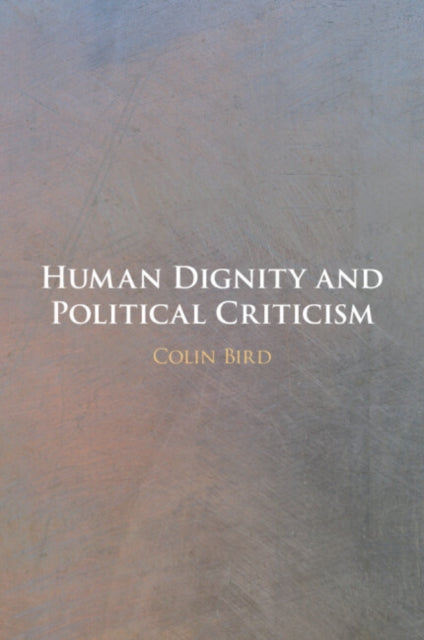
This book explores whether the philosophical idea of human dignity can help achieve a society where the worth of people's lives is a lived reality. Colin Bird offers a new fourfold typology of dignity concepts, rejecting the idea that it refers to the inherent worth or status of individuals and reinterpreting it as a social relation constituted by affects of respect and modes of mutual attention. This new vision of human dignity as a vital political value and an agent of critical reflection on politics is an arresting vindication of its role.
Format: Paperback / softback
Length: 290 pages
Publication date: 24 August 2023
Publisher: Cambridge University Press
Many individuals, including prominent figures such as Marx, Rawls, and the contemporary Black Lives Matter movement, passionately advocate for the aspiration of establishing a coexistence where the value of human lives becomes a tangible and lived reality rather than a mere rhetorical flourish. This thought-provoking book delves into the question of whether, as some suggest, the philosophical concept of human dignity possesses the potential to fulfill this noble objective. Colin Bird, in his insightful work, presents a novel four-fold typology of dignity concepts, arguing that human dignity can only fulfill this role if certain traditional notions of it are abandoned. Bird challenges the notion that human dignity refers to an inherent worth or status of individuals, instead reinterpreting it as a social relation, formed by the affects of respect and the modes of mutual attention they generate. What emerges is a fresh perspective on human dignity as a vital political value, and a compelling justification of its role as a catalyst for critical reflection on politics.
Bird's exploration of human dignity is deeply rooted in his rejection of essentialist notions of human nature. He argues that human dignity is not an inherent quality possessed by individuals but rather a social construct that is shaped by the interactions between individuals and their social contexts. This perspective emphasizes the importance of recognizing the diverse experiences and perspectives of individuals and the need to create a society that values and respects the inherent worth of all its members.
Bird's four-fold typology of dignity concepts provides a valuable framework for understanding the various dimensions of human dignity. The first dimension, "respectful attention," refers to the way in which individuals are treated with dignity and respect by others. This includes the recognition of their inherent worth, the valuing of their perspectives, and the acknowledgment of their contributions to society. The second dimension, "reciprocal regard," involves the mutual recognition and respect between individuals and groups. This includes the ability to engage in meaningful dialogue, the willingness to listen and learn from others, and the commitment to building inclusive and equitable communities. The third dimension, "social recognition," encompasses the broader social and political contexts in which individuals live and interact. This includes the recognition of human rights, the protection of social and economic inequalities, and the promotion of social justice and equality. The fourth dimension, "political agency," emphasizes the role of individuals and groups in shaping their social and political environments. This includes the ability to participate in democratic processes, the exercise of political power, and the advocacy for social and political change.
Bird's reinterpretation of human dignity as a social relation is particularly significant in the context of contemporary political discourse. In a world marked by polarization, inequality, and social unrest, the concept of human dignity provides a powerful tool for promoting empathy, understanding, and cooperation. By recognizing the inherent worth of all individuals and the importance of their contributions to society, we can create a more inclusive and just world where the lives of all people are valued and respected.
However, Bird's argument also raises important challenges and questions. One of the most significant concerns is the potential for the concept of human dignity to be used as a tool of exclusion and discrimination. While recognizing the inherent worth of all individuals is essential, it is also important to acknowledge the historical and systemic inequalities that have marginalized certain groups and individuals. The concept of human dignity must be inclusive and equitable, and it must be used to challenge and dismantle these inequalities rather than perpetuate them.
Another challenge is the question of how to operationalize the concept of human dignity in practical terms. While recognizing the importance of the social and political dimensions of human dignity, it is also important to address the practical challenges of implementing these values in everyday life. This includes the need for policies and practices that promote social inclusion, economic equality, and human rights, as well as the development of institutions and systems that support these values.
In conclusion, Colin Bird's book offers a compelling and innovative perspective on human dignity. By rejecting essentialist notions of human nature and reinterpreting human dignity as a social relation, Bird provides a valuable framework for understanding the various dimensions of human dignity and promoting empathy, understanding, and cooperation in contemporary society. While there are important challenges and questions that must be addressed, the concept of human dignity remains a vital political value and an agent of critical reflection on politics. As we continue to navigate the complex and interconnected world of today, it is essential to embrace the concept of human dignity and work towards a more inclusive and just world for all.
ISBN-13: 9781108927628
This item can be found in:
UK and International shipping information
UK and International shipping information
UK Delivery and returns information:
- Delivery within 2 - 3 days when ordering in the UK.
- Shipping fee for UK customers from £2.39. Fully tracked shipping service available.
- Returns policy: Return within 30 days of receipt for full refund.
International deliveries:
Shulph Ink now ships to Australia, Belgium, Canada, France, Germany, Ireland, Italy, India, Luxembourg Saudi Arabia, Singapore, Spain, Netherlands, New Zealand, United Arab Emirates, United States of America.
- Delivery times: within 5 - 10 days for international orders.
- Shipping fee: charges vary for overseas orders. Only tracked services are available for most international orders. Some countries have untracked shipping options.
- Customs charges: If ordering to addresses outside the United Kingdom, you may or may not incur additional customs and duties fees during local delivery.