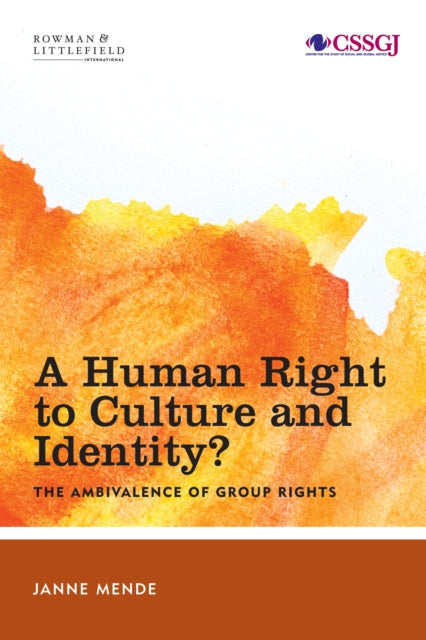
Janne Mende
Human Right to Culture and Identity: The Ambivalence of Group Rights
Human Right to Culture and Identity: The Ambivalence of Group Rights
💎 Earn 191 Points (£1.91) on this item.
We can order this item for you. Delivery usually takes about 4 to 6 weeks.
This item is not held in our immediate stock. We will order it for you after checkout.
Estimated delivery: About 4 to 6 weeks
- Condition: Brand new
- UK Delivery times: Usually arrives within 2 - 3 working days
- UK Shipping: Fee starts at £2.39. Subject to product weight & dimension
Bulk ordering. Want 15 or more copies? Get a personalised quote and bigger discounts. Learn more about bulk orders.
Couldn't load pickup availability
- More about Human Right to Culture and Identity: The Ambivalence of Group Rights
Human rights for cultural identities are complex, with different conceptions of culture and identity complicating the question. A human right to collective identity should be outlined to avoid excluding marginalized cultural groups and reproducing rigid distinctions between cultures. This book reveals the pitfalls, benefits, and demands surrounding the debate for and against culture and identity in human rights, connecting a theoretical debate with empirical findings about collective rights for indigenous groups.
Format: Paperback / softback
Length: 222 pages
Publication date: 17 January 2018
Publisher: Rowman & Littlefield International
Human rights for cultural identities have been a topic of debate for many years. While some argue that distinct human rights for cultural identities are necessary to protect and promote cultural diversity, others argue that such rights can be harmful and perpetuate divisions between groups. One of the main challenges in defining a human right to collective identity is the fact that cultures and identities are constantly evolving and changing. This means that any definition of a human right to collective identity must be flexible and adaptable to changing circumstances.
One of the benefits of having distinct human rights for cultural identities is that it can help to protect cultural heritage and traditions. Cultural heritage is often deeply intertwined with a group's identity and can be a source of pride and self-esteem. By recognizing the rights of cultural groups to their heritage, we can help to ensure that it is preserved and protected for future generations.
However, there are also concerns that distinct human rights for cultural identities can be used to justify discrimination and violence against other groups. For example, some groups may use their cultural identity to claim superiority over other groups or to justify acts of violence against them. This can lead to tensions and conflicts between different groups and can undermine the principles of equality and human rights.
To address these concerns, it is important to develop a human right to collective identity that is based on principles of equality and non-discrimination. This means that all individuals, regardless of their cultural identity, should have the same rights and freedoms. It also means that cultural groups should be able to express their cultural identity in a way that is respectful of the rights of others.
One way to achieve this is to establish a system of cultural rights that recognizes the rights of cultural groups to their heritage, language, and traditions. This system should also provide for the protection of cultural rights from discrimination and violence.
However, establishing a system of cultural rights can be challenging. Many countries have already established cultural rights, but these rights are often limited in scope and do not provide for the full range of cultural rights that are necessary to protect and promote cultural diversity.
In addition to establishing a system of cultural rights, it is also important to promote cultural diversity and understanding. This can be done through education, cultural exchange programs, and the promotion of cultural heritage.
Education is particularly important in promoting cultural diversity and understanding. By providing education to individuals from different cultural backgrounds, we can help to break down barriers and promote understanding and respect between different groups.
Cultural exchange programs can also be a valuable tool for promoting cultural diversity and understanding. These programs allow individuals from different cultures to come together and share their experiences and perspectives.
In addition to promoting cultural diversity and understanding, it is also important to address the underlying causes of cultural conflicts and tensions. This can be done through dialogue and negotiation.
Dialogue and negotiation can help to build trust and understanding between different groups and can help to resolve conflicts and tensions. However, it is important to ensure that these processes are conducted in a fair and transparent manner.
In conclusion, human rights for cultural identities are a complex and controversial topic. While some argue that distinct human rights for cultural identities are necessary to protect and promote cultural diversity, others argue that such rights can be harmful and perpetuate divisions between groups. To address these concerns, it is important to develop a human right to collective identity that is based on principles of equality and non-discrimination. This system should also provide for the protection of cultural rights from discrimination and violence. In addition to establishing a system of cultural rights, it is also important to promote cultural diversity and understanding through education, cultural exchange programs, and the promotion of cultural heritage. By doing so, we can help to create a more inclusive and equitable world for all individuals, regardless of their cultural identity.
Weight: 350g
Dimension: 152 x 228 x 14 (mm)
ISBN-13: 9781783486793
UK and International shipping information
UK and International shipping information
UK Delivery and returns information:
- Delivery within 2 - 3 days when ordering in the UK.
- Shipping fee for UK customers from £2.39. Fully tracked shipping service available.
- Returns policy: Return within 30 days of receipt for full refund.
International deliveries:
Shulph Ink now ships to Australia, Belgium, Canada, France, Germany, Ireland, Italy, India, Luxembourg Saudi Arabia, Singapore, Spain, Netherlands, New Zealand, United Arab Emirates, United States of America.
- Delivery times: within 5 - 10 days for international orders.
- Shipping fee: charges vary for overseas orders. Only tracked services are available for most international orders. Some countries have untracked shipping options.
- Customs charges: If ordering to addresses outside the United Kingdom, you may or may not incur additional customs and duties fees during local delivery.