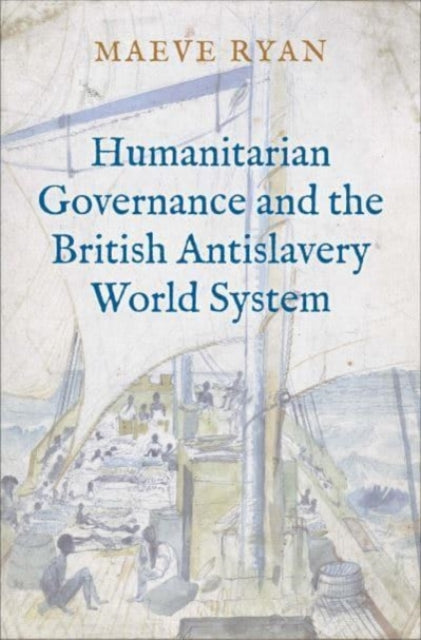
Maeve Ryan
Humanitarian Governance and the British Antislavery World System
Humanitarian Governance and the British Antislavery World System
YOU SAVE £3.52
- Condition: Brand new
- UK Delivery times: Usually arrives within 2 - 3 working days
- UK Shipping: Fee starts at £3.89. Subject to product weight & dimension
Bulk ordering. Want 15 or more copies? Get a personalised quote and bigger discounts. Learn more about bulk orders.
Couldn't load pickup availability
- More about Humanitarian Governance and the British Antislavery World System
The suppression of the slave trade and the "disposal" of liberated Africans by the British Navy led to the emergence of modern humanitarianism. Maeve Ryan's book explores the imperial experiments and the dual discourses of compassion and control that shaped policies towards the liberated Africans. It demonstrates the impact of interventionist experiments on their lives, the evolution of a British antislavery "world system," and the emergence of modern understandings of refuge, asylum, and humanitarian governance.
Format: Hardback
Length: 328 pages
Publication date: 07 June 2022
Publisher: Yale University Press
Between 1808 and 1867, the British Navy's Atlantic squadrons embarked on a remarkable mission to seize nearly two thousand slave ships, rescuing almost two hundred thousand enslaved individuals and resettling them as liberated Africans across various locations, including Sierra Leone, Cape Colony, the West Indies, Brazil, Cuba, and beyond. In her comprehensive study, Maeve Ryan delves into the intricate set of imperial experiments that unfolded as British authorities sought to govern and utilize the liberated Africans. Ryan examines the evolving dual discourses of compassion and control surrounding this population, who were expected to repay the debt of their salvation. She traces the ideas that informed "disposal" policies towards liberated Africans and the diverse forms of resistance and accommodation they adopted in response. This book serves as a powerful testament to the profound impact of interventionist experiments on the lives of the liberated individuals, the development of a British antislavery "world system," and the emergence of modern understandings of refuge, asylum, and humanitarian governance.
The suppression of the slave trade and the "disposal" of liberated Africans played a pivotal role in shaping the emergence of modern humanitarianism. During the period between 1808 and 1867, the British Navy's Atlantic squadrons embarked on a remarkable mission to seize nearly two thousand slave ships, rescuing almost two hundred thousand enslaved individuals and resettling them as liberated Africans across various locations, including Sierra Leone, Cape Colony, the West Indies, Brazil, Cuba, and beyond. In her comprehensive study, Maeve Ryan delves into the intricate set of imperial experiments that unfolded as British authorities sought to govern and utilize the liberated Africans. Ryan examines the evolving dual discourses of compassion and control surrounding this population, who were expected to repay the debt of their salvation. She traces the ideas that informed "disposal" policies towards liberated Africans and the diverse forms of resistance and accommodation they adopted in response. This book serves as a powerful testament to the profound impact of interventionist experiments on the lives of the liberated individuals, the development of a British antislavery "world system," and the emergence of modern understandings of refuge, asylum, and humanitarian governance.
The British Navy's Atlantic squadrons played a significant role in the suppression of the slave trade and the "disposal" of liberated Africans. Between 1808 and 1867, they seized nearly two thousand slave ships, rescuing almost two hundred thousand enslaved individuals and resettling them as liberated Africans across various locations, including Sierra Leone, Cape Colony, the West Indies, Brazil, Cuba, and beyond. In her comprehensive study, Maeve Ryan delves into the intricate set of imperial experiments that unfolded as British authorities sought to govern and utilize the liberated Africans. Ryan examines the evolving dual discourses of compassion and control surrounding this population, who were expected to repay the debt of their salvation. She traces the ideas that informed "disposal" policies towards liberated Africans and the diverse forms of resistance and accommodation they adopted in response. This book serves as a powerful testament to the profound impact of interventionist experiments on the lives of the liberated individuals, the development of a British antislavery "world system," and the emergence of modern understandings of refuge, asylum, and humanitarian governance.
The suppression of the slave trade and the "disposal" of liberated Africans had a profound impact on shaping the emergence of modern humanitarianism. During the period between 1808 and 1867, the British Navy's Atlantic squadrons embarked on a remarkable mission to seize nearly two thousand slave ships, rescuing almost two hundred thousand enslaved individuals and resettling them as liberated Africans across various locations, including Sierra Leone, Cape Colony, the West Indies, Brazil, Cuba, and beyond. In her comprehensive study, Maeve Ryan delves into the intricate set of imperial experiments that unfolded as British authorities sought to govern and utilize the liberated Africans. Ryan examines the evolving dual discourses of compassion and control surrounding this population, who were expected to repay the debt of their salvation. She traces the ideas that informed "disposal" policies towards liberated Africans and the diverse forms of resistance and accommodation they adopted in response. This book serves as a powerful testament to the profound impact of interventionist experiments on the lives of the liberated individuals, the development of a British antislavery "world system," and the emergence of modern understandings of refuge, asylum, and humanitarian governance.
Dimension: 235 x 156 x 25 (mm)
ISBN-13: 9780300251395
UK and International shipping information
UK and International shipping information
We deliver throughout the United Kingdom and to 128 countries and territories worldwide, including the United States, Australia, Canada, Germany, Spain and France.