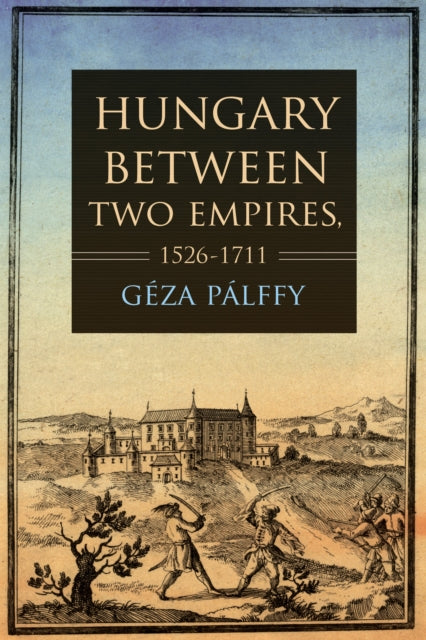
Geza Palffy
Hungary between Two Empires 1526-1711
Hungary between Two Empires 1526-1711
💎 Earn 144 Points (£1.44) on this item.
YOU SAVE £6.09
- Condition: Brand new
- UK Delivery times: Usually arrives within 2 - 3 working days
- UK Shipping: Fee starts at £2.39. Subject to product weight & dimension
Bulk ordering. Want 15 or more copies? Get a personalised quote and bigger discounts. Learn more about bulk orders.
Couldn't load pickup availability
- More about Hungary between Two Empires 1526-1711
The Hungarian defeat at the Battle of Mohács in 1526 led to the division of the Kingdom of Hungary into three parts, altering Central Europe's shape and ethnic composition for centuries. Hungary became a battleground between the Ottoman and Habsburg empires, and Géza Pálffy's book explores Hungary's role as a borderland and theater of war through the turn of the 18th century, offering a fresh and thorough exploration of this key moment in Hungarian history and the creation of a modern Europe.
\n Format: Paperback / softback
\n Length: 318 pages
\n Publication date: 08 June 2021
\n Publisher: Indiana University Press
\n
The Hungarian defeat at the pivotal Battle of Mohács in 1526 marked a significant turning point in Central European history, leading to the division of the Kingdom of Hungary into three parts. This event not only altered the physical landscape of the region but also had a profound impact on its ethnic composition, shaping it for centuries to come. As a result, Hungary became a battleground between the Ottoman and Habsburg empires, with profound consequences for the region's political, economic, and cultural landscape.
In his comprehensive work, Hungary between Two Empires 1526–1711, Géza Pálffy delves into this crucial period of Hungarian history, exploring the country's role as a borderland and a theater of war. Through meticulous archival research spanning 25 years, Pálffy offers a fresh and thorough exploration of this pivotal moment in Hungarian history, shedding light on its impact on the creation of a modern Europe.
The Battle of Mohács in 1526 marked the beginning of a long and devastating conflict between Hungary and the Ottoman Empire. The Ottomans, seeking to expand their empire, launched a series of campaigns against Hungary, culminating in the decisive victory at Mohács. This defeat not only resulted in the loss of vast territories but also led to the displacement of millions of Hungarian people, who were forced to flee to neighboring countries.
The division of Hungary into three parts following the Battle of Mohács was a significant event that had far-reaching consequences. The western part of Hungary, known as Transylvania, became a province of the Ottoman Empire, while the central and eastern parts, including Budapest, became part of the Habsburg Empire. This division not only altered the political landscape of the region but also had a profound impact on the cultural and economic development of Hungary.
The Ottoman Empire's rule over Transylvania brought about significant changes in the region's culture and society. The Ottomans introduced Islam as the official religion, and many Hungarian people were forced to convert to Islam. This led to the development of a distinct Muslim community in Transylvania, which had its own customs, traditions, and language. However, the Ottoman Empire's rule was also characterized by oppression and brutality, with the local population subjected to heavy taxes, forced labor, and other forms of exploitation.
In contrast, the Habsburg Empire's rule over the central and eastern parts of Hungary brought about a period of relative stability and prosperity. The Habsburgs were known for their support of the arts and culture, and they invested heavily in the development of Budapest, which became one of the most important cultural centers in Europe. The Habsburg Empire also implemented policies that promoted economic development, such as the establishment of trade routes and the promotion of agriculture.
However, the Habsburg Empire's rule was also marked by internal conflicts and rivalries. The Habsburg monarchy was divided into several branches, each with its own interests and ambitions. This led to power struggles and political instability, which sometimes spilled over into conflicts with neighboring countries.
The Battle of Mohács also had a profound impact on the religious and cultural landscape of Central Europe. The defeat of Hungary at the hands of the Ottomans led to the spread of Islam in the region, which had a significant impact on the religious and cultural practices of the local population. The Ottomans also introduced new technologies and practices, such as the use of gunpowder weapons, which had a significant impact on the military capabilities of the region.
In conclusion, the Hungarian defeat at the Battle of Mohács in 1526 marked a significant turning point in Central European history, leading to the division of the Kingdom of Hungary into three parts and the establishment of a battleground between the Ottoman and Habsburg empires. This event had profound consequences for the region's political, economic, and cultural landscape, shaping it for centuries to come. Through meticulous archival research and a fresh perspective, Hungary between Two Empires 1526–1711 offers a valuable exploration of this crucial period in Hungarian history and its impact on the creation of a modern Europe.
\n Weight: 740g\n
Dimension: 177 x 255 x 25 (mm)\n
ISBN-13: 9780253054654\n \n
This item can be found in:
UK and International shipping information
UK and International shipping information
UK Delivery and returns information:
- Delivery within 2 - 3 days when ordering in the UK.
- Shipping fee for UK customers from £2.39. Fully tracked shipping service available.
- Returns policy: Return within 30 days of receipt for full refund.
International deliveries:
Shulph Ink now ships to Australia, Belgium, Canada, France, Germany, Ireland, Italy, India, Luxembourg Saudi Arabia, Singapore, Spain, Netherlands, New Zealand, United Arab Emirates, United States of America.
- Delivery times: within 5 - 10 days for international orders.
- Shipping fee: charges vary for overseas orders. Only tracked services are available for most international orders. Some countries have untracked shipping options.
- Customs charges: If ordering to addresses outside the United Kingdom, you may or may not incur additional customs and duties fees during local delivery.