Mark Coppenger
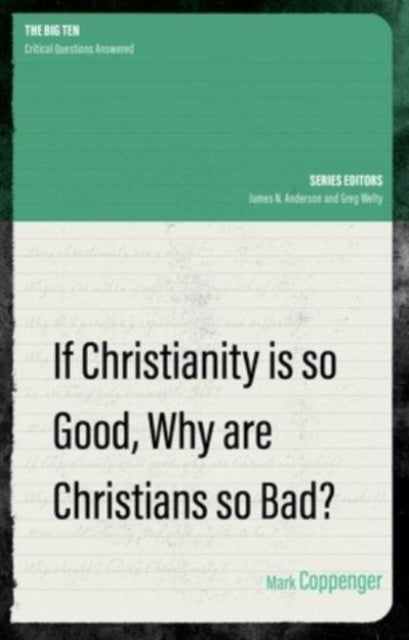
If Christianity is So Good, Why are Christians So Bad?
If Christianity is So Good, Why are Christians So Bad?
💎 Earn 31 Points (£0.31) on this item.
YOU SAVE £2.63
- Condition: Brand new
- UK Delivery times: Usually arrives within 2 - 3 working days
- UK Shipping: Fee starts at £2.39. Subject to product weight & dimension
Bulk ordering. Want 15 or more copies? Get a personalised quote and bigger discounts. Learn more about bulk orders.
Couldn't load pickup availability
- More about If Christianity is So Good, Why are Christians So Bad?
The followers of Jesus Christ should exude the same moral goodness as him, but Christians often fail to live up to the standards set by the Bible. Mark Coppenger's book "The Big Ten: Critical Questions Answered" engages with these questions and provides answers based on the Bible. The book is challenging and thought-provoking, dealing with subjects ranging from hell to science, and is a good read for anyone, regardless of their present opinions.
Format: Paperback / softback
Length: 192 pages
Publication date: 11 March 2022
Publisher: Christian Focus Publications Ltd
It is reasonable to expect that the followers of Jesus Christ would exude the same sort of moral goodness that he did. However, what does it mean to be good? What does it mean for the reality of the Christian faith that Christians fail to live up to the standards set by the Bible? Mark Coppenger engages with these challenging questions in his book, "The Big Ten: Critical Questions Answered."
In the introduction, Coppenger provides a brief overview of the book and addresses a few questions about the question itself. He suggests that we may have asked for it, as the topic of moral goodness and the failure of Christians to live up to biblical standards is a complex and often debated one.
The book is divided into ten chapters, each focusing on a different aspect of moral goodness and the Christian faith. Here are the main points of each chapter:
A Few Questions About the Question:
Coppenger begins by asking a few questions about the nature of moral goodness and the standards set by the Bible. He explores the concept of "moral relativism," which suggests that there is no universal standard of right and wrong, and questions whether this view is compatible with the Christian faith.
I Suppose We Asked For It:
In this chapter, Coppenger discusses the problem of false professors in the Christian church. He argues that many Christians claim to be followers of Jesus Christ but do not live up to the moral standards set by the Bible. He suggests that this problem is not limited to a particular denomination or group of Christians but is widespread throughout the Christian community.
Some You Might Have Missed:
Coppenger highlights some of the most commonly asked questions about God, the Bible, and Christianity. He addresses topics such as the existence of hell, the reliability of the Bible, the problem of evil, and the nature of God.
The Bible Tells Me So:
Coppenger examines the Bible's teachings on moral goodness and the standards set by God. He argues that the Bible is a reliable source of truth and that its teachings are consistent with the moral standards of God. However, he also acknowledges that some Christians may interpret the Bible in ways that are contrary to its teachings.
Are You Sure About That? The Problem of False Professors:
Coppenger explores the problem of false professors in the Christian church. He argues that these individuals may claim to be followers of Jesus Christ but do not live up to the moral standards set by the Bible. He suggests that this problem is not limited to a particular denomination or group of Christians but is widespread throughout the Christian community.
Are You Sure About That? Doubtful Narratives:
Coppenger discusses the issue of doubtful narratives in the Bible. He argues that some of the stories and teachings in the Bible may be unreliable or inaccurate, and that this can lead to confusion and misunderstanding among Christians. He suggests that it is important to approach the Bible with a critical eye and to be open to the possibility that some of its teachings may be false.
Whos Counting? Antibodies: Devotional and Congregational:
In this chapter, Coppenger explores the concept of antibodies in the Christian faith. He argues that Christians should strive to live up to the moral standards set by the Bible and that this can be achieved through devotional practices and congregational involvement. He also discusses the importance of environmental protection and the role that Christians can play in promoting sustainability.
The Rest of the Story:
Coppenger concludes the book by discussing the rest of the story. He argues that the Christian faith is not about perfection but about striving to live a life that is pleasing to God. He suggests that Christians should continue to study the Bible and seek to understand its teachings in a deeper way, and that they should also be open to the guidance and inspiration of the Holy Spirit.
Each chapter includes a summary of the main points, making it easy to follow the book's arguments and conclusions.
The Big Ten: Critical Questions Answered is a Christian apologetics series that addresses ten commonly asked questions about God, the Bible, and Christianity. Each book in the series is challenging and thought-provoking, dealing with subjects ranging from hell to science. While easy to read, the books are designed to engage readers and encourage them to think critically about their beliefs and values.
Whether you are a Christian or someone who is interested in learning more about the Christian faith, "The Big Ten: Critical Questions Answered" is a good read. The book provides a comprehensive and thoughtful exploration of the topics covered, and it is sure to challenge and inspire you.
Weight: 214g
Dimension: 197 x 130 x 18 (mm)
ISBN-13: 9781527107748
UK and International shipping information
UK and International shipping information
UK Delivery and returns information:
- Delivery within 2 - 3 days when ordering in the UK.
- Shipping fee for UK customers from £2.39. Fully tracked shipping service available.
- Returns policy: Return within 30 days of receipt for full refund.
International deliveries:
Shulph Ink now ships to Australia, Belgium, Canada, France, Germany, Ireland, Italy, India, Luxembourg Saudi Arabia, Singapore, Spain, Netherlands, New Zealand, United Arab Emirates, United States of America.
- Delivery times: within 5 - 10 days for international orders.
- Shipping fee: charges vary for overseas orders. Only tracked services are available for most international orders. Some countries have untracked shipping options.
- Customs charges: If ordering to addresses outside the United Kingdom, you may or may not incur additional customs and duties fees during local delivery.