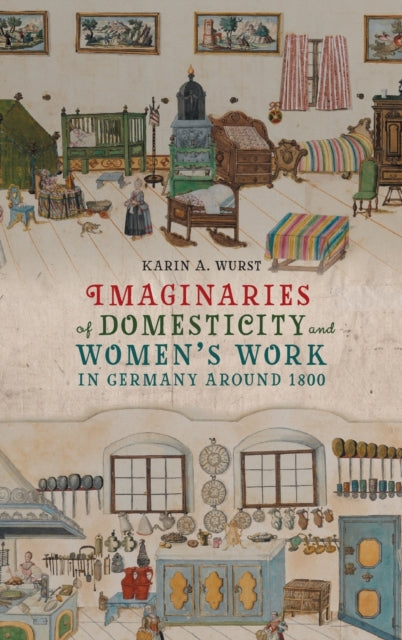
Professor Karin A.Wurst
Imaginaries of Domesticity and Women's Work in Germany around 1800
Imaginaries of Domesticity and Women's Work in Germany around 1800
💎 Earn 351 Points (£3.51) on this item.
YOU SAVE £14.79
- Condition: Brand new
- UK Delivery times: Usually arrives within 2 - 3 working days
- UK Shipping: Fee starts at £2.39. Subject to product weight & dimension
Bulk ordering. Want 15 or more copies? Get a personalised quote and bigger discounts. Learn more about bulk orders.
Couldn't load pickup availability
- More about Imaginaries of Domesticity and Women's Work in Germany around 1800
Domesticity, a set of practices, emotions, and values that connect one's subjective experience to the material environment, was a high-stakes cultural formation in late Enlightenment Germany. Karin A. Wurst examines texts from female authors, autobiographical texts, popular philosophy, advice literature, periodicals, pedagogical tracts, and household manuals to rethinking the relationship between women's roles as wives, mothers, and housekeepers and as creators of the cultural spaces of the home. She finds that the high-value imaginary of domesticity encouraged women's agency, but also showed the under-illuminated contribution of women's work to social and political change.
Format: Hardback
Length: 248 pages
Publication date: 04 April 2023
Publisher: Boydell & Brewer Ltd
In late Enlightenment Germany, a profound shift occurred in the perception of women's roles as wives, mothers, and housekeepers. Writers from Joachim Heinrich Campe to Theodor von Hippel, and Sophie La Roche, among others, envisioned the home as a transformative space where genuine human essence could be realized. This high-stakes cultural formation of domesticity became intertwined with a broader discourse on the pursuit of happiness as a fulfilling life. As domesticity emerged as a surrogate for the lost religious certainties of the vanishing pre-modern world, an obsessive anxiety surrounding its definition in discourse revealed both its significance and its fragility. It also shed light on the consequences of its failure.
To explore this intricate relationship further, Karin A. Wurst delves into a diverse range of texts, including didactic novels by female authors, autobiographical writings, popular philosophy, advice literature, periodicals, pedagogical tracts, and household manuals. Through her meticulous examination, Wurst seeks to provide a nuanced rethinking of the multifaceted roles of women as wives, mothers, and housekeepers, as well as their role in shaping the cultural spaces of the home. What emerges is a compelling narrative that challenges traditional notions of gender roles and sheds light on the overlooked contributions of women to social and political change within the patriarchal structures of eighteenth-century Germany.
One of the key findings of Wurst's study is that the high-value imaginary of domesticity encouraged women's agency. Women were tasked with translating theoretical ideals into practical realities, which enabled them to exercise greater control over their lives and contribute to the well-being of their families and communities. However, Wurst also highlights the under-illuminated contribution of women's work to social and political change from within the patriarchal structures of eighteenth-century Germany. While women's roles were often confined to the domestic sphere, their tireless efforts in nurturing and sustaining the home played a vital role in shaping the social fabric of the time.
Domesticity, as Wurst argues, is not merely a set of practices or emotions but a complex interplay of practices, emotions, and values that culminate in a nourishing emotional and physical ambience. It is the feeling of being at home and belonging, a connection that transcends the material realm and taps into the deepest aspects of our subjective experience. By examining the various texts from late Enlightenment Germany, Wurst offers a fresh perspective on women's roles and their significance in shaping the cultural spaces of the home. Her book serves as a valuable contribution to our understanding of gender roles, social change, and the complex interplay between the personal and the political in eighteenth-century Germany.
Dimension: 229 x 152 (mm)
ISBN-13: 9781640141285
UK and International shipping information
UK and International shipping information
UK Delivery and returns information:
- Delivery within 2 - 3 days when ordering in the UK.
- Shipping fee for UK customers from £2.39. Fully tracked shipping service available.
- Returns policy: Return within 30 days of receipt for full refund.
International deliveries:
Shulph Ink now ships to Australia, Belgium, Canada, France, Germany, Ireland, Italy, India, Luxembourg Saudi Arabia, Singapore, Spain, Netherlands, New Zealand, United Arab Emirates, United States of America.
- Delivery times: within 5 - 10 days for international orders.
- Shipping fee: charges vary for overseas orders. Only tracked services are available for most international orders. Some countries have untracked shipping options.
- Customs charges: If ordering to addresses outside the United Kingdom, you may or may not incur additional customs and duties fees during local delivery.