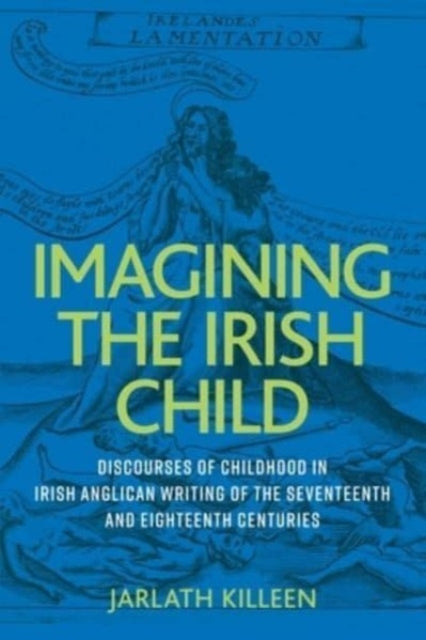
Jarlath Killeen
Imagining the Irish Child: Discourses of Childhood in Irish Anglican Writing of the Seventeenth and Eighteenth Centuries
Imagining the Irish Child: Discourses of Childhood in Irish Anglican Writing of the Seventeenth and Eighteenth Centuries
💎 Earn 376 Points (£3.76) on this item.
We can order this item for you. Delivery usually takes about 4 to 6 weeks.
This item is not held in our immediate stock. We will order it for you after checkout.
Estimated delivery: About 4 to 6 weeks
YOU SAVE £9.77
- Condition: Brand new
- UK Delivery times: Usually arrives within 2 - 3 working days
- UK Shipping: Fee starts at £2.39. Subject to product weight & dimension
Bulk ordering. Want 15 or more copies? Get a personalised quote and bigger discounts. Learn more about bulk orders.
Couldn't load pickup availability
- More about Imagining the Irish Child: Discourses of Childhood in Irish Anglican Writing of the Seventeenth and Eighteenth Centuries
This book explores how Irish Protestant writers of the 17th and 18th centuries changed their views on children, childhood, and Ireland. It examines six "versions of the child" across various genres and shows how these views related to debates about Irish nationality, politics, and history.
Format: Hardback
Length: 296 pages
Publication date: 07 February 2023
Publisher: Manchester University Press
This captivating book delves into the intricate interplay of ideas surrounding children, childhood, and Ireland during the seventeenth and eighteenth centuries in Irish Protestant writing. It explores the diverse manifestations of the child found in the works of a diverse array of Irish Protestant writers, theologians, philosophers, educationalists, politicians, and parents, spanning from the early seventeenth century to the outbreak of the 1798 Rebellion. The book is organized around a comprehensive analysis of six distinct "versions of the child," including the evil child, the vulnerable/innocent child, the political child, the believing child, the enlightened child, and the freakish child. It traces these versions across a wide spectrum of genres, such as fiction, sermons, political pamphlets, letters, educational treatises, histories, catechisms, and children's bibles, revealing how concepts of childhood intertwined with debates about Irish nationality, politics, and history throughout these two centuries.
The book's central theme revolves around the evolution of ideas about children and their place in society within the Irish Protestant community. It sheds light on the shifting perspectives and attitudes towards children, from their perceived vulnerability and innocence to their role as active participants in political and historical processes. The authors examine how these changing notions of childhood influenced the writing of literature, sermons, and political pamphlets, as well as the development of educational institutions and parenting practices.
One of the key aspects of the book is its exploration of the various "versions of the child" that emerged during this period. The evil child, for instance, was often depicted as a symbol of sin and rebellion, representing the challenges faced by the Irish Protestant community in maintaining their religious and cultural identity amidst the oppressive forces of the British Empire. On the other hand, the vulnerable/innocent child was seen as a source of hope and purity, representing the potential for transformation and redemption in the face of adversity. The political child, meanwhile, was portrayed as a tool of the state and society, with the responsibility of shaping the future of Ireland and the Protestant community.
The book also delves into the complex relationship between childhood and religion. It explores how religious beliefs and practices shaped the way children were perceived and treated, both within the family and in broader society. The authors examine how religious texts, such as the Bible, were used to teach children about morality, ethics, and the importance of obedience and submission. They also explore how religious institutions, such as schools and churches, played a crucial role in shaping the social and intellectual development of children.
In addition to its examination of the child's role in Irish Protestant society, the book also explores the broader cultural and historical context in which these ideas developed. It examines how the political, social, and economic developments of the seventeenth and eighteenth centuries influenced the way children were perceived and treated. The authors highlight the role of the Protestant Ascendancy, the Glorious Revolution, and the Irish Rebellion in shaping the attitudes and beliefs of Irish Protestants towards children and childhood.
Overall, this book provides a rich and nuanced exploration of the complex relationship between children, childhood, and Ireland during the seventeenth and eighteenth centuries. It offers valuable insights into the social, cultural, and religious dynamics that shaped the lives of children and their families in this period. The book's interdisciplinary approach, drawing on literature, theology, philosophy, and history, makes it accessible to a wide range of readers interested in the history of childhood and the development of Irish Protestantism.
Dimension: 234 x 156 (mm)
ISBN-13: 9781526161970
UK and International shipping information
UK and International shipping information
UK Delivery and returns information:
- Delivery within 2 - 3 days when ordering in the UK.
- Shipping fee for UK customers from £2.39. Fully tracked shipping service available.
- Returns policy: Return within 30 days of receipt for full refund.
International deliveries:
Shulph Ink now ships to Australia, Belgium, Canada, France, Germany, Ireland, Italy, India, Luxembourg Saudi Arabia, Singapore, Spain, Netherlands, New Zealand, United Arab Emirates, United States of America.
- Delivery times: within 5 - 10 days for international orders.
- Shipping fee: charges vary for overseas orders. Only tracked services are available for most international orders. Some countries have untracked shipping options.
- Customs charges: If ordering to addresses outside the United Kingdom, you may or may not incur additional customs and duties fees during local delivery.