Dr. Peter Lorge
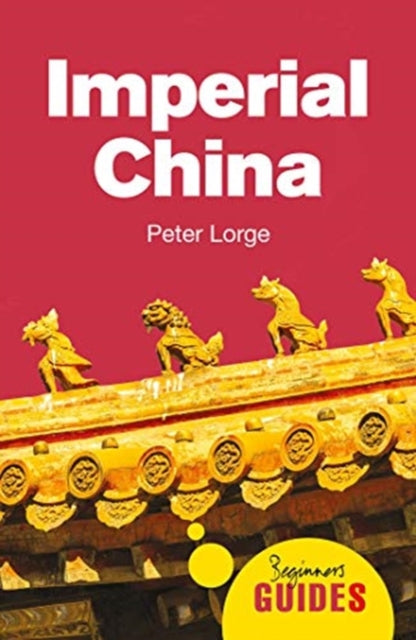
Imperial China: A Beginner's Guide
Imperial China: A Beginner's Guide
YOU SAVE £3.16
- Condition: Brand new
- UK Delivery times: Usually arrives within 2 - 3 working days
- UK Shipping: Fee starts at £3.89. Subject to product weight & dimension
Bulk ordering. Want 15 or more copies? Get a personalised quote and bigger discounts. Learn more about bulk orders.
Couldn't load pickup availability
- More about Imperial China: A Beginner's Guide
The Qin state conquered its neighbors in 221 BCE, creating the first unified Chinese empire and beginning the imperial era. Dynasties claimed divine assent and ruled for over 2,000 years, with borders shifting and emperors struggling to exert control. Elites held that they were inheritors of a rich, pre-imperial culture, and their society produced world-changing inventions such as the compass, printing, gunpowder, and the gun. Imperial China was altered as it came into contact with others through trade, exploration, and war.
Format: Paperback / softback
Length: 208 pages
Publication date: 01 July 2021
Publisher: Oneworld Publications
The Qin state, in 221 BCE, embarked on a remarkable journey that would ultimately lead to the creation of the first unified Chinese empire in history. This pivotal moment marked the beginning of the imperial era, a period that lasted for over 2,000 years and was characterized by dynasties claiming divine authority. Borders shifted, and emperors faced the daunting challenge of exerting control over vast and diverse territories. However, amidst the chaos, a sense of cultural richness and innovation flourished. Elites believed that they were heirs to a pre-imperial culture that had produced world-changing inventions such as the compass, printing, gunpowder, and the gun.
Imperial China itself underwent significant changes as it interacted with other cultures through trade, exploration, and war. The empire was a melting pot of diverse traditions, languages, and religions, creating a rich tapestry of cultural heritage. Major ruling dynasties, such as the Han, Tang, and Ming, each left their mark on the empire, contributing to its political, economic, and artistic development.
Religion played a central role in imperial China, with various belief systems coexisting and influencing each other. Buddhism, Confucianism, Taoism, and Christianity all found a place in the empire's spiritual landscape. Temples, monasteries, and shrines dotted the countryside, serving as centers of worship and places of learning.
The arts flourished under imperial rule, with literature, painting, sculpture, and music reaching new heights of creativity and sophistication. Poets, painters, and calligraphers showcased their talents, producing works that celebrated the beauty of nature, the achievements of the empire, and the lives of its people.
Imperial China was also a hub of intellectual and scientific innovation. Philosophers, scholars, and inventors worked tirelessly to advance knowledge and technology, leading to breakthroughs in fields such as mathematics, astronomy, medicine, and engineering. The invention of paper money, the compass, and the printing press were among the most significant contributions made during this period.
The military advancements of imperial China were equally impressive. The empire employed a well-trained and disciplined army that was equipped with advanced weapons and tactics. The construction of the Great Wall, a massive network of fortifications, was a testament to the empire's defensive capabilities.
Economic development was another key aspect of imperial China. The empire's vast territories provided a rich source of resources, including minerals, textiles, and agricultural products. Trade routes were established, and cities such as Canton and Shanghai became centers of commerce and trade.
Historians have played a crucial role in studying and understanding the imperial era. Peter Lorge, in his book "Imperial China," provides a comprehensive overview of the major ruling dynasties, religions, arts, thinkers, inventions, military advancements, economic developments, and historians of this fascinating period. The book offers a wealth of information and insights into the rich tapestry of imperial China, making it an essential resource for anyone interested in exploring this captivating chapter of history.
In conclusion, the imperial era in China was a period of immense cultural, political, and economic transformation. Dynasties claiming divine authority. authority, borders shifted, and emperors struggled to exert control over vast territories. However, amidst the chaos, a sense of cultural richness and innovation flourished. Elites believed that they were heirs to a pre-imperial culture that had produced world-changing inventions, and imperial China itself underwent significant changes as it interacted with other cultures through trade, exploration, and war. Religion played a central role, with various belief systems coexisting and influencing each other. The arts flourished, and intellectual and scientific innovation led to breakthroughs in various fields. The military advancements were impressive, and economic development was key to the empire's success. Historians have played a crucial role in studying and understanding this fascinating period, and Peter Lorge's book "Imperial China" provides a comprehensive overview of the major ruling dynasties, religions, arts, thinkers, inventions, military advancements, economic developments, and historians of this era.
Weight: 158g
Dimension: 180 x 312 x 16 (mm)
ISBN-13: 9781786075789
UK and International shipping information
UK and International shipping information
We deliver throughout the United Kingdom and to 128 countries and territories worldwide, including the United States, Australia, Canada, Germany, Spain and France.