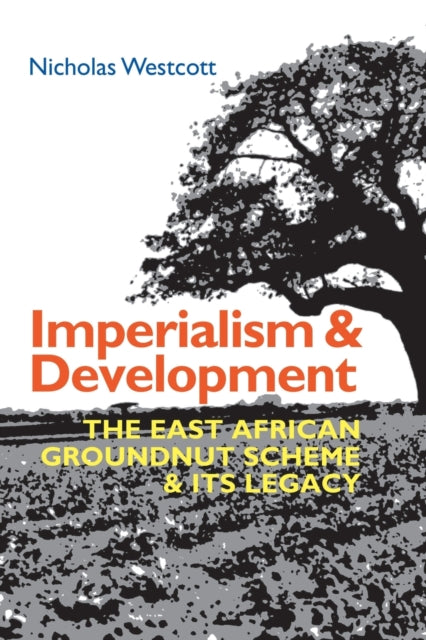
Nicholas Westcott
Imperialism and Development: The East African Groundnut Scheme and its Legacy
Imperialism and Development: The East African Groundnut Scheme and its Legacy
💎 Earn 152 Points (£1.52) on this item.
- Condition: Brand new
- UK Delivery times: Usually arrives within 2 - 3 working days
- UK Shipping: Fee starts at £2.39. Subject to product weight & dimension
Bulk ordering. Want 15 or more copies? Get a personalised quote and bigger discounts. Learn more about bulk orders.
Couldn't load pickup availability
- More about Imperialism and Development: The East African Groundnut Scheme and its Legacy
The Groundnut Scheme was a disastrous intervention by Britain's Labour Government in Tanganyika, aimed at converting 3 million acres of bush into the largest mechanized groundnut farm in the world. It was the largest, most expensive, and most disastrous development scheme ever undertaken by the British Government, with costs rising to 36 million and almost no groundnuts exported. It was the prototype of many large-scale, government-run, high-cost development projects that failed to deliver, and its legacy in development practice still with us today.
Format: Paperback / softback
Length: 260 pages
Publication date: 18 October 2022
Publisher: James Currey
After the Second World War, as colonial development gained momentum, Britain's Labour Government launched the Groundnut Scheme, an ambitious project aimed at transforming 3 million acres of bush in Tanganyika into the world's largest mechanized groundnut farm. However, this initiative would ultimately become one of the most ill-advised and calamitous interventions in colonial development history.
The author delves into the political dynamics that propelled the Groundnut Scheme forward, despite the grave doubts of agriculturalists and economists. They explore why it went so wrong, and the lasting impact it has had on the practice of economic development. Initially, the government employed the United Africa Company as the agent, setting up the Overseas Food Corporation to oversee the scheme as an example of socialist development in Africa. Troops, including surplus equipment and demobilized soldiers, were dispatched to Kongwa to clear the bush.
By the time the project was abandoned in 1950, costs had soared to a staggering 36 million pounds, equivalent to over 1 billion pounds today. Despite this enormous investment, almost no groundnuts had been exported. The Groundnut Scheme stands as a prototype of many large-scale, government-run, high-cost development projects that failed to deliver. It is considered the first significant failure of agricultural development in Africa, and its legacy continues to shape development practices to this day.
The scheme's failure was attributed to various factors, including poor management, inadequate infrastructure, and unforeseen environmental challenges. The government's decision to prioritize groundnuts over other crops, such as coffee and tea, also contributed to its downfall. Furthermore, the scheme's reliance on imported machinery and technology proved to be a significant obstacle, as it was expensive and difficult to maintain.
The Groundnut Scheme's legacy is a cautionary tale for policymakers and development practitioners. It highlights the importance of conducting thorough feasibility studies, considering local contexts, and engaging with stakeholders before embarking on large-scale projects. It also underscores the need for sustainable and equitable development practices that prioritize the well-being of communities and the environment.
In conclusion, the Groundnut Scheme serves as a poignant reminder of the risks and challenges associated with large-scale development projects. Its failure highlights the need for careful planning, effective management, and a nuanced understanding of the local context to ensure the success of development initiatives. As we navigate the complexities of global development, it is essential to learn from the past and strive for more sustainable and equitable outcomes.
Dimension: 234 x 156 (mm)
ISBN-13: 9781847013453
This item can be found in:
UK and International shipping information
UK and International shipping information
UK Delivery and returns information:
- Delivery within 2 - 3 days when ordering in the UK.
- Shipping fee for UK customers from £2.39. Fully tracked shipping service available.
- Returns policy: Return within 30 days of receipt for full refund.
International deliveries:
Shulph Ink now ships to Australia, Belgium, Canada, France, Germany, Ireland, Italy, India, Luxembourg Saudi Arabia, Singapore, Spain, Netherlands, New Zealand, United Arab Emirates, United States of America.
- Delivery times: within 5 - 10 days for international orders.
- Shipping fee: charges vary for overseas orders. Only tracked services are available for most international orders. Some countries have untracked shipping options.
- Customs charges: If ordering to addresses outside the United Kingdom, you may or may not incur additional customs and duties fees during local delivery.