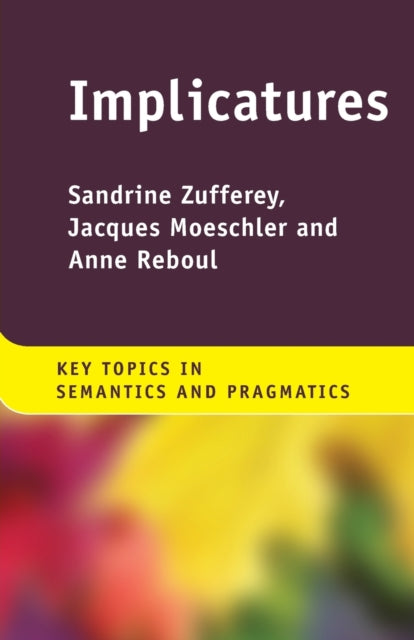
SandrineZufferey,JacquesMoeschler,Anne Reboul
Implicatures
Implicatures
💎 Earn 160 Points (£1.60) on this item.
We can order this item for you. Delivery usually takes about 4 to 6 weeks.
This item is not held in our immediate stock. We will order it for you after checkout.
Estimated delivery: About 4 to 6 weeks
YOU SAVE £1.90
- Condition: Brand new
- UK Delivery times: Usually arrives within 2 - 3 working days
- UK Shipping: Fee starts at £2.39. Subject to product weight & dimension
Bulk ordering. Want 15 or more copies? Get a personalised quote and bigger discounts. Learn more about bulk orders.
Couldn't load pickup availability
- More about Implicatures
Implicatures is an accessible and thorough introduction to implicatures,a key topic in pragmatics. It covers many important questions for current pragmatic theories,such as the distinction between explicit and implicit forms of pragmatic enrichment,the criteria for drawing a line between semantic and pragmatic meaning,the relations between the structure of language and its use,the social and cognitive factors underlying the use of implicatures by native speakers,and the factors influencing their acquisition for children and second language learners.
Format: Paperback / softback
Length: 263 pages
Publication date: 07 October 2021
Publisher: Cambridge University Press
An in-depth exploration of implicatures, a fundamental concept in all pragmatic frameworks, is presented in this comprehensive and accessible guide. The book begins by defining the various types of implicatures found in Gricean, neo-Gricean, and post-Gricean pragmatics, covering a wide range of important topics for contemporary pragmatic theories. These include the distinction between explicit and implicit forms of pragmatic enrichment, the criteria for determining the boundary between semantic and pragmatic meaning, the relationship between language structure (syntax) and its usage (pragmatics), the social and cognitive factors that influence native speakers' use of implicatures, and the factors that impact their acquisition for children and second language learners. Written in a non-technical language, Implicatures is designed to appeal to students and teachers in linguistics, applied linguistics, psychology, and sociology who are interested in understanding how language is employed for communication and how children and learners develop pragmatic skills.
Introduction:
Implicatures are a central aspect of pragmatics, a branch of linguistics that studies how language is used to convey meaning. They are often referred to as "unstated" or "invisible" meanings, as they are not explicitly stated in the utterance but are inferred by the listener or reader based on the context and the speaker's intentions. Implicatures play a crucial role in communication, as they allow speakers to convey more information than what is explicitly stated in their utterances.
Types of Implicatures:
Implicatures can be divided into several types, including conversational implicatures, presuppositions, and deontic implicatures. Conversational implicatures arise from the social context in which the utterance is made and are based on the assumptions and expectations of the participants. Presuppositions are beliefs that are assumed to be true by the participants in the conversation and are not explicitly stated. Deontic implicatures are moral or legal obligations that are inferred from the utterance.
Criteria for Drawing the Line Between Semantic and Pragmatic Meaning:
One of the key challenges in pragmatics is determining the boundary between semantic and pragmatic meaning. Semantic meaning refers to the literal or dictionary meaning of an utterance, while pragmatic meaning refers to the intended or inferred meaning. Drawing the line between these two types of meaning is important for understanding how language is used in different contexts.
Relationships Between Language Structure and Pragmatic Usage:
The relationship between language structure and pragmatic usage is complex and multifaceted. Syntax plays a crucial role in shaping the pragmatic meaning of an utterance, as it determines the grammatical structure and the available options for interpretation. For example, the use of certain verb tenses can indicate the speaker's intention to convey a certain time or event, which can in turn influence the interpretation of the utterance by the listener.
Social and Cognitive Factors Underlying the Use of Implicatures:
The use of implicatures is influenced by a range of social and cognitive factors. These factors include the social context in which the utterance is made, the participants' beliefs and assumptions, and the speaker's intentions. For example, speakers may use implicatures to avoid confrontation or to convey politeness or respect.
Factors Influencing the Acquisition of Implicatures by Children and Second Language Learners:
Acquiring implicatures is a complex process that involves both cognitive and social factors. Children learn implicatures through social interaction and observation, while second language learners may face additional challenges due to their limited language proficiency. Factors such as exposure to native speakers, practice, and feedback can play a significant role in the acquisition of implicatures.
Conclusion:
In conclusion, implicatures are a fundamental aspect of pragmatics that play a crucial role in communication. This comprehensive guide provides an in-depth exploration of the different types of implicatures, the criteria for drawing the line between semantic and pragmatic meaning, the relationships between language structure and pragmatic usage, the social and cognitive factors underlying the use of implicatures, and the factors that influence their acquisition by children and second language learners. By understanding implicatures, we can better appreciate the complexity and richness of language usage and how it contributes to our understanding of the world around us.
Weight: 332g
Dimension: 138 x 216 x 19 (mm)
ISBN-13: 9781107565234
This item can be found in:
UK and International shipping information
UK and International shipping information
UK Delivery and returns information:
- Delivery within 2 - 3 days when ordering in the UK.
- Shipping fee for UK customers from £2.39. Fully tracked shipping service available.
- Returns policy: Return within 30 days of receipt for full refund.
International deliveries:
Shulph Ink now ships to Australia, Belgium, Canada, France, Germany, Ireland, Italy, India, Luxembourg Saudi Arabia, Singapore, Spain, Netherlands, New Zealand, United Arab Emirates, United States of America.
- Delivery times: within 5 - 10 days for international orders.
- Shipping fee: charges vary for overseas orders. Only tracked services are available for most international orders. Some countries have untracked shipping options.
- Customs charges: If ordering to addresses outside the United Kingdom, you may or may not incur additional customs and duties fees during local delivery.