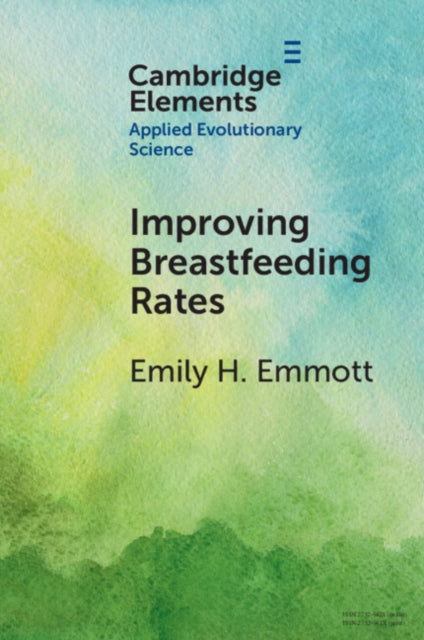
Emily H.Emmott
Improving Breastfeeding Rates: Evolutionary Anthropological Insights for Public Health
Improving Breastfeeding Rates: Evolutionary Anthropological Insights for Public Health
💎 Earn 84 Points (£0.84) on this item.
We can order this item for you. Delivery usually takes about 4 to 6 weeks.
This item is not held in our immediate stock. We will order it for you after checkout.
Estimated delivery: About 4 to 6 weeks
YOU SAVE £1.01
- Condition: Brand new
- UK Delivery times: Usually arrives within 2 - 3 working days
- UK Shipping: Fee starts at £2.39. Subject to product weight & dimension
Bulk ordering. Want 15 or more copies? Get a personalised quote and bigger discounts. Learn more about bulk orders.
Couldn't load pickup availability
- More about Improving Breastfeeding Rates: Evolutionary Anthropological Insights for Public Health
Breastfeeding is an effective way to improve global health, but progress has stagnated, and exclusive breastfeeding rates remain low. An evolutionary anthropological perspective suggests that low breastfeeding rates may be an evolutionary puzzle, as breastfeeding confers survival and fitness advantages to children and mothers.
Format: Paperback / softback
Length: 75 pages
Publication date: 23 February 2023
Publisher: Cambridge University Press
Breastfeeding is widely recognized as a powerful tool for improving global health, leading to better outcomes for both children and mothers. Over the past four decades, numerous public health strategies have been devised and implemented to promote breastfeeding, yet progress has remained stagnant, and exclusive breastfeeding rates remain low worldwide. From an evolutionary anthropological perspective, the low prevalence of breastfeeding raises intriguing questions. Breastfeeding is a behavior that provides significant survival and fitness advantages to children and mothers, yet many mothers choose not to breastfeed exclusively or at all. Is this a globally maladaptive behavior?
By framing breastfeeding as a maternal investment behavior, an evolutionary perspective encourages us to examine the fitness costs associated with breastfeeding, as well as the influence of social learning and cultural norms. Indeed, an evolutionary anthropological lens offers valuable insights into why certain breastfeeding promotion strategies may have been ineffective, while highlighting potentially promising policies and practices that have been overlooked.
One key aspect to consider is the biological mechanisms that drive breastfeeding. Evolutionary theory suggests that breastfeeding is a natural response to the needs of infants, who require a specialized diet and immune protection provided by breast milk. Mothers who breastfeed are more likely to survive and reproduce, passing on their genetic traits to future generations. However, the costs of breastfeeding can be significant, particularly in terms of time and energy expenditure.
From an evolutionary perspective, it is important to understand why some mothers may choose not to breastfeed exclusively or at all. One factor that may play a role is the availability of alternative sources of nutrition, such as formula milk or other foods that can provide adequate nutrition to infants. In some cultures, for example, formula milk is widely accepted and considered a reliable source of nutrition, leading mothers to prioritize its convenience over breastfeeding.
Another factor that may influence breastfeeding rates is social learning. Children who observe their mothers breastfeeding are more likely to breastfeed themselves in the future. However, if mothers in a particular culture do not breastfeed or do not breastfeed exclusively, this can create a negative social norm that discourages breastfeeding. Additionally, cultural norms and beliefs about the role of women in society can also play a role in breastfeeding rates. In some cultures, for example, women may be expected to prioritize their careers over their responsibilities as mothers, leading them to choose not to breastfeed or to breastfeed for a shorter duration.
To address the challenges of low breastfeeding rates, it is important to develop and implement policies and practices that promote breastfeeding. One approach that has shown promise is the provision of education and support to mothers, particularly during the postpartum period. This can include counseling, peer support groups, and access to lactation consultants who can provide guidance and assistance to mothers who are experiencing difficulties with breastfeeding.
In addition, policies that promote workplace support for breastfeeding, such as paid parental leave and flexible work schedules, can also contribute to increased breastfeeding rates. Employers who prioritize the health and well-being of their employees are more likely to have higher breastfeeding rates, as mothers are more likely to breastfeed if they feel supported and valued in their work environment.
Another promising approach is the promotion of breastfeeding through public health campaigns and social marketing. These campaigns can focus on raising awareness about the benefits of breastfeeding, as well as dispelling myths and misconceptions that may discourage breastfeeding. By creating a positive social norm around breastfeeding, these campaigns can help to increase the prevalence of exclusive breastfeeding and breastfeeding at a young age.
In conclusion, breastfeeding is a behavior that confers significant survival and fitness advantages to children and mothers. However, low breastfeeding rates remain a global challenge that requires innovative and effective solutions. By adopting an evolutionary anthropological perspective, we can gain insights into why some breastfeeding-promotion strategies may have been ineffective, while highlighting potentially promising policies and practices that have been overlooked. By promoting breastfeeding as a maternal investment behavior, providing education and support to mothers, and creating policies that support workplace support, we can work towards improving global health and well-being for both children and mothers.
Weight: 105g
ISBN-13: 9781009217484
This item can be found in:
UK and International shipping information
UK and International shipping information
UK Delivery and returns information:
- Delivery within 2 - 3 days when ordering in the UK.
- Shipping fee for UK customers from £2.39. Fully tracked shipping service available.
- Returns policy: Return within 30 days of receipt for full refund.
International deliveries:
Shulph Ink now ships to Australia, Belgium, Canada, France, Germany, Ireland, Italy, India, Luxembourg Saudi Arabia, Singapore, Spain, Netherlands, New Zealand, United Arab Emirates, United States of America.
- Delivery times: within 5 - 10 days for international orders.
- Shipping fee: charges vary for overseas orders. Only tracked services are available for most international orders. Some countries have untracked shipping options.
- Customs charges: If ordering to addresses outside the United Kingdom, you may or may not incur additional customs and duties fees during local delivery.