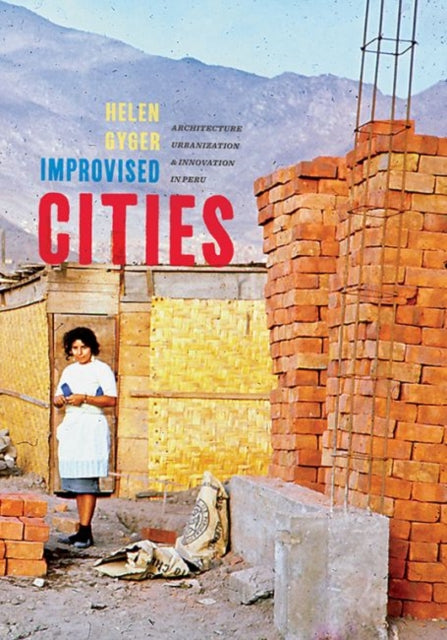
Helen Gyger
Improvised Cities: Architecture, Urbanization, and Innovation in Peru
Improvised Cities: Architecture, Urbanization, and Innovation in Peru
💎 Earn 296 Points (£2.96) on this item.
- Condition: Brand new
- UK Delivery times: Usually arrives within 2 - 3 working days
- UK Shipping: Fee starts at £3.89. Subject to product weight & dimension
Bulk ordering. Want 15 or more copies? Get a personalised quote and bigger discounts. Learn more about bulk orders.
Couldn't load pickup availability
- More about Improvised Cities: Architecture, Urbanization, and Innovation in Peru
Improvised Cities explores the history of aided self-help housing in Peru, from 1954 to 1986, under different political regimes. It examines the circumstances that made Peru a fertile site for innovation, the influences on architectural culture, and the context in which international development agencies embraced these projects.
Format: Hardback
Length: 432 pages
Publication date: 02 April 2019
Publisher: University of Pittsburgh Press
In the 1950s, a surge in rural-urban migration surged the population of cities across Peru, resulting in a severe housing shortage and the emergence of self-built shelters clustered in barriadas, or squatter settlements. This phenomenon gave rise to improvised cities, a term used to describe the unauthorized urbanization that emerged in response to the lack of affordable housing options.
Improved Cities delves into the history of aided self-help housing, or technical assistance to self-builders, which took various forms in Peru from 1954 to 1986. While the postwar period witnessed trial projects in aided self-help housing across the developing world, Peru stood out as a pioneer in this field, undertaking significant experiments and implementing a comprehensive policy of land tenure regularization in improvised, unauthorized cities.
The book focuses on three interconnected themes: the factors that made Peru an ideal breeding ground for innovation in low-cost housing under a succession of different political regimes; the influences on and movements within architectural culture that prompted architects to consider self-help housing as an alternative mode of practice; and the context in which international development agencies embraced these projects as part of their broader goals during the Cold War and beyond.
The first theme explores the political and social context that facilitated the emergence of improvised cities. Peru's history of political instability, coupled with rapid urbanization and the absence of adequate housing infrastructure, created a fertile ground for self-help housing initiatives. Different political regimes, including military governments, authoritarian regimes, and democratic governments, adopted varying approaches to address the housing crisis, leading to the emergence of diverse self-help housing projects.
The second theme examines the influences on architectural culture that prompted architects to consider self-help housing as an alternative mode of practice. The book explores the role of architectural journals, professional associations, and educational institutions in promoting self-help housing as a viable solution to the housing crisis. Architects in Peru were influenced by international trends in modern architecture, as well as local traditions and cultural values. They saw self-help housing as a way to provide affordable housing to the masses and to address the social and economic inequalities that existed in urban areas.
The third theme explores the context in which international development agencies embraced these projects as part of their larger goals during the Cold War and beyond. The book discusses the role of international organizations such as the United Nations, the World Bank, and the International Monetary Fund in providing financial and technical support to self-help housing initiatives in Peru. These organizations saw self-help housing as a means to promote economic development, reduce poverty, and promote social stability in developing countries.
Improved Cities provides a comprehensive and insightful analysis of the history of aided self-help housing in Peru. It sheds light on the challenges faced by urban residents, the efforts of architects and policymakers to address the housing crisis, and the broader political and social implications of improvised cities. The book is valuable for scholars, researchers, and policymakers interested in urban development, housing, and social inequality.
Weight: 1330g
Dimension: 189 x 262 x 29 (mm)
ISBN-13: 9780822945369
UK and International shipping information
UK and International shipping information
We deliver throughout the United Kingdom and to 128 countries and territories worldwide, including the United States, Australia, Canada, Germany, Spain and France.