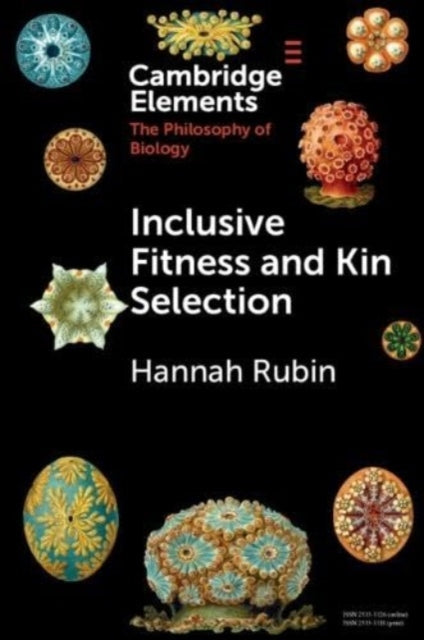
HannahRubin
Inclusive Fitness and Kin Selection
Inclusive Fitness and Kin Selection
💎 Earn 84 Points (£0.84) on this item.
We can order this item for you. Delivery usually takes about 4 to 6 weeks.
This item is not held in our immediate stock. We will order it for you after checkout.
Estimated delivery: About 4 to 6 weeks
YOU SAVE £1.01
- Condition: Brand new
- UK Delivery times: Usually arrives within 2 - 3 working days
- UK Shipping: Fee starts at £2.39. Subject to product weight & dimension
Bulk ordering. Want 15 or more copies? Get a personalised quote and bigger discounts. Learn more about bulk orders.
Couldn't load pickup availability
- More about Inclusive Fitness and Kin Selection
The biological world contains phenomena that seem to go against Darwin's theory of natural selection, such as why organisms in some species divide reproductive labor and why insects are distasteful to their predators. This Element will cover the shared foundations of evolutionary explanations for these and other seemingly puzzling phenomena, focusing on inclusive fitness and kin selection.
Format: Paperback / softback
Length: 86 pages
Publication date: 25 April 2024
Publisher: Cambridge University Press
The biological world presents a fascinating array of phenomena that challenge Darwin's notion that natural selection can result in the emergence of design. For instance, why do organisms in certain species divide reproductive labor? The presence of non-reproducing individuals in such eusocial species seems to contradict an evolutionary theory that attributes traits to their ability to enhance organisms' survival and reproduction. What is the evolutionary advantage of an insect being distasteful to its predators? While the distastefulness is intended to deter predators, its impact only occurs when the insect is consumed, making it challenging to comprehend how such a trait could be inherited. This Element will delve into the common underpinnings of evolutionary explanations for these and other seemingly perplexing phenomena, with a particular focus on the concepts of inclusive fitness and kin selection.
The biological world is full of phenomena that seem to run counter to Darwin's insight that natural selection can lead to the appearance of design. For instance, why do organisms in some species divide reproductive labor? The existence of non-reproducing organisms in such eusocial species looks to be at odds with an evolutionary theory which posits traits exist because they help organisms survive and reproduce. What is the evolutionary advantage of an insect being distasteful to its predators? The distastefulness appears designed to deter predators,but can only affect the predator's actions when the insect is eaten; it is hard to see how such a trait could be passed on.
The biological world presents a fascinating array of phenomena that challenge Darwin's notion that natural selection can result in the emergence of design. For instance, why do organisms in certain species divide reproductive labor? The presence of non-reproducing individuals in such eusocial species seems to contradict an evolutionary theory that attributes traits to their ability to enhance organisms' survival and reproduction. What is the evolutionary advantage of an insect being distasteful to its predators? While the distastefulness is intended to deter predators, its impact only occurs when the insect is consumed, making it challenging to comprehend how such a trait could be inherited.
This Element will delve into the common underpinnings of evolutionary explanations for these and other seemingly perplexing phenomena, with a particular focus on the concepts of inclusive fitness and kin selection.
The concept of inclusive fitness, introduced by Charles Darwin, is a fundamental principle in evolutionary biology. It states that an individual's fitness is not solely determined by its own reproductive success but also by the reproductive success of its close relatives. This means that individuals are more likely to pass on their genes if they contribute to the survival and reproduction of their kin.
Kin selection, on the other hand, is a related concept that emphasizes the importance of genetic relatedness between individuals. It states that individuals are more likely to prioritize the survival and reproduction of their close relatives over that of unrelated individuals. This is because individuals share a common set of genes and are therefore more likely to be similar in their traits and behaviors.
Inclusive fitness and kin selection are two key factors that explain a wide range of seemingly puzzling phenomena in the biological world. For example, why do organisms in some species divide reproductive labor? By dividing labor, individuals can increase their reproductive success by focusing on specific tasks, such as finding food or caring for young. This division of labor also allows for the specialization of individuals, which can enhance their overall fitness.
Another example of inclusive fitness and kin selection is the evolution of cooperative behaviors in animals. Cooperative behaviors, such as mutual defense or resource sharing, can increase an individual's fitness by reducing the risk of predation or competition. These behaviors are often facilitated by genetic relatedness, as individuals are more likely to cooperate with their close relatives than with strangers.
In addition to these examples, inclusive fitness and kin selection also explain the evolution of distasteful traits in insects. Distasteful traits, such as the ability to produce toxic or unpleasant substances, are often used as a defense against predators. By deterring predators, these traits can increase an individual's survival and reproduction, and can be passed on to future generations.
However, it is important to note that inclusive fitness and kin selection are not the only factors that influence evolution. Other factors, such as natural selection and genetic drift, can also play a role in shaping the evolution of species. Natural selection is the process by which individuals with advantageous traits are more likely to survive and reproduce, while genetic drift is the random variation in gene frequencies due to chance.
In conclusion, the biological world is full of phenomena that challenge Darwin's notion that natural selection can lead to the appearance of design. However, by understanding the concepts of inclusive fitness and kin selection, we can gain a deeper understanding of these phenomena and their evolutionary significance. These concepts provide a framework for explaining a wide range of seemingly puzzling phenomena, from the division of reproductive labor to the evolution of cooperative behaviors and distasteful traits. While other factors, such as natural selection and genetic drift, can also play a role in evolution, inclusive fitness and kin selection are two key factors that are often overlooked but play a critical role in shaping the diversity of life on Earth.
Weight: 142g
Dimension: 151 x 229 x 7 (mm)
ISBN-13: 9781009011488
This item can be found in:
UK and International shipping information
UK and International shipping information
UK Delivery and returns information:
- Delivery within 2 - 3 days when ordering in the UK.
- Shipping fee for UK customers from £2.39. Fully tracked shipping service available.
- Returns policy: Return within 30 days of receipt for full refund.
International deliveries:
Shulph Ink now ships to Australia, Belgium, Canada, France, Germany, Ireland, Italy, India, Luxembourg Saudi Arabia, Singapore, Spain, Netherlands, New Zealand, United Arab Emirates, United States of America.
- Delivery times: within 5 - 10 days for international orders.
- Shipping fee: charges vary for overseas orders. Only tracked services are available for most international orders. Some countries have untracked shipping options.
- Customs charges: If ordering to addresses outside the United Kingdom, you may or may not incur additional customs and duties fees during local delivery.