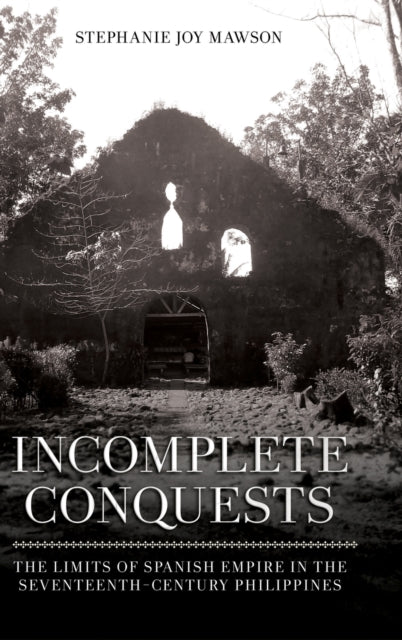
Stephanie Joy Mawson
Incomplete Conquests: The Limits of Spanish Empire in the Seventeenth-Century Philippines
Incomplete Conquests: The Limits of Spanish Empire in the Seventeenth-Century Philippines
💎 Earn 513 Points (£5.13) on this item.
We can order this item for you. Delivery usually takes about 4 to 6 weeks.
This item is not held in our immediate stock. We will order it for you after checkout.
Estimated delivery: About 4 to 6 weeks
YOU SAVE £13.34
- Condition: Brand new
- UK Delivery times: Usually arrives within 2 - 3 working days
- UK Shipping: Fee starts at £3.89. Subject to product weight & dimension
Bulk ordering. Want 15 or more copies? Get a personalised quote and bigger discounts. Learn more about bulk orders.
Couldn't load pickup availability
- More about Incomplete Conquests: The Limits of Spanish Empire in the Seventeenth-Century Philippines
In Incomplete Conquests, Stephanie Joy Mawson explores the limits of Spanish empire in the Philippines during the 17th century, highlighting resistance, flight, evasion, conflict, and warfare among indigenous, Chinese, and Moro communities.
Format: Hardback
Length: 294 pages
Publication date: 15 July 2023
Publisher: Cornell University Press
The Spanish colonization of the Philippines, which commenced in 1565, is often regarded as a significant milestone in the history of globalization, as it brought together a diverse array of individuals from different ethnic backgrounds, including merchants, soldiers, sailors, and missionaries. Colonists sent enthusiastic reports back to Madrid, extolling the remarkable number of individuals who had embraced Christianity and the substantial number of people who were paying allegiance to the Spanish Crown. These assertions were designed to establish an illusion of imperial sovereignty, without necessarily accompanying the effective consolidation of colonial control in numerous regions where conversion and tribute collection were enforced.
Incomplete Conquests places a strong emphasis on the narratives of indigenous, Chinese, and Moro communities, highlighting their diverse experiences and responses to colonial agents. By weaving together these stories, the book captures the intricate cultural and environmental richness of the Philippine archipelago during the seventeenth century.
The Spanish colonization of the Philippines was marked by a series of incomplete conquests, as the Spanish forces struggled to establish firm control over the diverse and complex island nation. Despite their initial successes in converting large portions of the population to Christianity and collecting tribute, the Spanish encountered resistance and opposition from various indigenous groups, such as the Tagalogs, Igorots, and Moros.
The Tagalogs, who were the dominant ethnic group in the Philippines at the time, resisted Spanish rule with a series of armed conflicts known as the Mactan War. The Mactan War, which took place in 1521, marked the first major resistance to Spanish colonialism in the Philippines and was a significant setback for the Spanish. The Spanish were unable to capture the island of Mactan, which was a key stronghold for the Tagalogs, and the war resulted in the deaths of thousands of Spanish soldiers and the displacement of many Tagalogs.
The Igorots, who lived in the northern regions of the Philippines, also resisted Spanish rule. The Igorots were skilled in guerilla warfare and were able to inflict significant damage on Spanish forces. The Spanish were unable to establish a firm grip on the Igorot territories, and the Igorots continued to resist Spanish rule for many years.
The Moros, who were located in the southern regions of the Philippines, also posed a significant challenge to Spanish rule. The Moros were skilled in maritime warfare and were able to launch successful raids on Spanish ships and settlements. The Spanish were unable to subdue the Moros, and the Moros continued to resist Spanish rule for many years.
In addition to resistance from indigenous groups, the Spanish also faced opposition from Chinese traders and missionaries. The Chinese were a significant presence in the Philippines at the time and had established trading networks and missionary communities throughout the archipelago. The Spanish were concerned about the influence of the Chinese and attempted to restrict their activities in the Philippines.
The Spanish also faced resistance from other European powers, such as the Dutch and the English. The Dutch and the English were competing for trade and influence in the region and were eager to establish their presence in the Philippines. The Spanish were unable to prevent the Dutch and the English from establishing their own settlements and trading networks in the Philippines, and the Dutch and the English were able to exert some influence over Spanish colonial policies.
Despite these challenges, the Spanish were able to establish a relatively stable colonial regime in the Philippines. The Spanish colonization of the Philippines was marked by a series of significant cultural and economic changes, including the introduction of Christianity, the development of a Spanish-speaking elite, and the establishment of a colonial economy. The Spanish also introduced a number of modern technologies, such as the printing press and the telescope, to the Philippines.
However, the Spanish colonization of the Philippines was also marked by a series of negative consequences, including the exploitation of indigenous labor, the displacement of indigenous communities, and the spread of diseases such as smallpox and measles. The Spanish also imposed a number of oppressive policies, such as the encomienda system, which allowed Spanish colonists to own large tracts of land and exploit the labor of indigenous people.
In conclusion, the Spanish colonization of the Philippines was a complex and multifaceted phenomenon that had a significant impact on the history and culture of the Philippines. The Spanish colonization of the Philippines was marked by a series of incomplete conquests, as the Spanish forces struggled to establish firm control over the diverse and complex island nation. Despite their initial successes in converting large portions of the population to Christianity and collecting tribute, the Spanish encountered resistance and opposition from various indigenous groups, such as the Tagalogs, Igorots, and Moros.
The Spanish also faced opposition from Chinese traders and missionaries and other European powers. Despite these challenges, the Spanish were able to establish a relatively stable colonial regime in the Philippines, which was marked by significant cultural and economic changes, including the introduction of Christianity, the development of a Spanish-speaking elite, and the establishment of a colonial economy. However, the Spanish colonization of the Philippines was also marked by a series of negative consequences, including the exploitation of indigenous labor, the displacement of indigenous communities, and the spread of diseases such as smallpox and measles. The Spanish also imposed a number of oppressive policies, such as the encomienda system, which allowed Spanish colonists to own large tracts of land and exploit the labor of indigenous people.
Weight: 454g
Dimension: 229 x 152 x 27 (mm)
ISBN-13: 9781501770265
UK and International shipping information
UK and International shipping information
We deliver throughout the United Kingdom and to 128 countries and territories worldwide, including the United States, Australia, Canada, Germany, Spain and France.