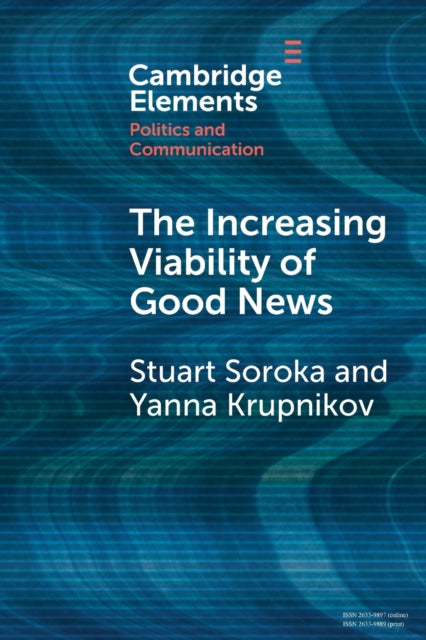
StuartSoroka,YannaKrupnikov
Increasing Viability of Good News
Increasing Viability of Good News
💎 Earn 84 Points (£0.84) on this item.
We can order this item for you. Delivery usually takes about 4 to 6 weeks.
This item is not held in our immediate stock. We will order it for you after checkout.
Estimated delivery: About 4 to 6 weeks
YOU SAVE £1.01
- Condition: Brand new
- UK Delivery times: Usually arrives within 2 - 3 working days
- UK Shipping: Fee starts at £2.39. Subject to product weight & dimension
Bulk ordering. Want 15 or more copies? Get a personalised quote and bigger discounts. Learn more about bulk orders.
Couldn't load pickup availability
- More about Increasing Viability of Good News
The prevalence of positive news is likely to increase due to valence-based asymmetries, individual preferences, and technology. Valence-based asymmetries vary over time, across individuals, and technology facilitates diverse news platforms. Results can inform media gatekeeping, political communication, and political psychology, and provide actionable findings for media content producers, communications platforms, and consumers.
\n Format: Paperback / softback
\n Length: 75 pages
\n Publication date: 12 August 2021
\n Publisher: Cambridge University Press
\n
Despite the prevailing perception of media coverage leaning towards negativity, there is reason to believe that the prevalence of positive news will likely rise. This assertion stems from three compelling factors:
1. Valence-based asymmetries: These disparities in the emotional valence of news stories have the potential to shift over time.
2. Individual variations: The perception of positivity or negativity in news can vary significantly among individuals, influenced by personal beliefs, values, and experiences.
3. Technological advancements: The rise of technology has facilitated the emergence of diverse news platforms that cater to diverse preferences, enabling individuals to access a broader range of positive news stories.
In the following paragraphs, we will delve into each of these claims, examining them through a comprehensive analysis of existing data on media content, psychophysiological responses, and survey-based experiments. Our findings will be considered in the context of understanding media gatekeeping, political communication, and political psychology, as well as offering practical insights for media content producers, communication platforms, and media consumers.
Valence-based asymmetries:
Emotional valence refers to the positive or negative connotation associated with a particular news story. Research has shown that valence-based asymmetries can vary over time, influenced by various factors such as societal events, political developments, and cultural trends. For instance, during times of crisis or conflict, negative news stories tend to receive more attention and coverage, as they evoke stronger emotional responses from viewers. However, as time passes and the situation improves, the emotional valence of news stories may shift towards more positive tones.
Individual variations:
Individual differences in perception play a significant role in shaping how individuals interpret and respond to news stories. Factors such as personality traits, cognitive biases, and prior experiences can influence an individual's emotional reactions to news. For example, individuals who tend to be more pessimistic or negative may be more likely to perceive news stories as negative, even if they contain positive aspects. Conversely, individuals who are more optimistic or positive may be more inclined to focus on the positive aspects of news stories and overlook the negative.
Technological advancements:
The advent of technology has revolutionized the way we consume and share news. With the rise of social media platforms, online news outlets, and mobile devices, individuals have access to a vast array of news sources and can tailor their news consumption based on their preferences. This has led to the emergence of positive news outlets and platforms that specialize in reporting uplifting stories, highlighting social progress, and promoting positive values.
In conclusion, while the media coverage may sometimes appear to be overwhelmingly negative, there is evidence to suggest that the prevalence of positive news will likely increase in the future. Valence-based asymmetries, individual variations, and technological advancements are all contributing factors to this trend. By understanding these factors and adapting our media consumption habits, we can promote a more balanced and positive view of the world.
\n Weight: 104g\n
Dimension: 152 x 228 x 7 (mm)\n
ISBN-13: 9781108987080\n \n
This item can be found in:
UK and International shipping information
UK and International shipping information
UK Delivery and returns information:
- Delivery within 2 - 3 days when ordering in the UK.
- Shipping fee for UK customers from £2.39. Fully tracked shipping service available.
- Returns policy: Return within 30 days of receipt for full refund.
International deliveries:
Shulph Ink now ships to Australia, Belgium, Canada, France, Germany, Ireland, Italy, India, Luxembourg Saudi Arabia, Singapore, Spain, Netherlands, New Zealand, United Arab Emirates, United States of America.
- Delivery times: within 5 - 10 days for international orders.
- Shipping fee: charges vary for overseas orders. Only tracked services are available for most international orders. Some countries have untracked shipping options.
- Customs charges: If ordering to addresses outside the United Kingdom, you may or may not incur additional customs and duties fees during local delivery.