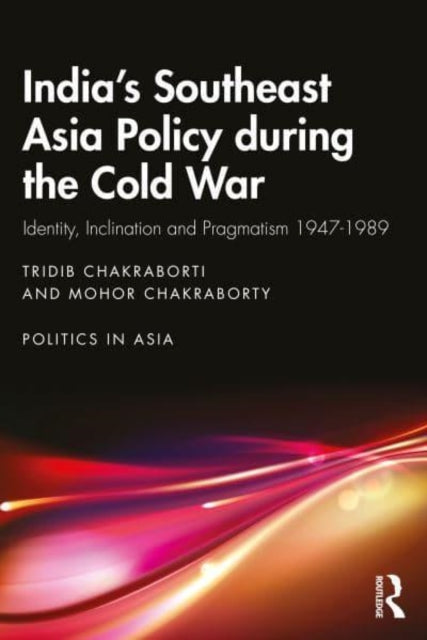
TridibChakraborti,MohorChakraborty
India's Southeast Asia Policy during the Cold War: Identity, Inclination and Pragmatism 1947-1989
India's Southeast Asia Policy during the Cold War: Identity, Inclination and Pragmatism 1947-1989
💎 Earn 193 Points (£1.93) on this item.
We can order this item for you. Delivery usually takes about 4 to 6 weeks.
This item is not held in our immediate stock. We will order it for you after checkout.
Estimated delivery: About 4 to 6 weeks
YOU SAVE £2.30
- Condition: Brand new
- UK Delivery times: Usually arrives within 2 - 3 working days
- UK Shipping: Fee starts at £3.89. Subject to product weight & dimension
Bulk ordering. Want 15 or more copies? Get a personalised quote and bigger discounts. Learn more about bulk orders.
Couldn't load pickup availability
- More about India's Southeast Asia Policy during the Cold War: Identity, Inclination and Pragmatism 1947-1989
Chakraborti and Chakraborty analyze India's foreign policy shift from nonalignment to realism and self-assertion,perceived by Southeast Asian countries. They study the development of India's foreign and security policies,driven by ideology, pragmatism, and changes in priorities,and draw lessons for the Indo-Pacific.
Format: Paperback / softback
Length: 214 pages
Publication date: 06 January 2023
Publisher: Taylor & Francis Ltd
Over the course of four decades of the Cold War, Chakraborti and Chakraborty meticulously analyze India's transformative journey from nonalignment towards realism and self-assertion, culminating in confidence-building and interdependence with its neighbors in Southeast Asia.
The reasons for India's shift from nonalignment to a more pragmatic approach to foreign relations in its interactions with both the non-Communist states of ASEAN and the Communist States of Indochina are multifaceted and complex. This shift was driven by a combination of factors, including India's growing economic and political influence, the need to secure its interests in a rapidly changing regional landscape, and the desire to align with countries that shared its values and interests.
One of the key drivers of India's shift was its recognition of the changing nature of the global power balance. As the Soviet Union began to decline and the United States emerged as the dominant superpower, India sought to establish closer ties with the West to ensure its security and prosperity. This led to India's participation in various regional and international organizations, including the Non-Aligned Movement (NAM) and the Association of Southeast Asian Nations (ASEAN).
At the same time, India also maintained close relations with the Soviet Union and other Communist countries, particularly during the Cold War. This was driven by India's ideological commitment to socialism and its desire to support the global struggle against imperialism and colonialism. However, as the Soviet Union began to collapse in the late 1980s and early 1990s, India's relationship with the Communist world began to deteriorate.
Another factor that influenced India's shift was the changing regional dynamics. As the Cold War came to an end, the United States and other Western countries began to focus their attention on the Asia-Pacific region, which was seen as a potential source of economic growth and stability. This led to the formation of the ASEAN and the establishment of closer ties between India and its neighbors in the region.
Pakistan's foreign and defense policies also played a significant role. Pakistan's close ties with the Soviet Union and other Communist countries, as well as its support for terrorism and insurgency in India and other neighboring countries, strained India's relations with the West. India's response to these policies was characterized by a mix of appeasement and assertiveness, with India attempting to balance its interests with those of its neighbors while also maintaining its commitment to nonalignment.
The lessons that can be drawn from India's shift from nonalignment to realism and self-assertion are numerous. Firstly, India's ability to navigate the complex and rapidly changing regional landscape is a testament to its resilience and adaptability. Secondly, India's commitment to nonalignment and its willingness to engage with a diverse range of countries and ideologies is a valuable asset in today's interconnected world. Thirdly, India's emphasis on building confidence and interdependence with its neighbors is a key factor in ensuring regional stability and peace.
As the Indo-Pacific region again becomes a major arena of great power rivalry, India's experiences and lessons from the Cold War are more relevant than ever. India's ability to balance its interests with those of its neighbors while also promoting regional stability and peace will be crucial in ensuring that the Indo-Pacific remains a region of peace and prosperity.
In order to address these questions, Chakraborti and Chakraborty study the development of India's foreign and security policies throughout the period, tracking the changes of stances between and within administrations. They evaluate how these decisions were driven by a combination of ideology, pragmatism, and changes in priorities as the regional architecture developed over time.
This book is a valuable read for scholars and students of India's foreign relations and of Indo-Pacific geopolitics more broadly. It provides a comprehensive and nuanced analysis of India's journey from nonalignment to realism and self-assertion, and its implications for the future of the Indo-Pacific region. The authors' meticulous research and analysis provide a deep understanding of the complex and multifaceted factors that shaped India's foreign and security policies, and their insights are sure to be of interest to anyone interested in the region.
Weight: 400g
Dimension: 234 x 156 (mm)
ISBN-13: 9780367724924
UK and International shipping information
UK and International shipping information
We deliver throughout the United Kingdom and to 128 countries and territories worldwide, including the United States, Australia, Canada, Germany, Spain and France.