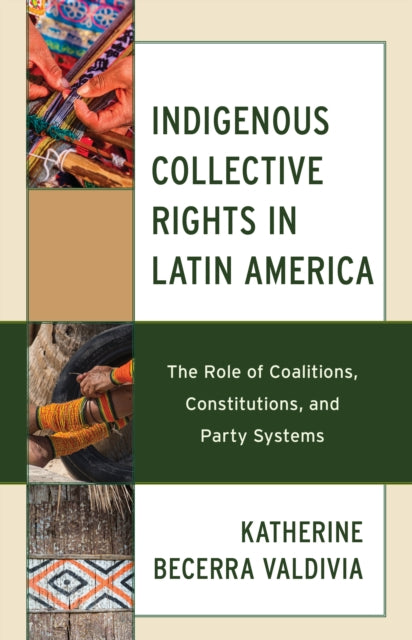
Katherine Becerra Valdivia
Indigenous Collective Rights in Latin America: The Role of Coalitions, Constitutions, and Party Systems
Indigenous Collective Rights in Latin America: The Role of Coalitions, Constitutions, and Party Systems
💎 Earn 451 Points (£4.51) on this item.
We can order this item for you. Delivery usually takes about 4 to 6 weeks.
This item is not held in our immediate stock. We will order it for you after checkout.
Estimated delivery: About 4 to 6 weeks
- Condition: Brand new
- UK Delivery times: Usually arrives within 2 - 3 working days
- UK Shipping: Fee starts at £2.39. Subject to product weight & dimension
Bulk ordering. Want 15 or more copies? Get a personalised quote and bigger discounts. Learn more about bulk orders.
Couldn't load pickup availability
- More about Indigenous Collective Rights in Latin America: The Role of Coalitions, Constitutions, and Party Systems
Latin America is known for its high recognition of indigenous collective rights, but legal protections vary significantly among countries. This book explores the factors that help enhance the presence of collective rights, such as organizational factors and institutional conditions, through qualitative comparative analysis and case studies.
Format: Hardback
Length: 192 pages
Publication date: 08 August 2022
Publisher: Lexington Books
Latin America is a region renowned for its strong recognition of indigenous collective rights. However, legal protections for these rights vary significantly across countries within the region. This disparity raises the question: why do certain countries in Latin America prioritize the recognition of collective rights for indigenous people, while others do not? To answer this question, this book explores the factors that contribute to the presence and strength of collective rights in Latin America.
The author begins by arguing that while indigenous social movements are vital in safeguarding indigenous rights, they alone are not sufficient. The recognition of these rights is influenced by a combination of organizational factors, such as alliances between indigenous peoples and non-indigenous allies, and institutional conditions, including constitutional replacements and party systems. By employing qualitative comparative analysis (QCA) and case studies from Bolivia, Chile, Colombia, Ecuador, Guatemala, Mexico, and Peru, this book seeks to unravel the complex interplay of these elements and their impact on the creation of conditions for diverse collective rights.
In Chapter 1, the author provides an overview of the historical context and legal frameworks that shape the recognition of indigenous collective rights in Latin America. They highlight the struggles and victories of indigenous peoples in the region, as well as the challenges they continue to face. The chapter also explores the role of international organizations and legal frameworks in promoting and protecting indigenous rights.
Chapter 2 delves into the organizational factors that contribute to the presence and strength of collective rights. The author examines the role of indigenous social movements, as well as the strategies they employ to advocate for their rights. They also explore the impact of alliances between indigenous peoples and non-indigenous allies on the protection and promotion of collective rights.
Chapter 3 examines the institutional conditions that influence the recognition of collective rights. The author discusses the role of constitutional replacements, as well as the political systems and party dynamics that shape the political landscape. They also explore the impact of legal frameworks and judicial decisions on the protection and enforcement of indigenous rights.
Chapter 4 presents case studies from Bolivia, Chile, Colombia, Ecuador, Guatemala, Mexico, and Peru, which provide concrete examples of the ways in which various elements combine to create conditions for collective rights. The case studies highlight the successes and challenges faced by indigenous communities in their efforts to assert and protect their rights.
In conclusion, this book offers a comprehensive analysis of the factors that contribute to the recognition of indigenous collective rights in Latin America. It highlights the importance of indigenous social movements, organizational factors, institutional conditions, and legal frameworks in shaping the protection and promotion of these rights. By employing a qualitative comparative analysis and case studies from a diverse range of countries, the book provides valuable insights into the complex dynamics that underpin the recognition of collective rights in the region.
Latin America is a region with high levels of recognition for indigenous collective rights. Still, legal protections differ considerably among the countries. Why do some countries in Latin America have a strong recognition of collective rights for indigenous people while others do not? What are the factors that help enhance the presence of collective rights?
Dimension: 229 x 152 (mm)
ISBN-13: 9781666909104
UK and International shipping information
UK and International shipping information
UK Delivery and returns information:
- Delivery within 2 - 3 days when ordering in the UK.
- Shipping fee for UK customers from £2.39. Fully tracked shipping service available.
- Returns policy: Return within 30 days of receipt for full refund.
International deliveries:
Shulph Ink now ships to Australia, Belgium, Canada, France, Germany, Ireland, Italy, India, Luxembourg Saudi Arabia, Singapore, Spain, Netherlands, New Zealand, United Arab Emirates, United States of America.
- Delivery times: within 5 - 10 days for international orders.
- Shipping fee: charges vary for overseas orders. Only tracked services are available for most international orders. Some countries have untracked shipping options.
- Customs charges: If ordering to addresses outside the United Kingdom, you may or may not incur additional customs and duties fees during local delivery.