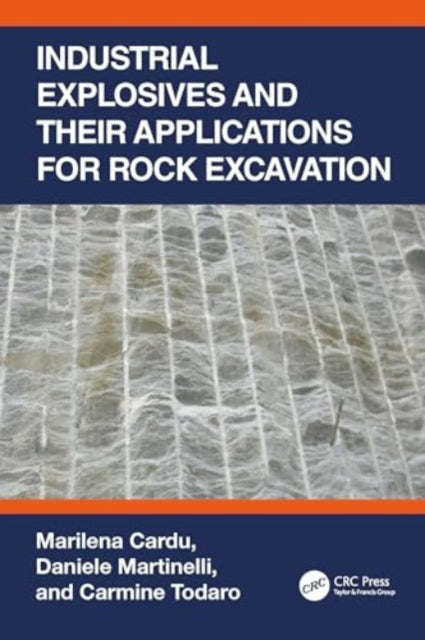
MarilenaCardu,DanieleMartinelli,CarmineTodaro
Industrial Explosives and their Applications for Rock Excavation
Industrial Explosives and their Applications for Rock Excavation
💎 Earn 521 Points (£5.21) on this item.
- Condition: Brand new
- UK Delivery times: Usually arrives within 2 - 3 working days
- UK Shipping: Fee starts at £2.39. Subject to product weight & dimension
Bulk ordering. Want 15 or more copies? Get a personalised quote and bigger discounts. Learn more about bulk orders.
Couldn't load pickup availability
- More about Industrial Explosives and their Applications for Rock Excavation
Industrial Explosives and their Applications for Rock Excavation provides an updated vision of industrial explosives, including the best technical advice for rock excavation. It contains harmonized preliminary modules aimed at introducing basic concepts of chemistry and physics applied to the drilling and blasting technique. It defines a balanced mix of theory capable of providing skills to design an efficient blasting and covers excavation problems from different points of view and in different contexts. It is aimed at graduate students, researchers, and professionals in mining engineering and explosives technology.
Format: Hardback
Length: 240 pages
Publication date: 28 June 2024
Publisher: Taylor & Francis Ltd
Industrial Explosives and their Applications for Rock Excavation is a comprehensive guide that delves into the diverse uses of industrial explosives in civil and mining engineering works. It provides a detailed explanation of explosives and their actions, covering the fundamentals, principles, and related chemistry. The book explores the various types of explosives and initiation devices, including their characteristics, geometry, and timing aspects of blast design. It also discusses the techniques and devices employed for rock excavation, such as obtaining large-sized blocks, constructing yards, excavating big foundations, and more. Furthermore, the book summarizes the criteria for mitigating the associated seismic disturbances that can arise during blasting operations.
Designed specifically for graduate students, researchers, and professionals in mining engineering and explosives technology, Industrial Explosives and their Applications for Rock Excavation offers a comprehensive and up-to-date perspective on the field. It serves as a valuable resource for those seeking to enhance their knowledge and expertise in this area.
The book is organized into five chapters, each covering a different aspect of industrial explosives and their applications in rock excavation. The first chapter provides an introduction to the topic, outlining the significance of explosives in civil and mining engineering. It also highlights the challenges faced in rock excavation and the need for efficient and sustainable techniques.
The second chapter delves into the basics of explosives, including their chemical composition, properties, and classification. It explains the principles of explosion, including the formation of shock waves, pressure waves, and thermal radiation. The chapter also covers the factors that influence the performance of explosives, such as temperature, pressure, and moisture.
The third chapter focuses on the application of industrial explosives in civil engineering works, such as tunneling, excavation, and demolition. It discusses the different types of explosives used in these applications and the techniques employed to optimize their efficiency and safety. The chapter also covers the design and implementation of blasting operations, including the selection of appropriate explosives, the design of blast patterns, and the monitoring of blasting effects.
The fourth chapter explores the use of industrial explosives in mining engineering works, including open-pit mining, underground mining, and quarrying. It discusses the different types of explosives used in these applications and the techniques employed to maximize productivity and minimize environmental impact. The chapter also covers the design and implementation of mining blasts, including the selection of appropriate explosives, the design of blast holes, and the monitoring of mining operations.
The fifth chapter summarizes the criteria for mitigating the associated seismic disturbances that can arise during blasting operations. It discusses the principles of seismic design, including the use of seismic monitors, the design of seismic barriers, and the implementation of seismic mitigation measures. The chapter also highlights the importance of conducting seismic surveys and analyzing the results to ensure the safety and stability of blasting operations.
Throughout the book, numerous examples and case studies are provided to illustrate the practical applications of industrial explosives in rock excavation. These examples cover a wide range of industries, including construction, mining, and infrastructure development, and demonstrate the versatility and effectiveness of explosives in achieving various excavation objectives.
Industrial Explosives and their Applications for Rock Excavation is an essential resource for graduate students, researchers, and professionals in mining engineering and explosives technology. It provides a comprehensive and up-to-date understanding of the field, covering the theoretical foundations, practical applications, and safety considerations associated with industrial explosives. The book's clear and concise writing style makes it accessible to a wide audience, and its extensive references and appendices provide further information and guidance for those seeking to delve deeper into the subject.
In conclusion, Industrial Explosives and their Applications for Rock Excavation is a valuable tool for anyone involved in civil and mining engineering works. It offers a comprehensive and up-to-date perspective on the use of industrial explosives, covering the fundamentals, principles, and practical applications of the field. By providing a balanced mix of theory and practice, the book equips readers with the skills and knowledge necessary to design and implement efficient blasting operations, while also addressing the associated seismic disturbances. Whether you are a student, researcher, or professional, this book is a must-have resource for enhancing your understanding and expertise in industrial explosives and their applications in rock excavation.
Weight: 600g
Dimension: 253 x 181 x 21 (mm)
ISBN-13: 9781032149646
UK and International shipping information
UK and International shipping information
UK Delivery and returns information:
- Delivery within 2 - 3 days when ordering in the UK.
- Shipping fee for UK customers from £2.39. Fully tracked shipping service available.
- Returns policy: Return within 30 days of receipt for full refund.
International deliveries:
Shulph Ink now ships to Australia, Belgium, Canada, France, Germany, Ireland, Italy, India, Luxembourg Saudi Arabia, Singapore, Spain, Netherlands, New Zealand, United Arab Emirates, United States of America.
- Delivery times: within 5 - 10 days for international orders.
- Shipping fee: charges vary for overseas orders. Only tracked services are available for most international orders. Some countries have untracked shipping options.
- Customs charges: If ordering to addresses outside the United Kingdom, you may or may not incur additional customs and duties fees during local delivery.