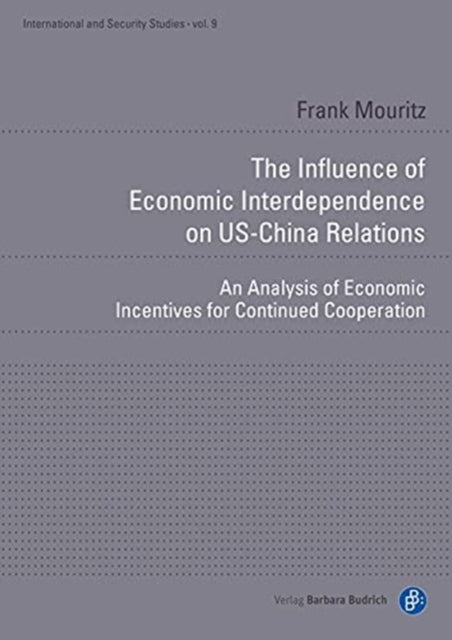
Frank Mouritz
Influence of Economic Interdependence on US- - An Analysis of Economic Incentives for Continued Cooperation
Influence of Economic Interdependence on US- - An Analysis of Economic Incentives for Continued Cooperation
💎 Earn 115 Points (£1.15) on this item.
YOU SAVE £6.99
- Condition: Brand new
- UK Delivery times: Usually arrives within 2 - 3 working days
- UK Shipping: Fee starts at £2.39. Subject to product weight & dimension
Bulk ordering. Want 15 or more copies? Get a personalised quote and bigger discounts. Learn more about bulk orders.
Couldn't load pickup availability
- More about Influence of Economic Interdependence on US- - An Analysis of Economic Incentives for Continued Cooperation
US-China tensions have escalated, raising the risk of conflict. The book examines the incentives for both sides to avoid conflict and continue cooperation due to their economic interconnectedness.
Format: Paperback / softback
Length: 146 pages
Publication date: 19 April 2021
Publisher: Verlag Barbara Budrich
The US-China tensions over global supremacy have escalated significantly in recent years, heightening the prospect of a future conflict. While an open conflict would have far-reaching consequences for both nations due to their deep economic interconnectedness, the book explores the question of how strong the incentives are for both sides to avoid conflict and maintain cooperation primarily driven by economic considerations.
The rise of China as a global economic power has led to concerns among the US and other countries about its influence and policies. The US has taken a number of measures to assert its dominance, including tariffs and sanctions on Chinese imports and investment. China, in turn, has responded with its own measures, such as tariffs and restrictions on US companies and investments.
The economic relationship between the US and China is complex and multifaceted. The two countries are the world's largest trading partners, with bilateral trade reaching over $600 billion annually. They are also major investors in each other's economies, with Chinese companies investing billions of dollars in the US and US companies investing billions of dollars in China.
However, the economic relationship is also fraught with tensions and challenges. The US has accused China of unfair trade practices, such as intellectual property theft and forced technology transfer, which it says harm American companies and workers. China has responded by accusing the US of protectionism and hindering its economic growth.
The book examines the various factors that drive US-China tensions over global supremacy, including economic competition, geopolitical concerns, and cultural differences. It also explores the potential consequences of a conflict between the two countries, including economic disruption, political instability, and military escalation.
The book argues that while the incentives for both sides to avoid conflict and maintain cooperation are strong, there are also risks and challenges that could undermine these efforts. For example, the economic relationship between the US and China is highly dependent on each other, making it vulnerable to sudden changes in trade policies or other economic shocks. Additionally, the political and geopolitical tensions between the two countries are complex and multifaceted, making it difficult to predict how they could evolve in the future.
The book also offers several recommendations for managing US-China tensions over global supremacy, including promoting economic dialogue and cooperation, building trust and understanding between the two countries, and addressing the underlying economic and political issues that contribute to tensions.
In conclusion, the US-China tensions over global supremacy have escalated significantly in recent years, raising the prospect of a future conflict. While an open conflict would have costly consequences for both sides, the book argues that there are also strong incentives for both sides to avoid conflict and maintain cooperation primarily driven by economic considerations. By promoting economic dialogue and cooperation, building trust and understanding, and addressing the underlying economic and political issues, the two countries can work towards a more stable and prosperous global economy.
The US-China tensions over global supremacy have escalated significantly in recent years, heightening the prospect of a future conflict. While an open conflict would have far-reaching consequences for both nations due to their deep economic interconnectedness, the book explores the question of how strong the incentives are for both sides to avoid conflict and maintain cooperation primarily driven by economic considerations.
The rise of China as a global economic power has led to concerns among the US and other countries about its influence and policies. The US has taken a number of measures to assert its dominance, including tariffs and sanctions on Chinese imports and investment. China, in turn, has responded with its own measures, such as tariffs and restrictions on US companies and investments.
The economic relationship between the US and China is complex and multifaceted. The two countries are the world's largest trading partners, with bilateral trade reaching over $600 billion annually. They are also major investors in each other's economies, with Chinese companies investing billions of dollars in the US and US companies investing billions of dollars in China.
However, the economic relationship is also fraught with tensions and challenges. The US has accused China of unfair trade practices, such as intellectual property theft and forced technology transfer, which it says harm American companies and workers. China has responded by accusing the US of protectionism and hindering its economic growth.
The book examines the various factors that drive US-China tensions over global supremacy, including economic competition, geopolitical concerns, and cultural differences. It also explores the potential consequences of a conflict between the two countries, including economic disruption, political instability, and military escalation.
The book argues that while the incentives for both sides to avoid conflict and maintain cooperation are strong, there are also risks and challenges that could undermine these efforts. For example, the economic relationship between the US and China is highly dependent on each other, making it vulnerable to sudden changes in trade policies or other economic shocks. Additionally, the political and geopolitical tensions between the two countries are complex and multifaceted, making it difficult to predict how they could evolve in the future.
The book also offers several recommendations for managing US-China tensions over global supremacy, including promoting economic dialogue and cooperation, building trust and understanding between the two countries, and addressing the underlying economic and political issues that contribute to tensions.
In conclusion, the US-China tensions over global supremacy have escalated significantly in recent years, raising the prospect of a future conflict. While an open conflict would have costly consequences for both sides, the book argues that there are also strong incentives for both sides to avoid conflict and maintain cooperation primarily driven by economic considerations. By promoting economic dialogue and cooperation, building trust and understanding, and addressing the underlying economic and political issues, the two countries can work towards a more stable and prosperous global economy.
Weight: 304g
Dimension: 149 x 210 x 12 (mm)
ISBN-13: 9783847425168
UK and International shipping information
UK and International shipping information
UK Delivery and returns information:
- Delivery within 2 - 3 days when ordering in the UK.
- Shipping fee for UK customers from £2.39. Fully tracked shipping service available.
- Returns policy: Return within 30 days of receipt for full refund.
International deliveries:
Shulph Ink now ships to Australia, Belgium, Canada, France, Germany, Ireland, Italy, India, Luxembourg Saudi Arabia, Singapore, Spain, Netherlands, New Zealand, United Arab Emirates, United States of America.
- Delivery times: within 5 - 10 days for international orders.
- Shipping fee: charges vary for overseas orders. Only tracked services are available for most international orders. Some countries have untracked shipping options.
- Customs charges: If ordering to addresses outside the United Kingdom, you may or may not incur additional customs and duties fees during local delivery.