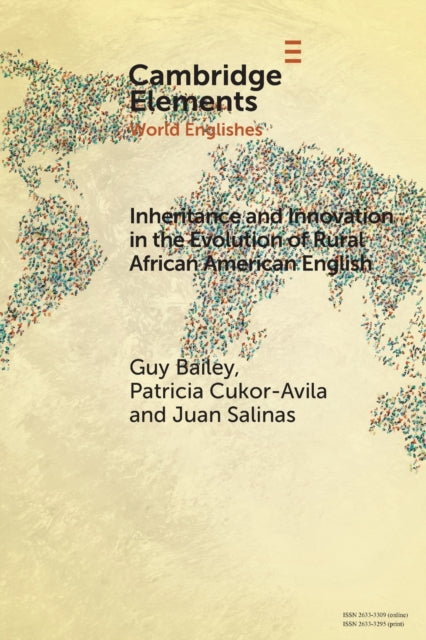
Guy Bailey,PatriciaCukor-Avila,Juan Salinas
Inheritance and Innovation in the Evolution of Rural African American English
Inheritance and Innovation in the Evolution of Rural African American English
💎 Earn 84 Points (£0.84) on this item.
We can order this item for you. Delivery usually takes about 4 to 6 weeks.
This item is not held in our immediate stock. We will order it for you after checkout.
Estimated delivery: About 4 to 6 weeks
YOU SAVE £1.01
- Condition: Brand new
- UK Delivery times: Usually arrives within 2 - 3 working days
- UK Shipping: Fee starts at £3.89. Subject to product weight & dimension
Bulk ordering. Want 15 or more copies? Get a personalised quote and bigger discounts. Learn more about bulk orders.
Couldn't load pickup availability
- More about Inheritance and Innovation in the Evolution of Rural African American English
This Element examines how the functions of the inherited forms invariant be (from English sources) and zero (from creolization) have transformed over the twentieth century, driven by socio-cultural and linguistic factors. It highlights the emergence of aspectual markers invariant be and zero as a response to the mismatch between form and function within the present tense copula/auxiliary system and the grammatical ambiguities affecting these forms.
Format: Paperback / softback
Length: 75 pages
Publication date: 06 October 2022
Publisher: Cambridge University Press
This Element delves into the fascinating transformations undergone by the functions of the inherited forms invariant be (from English sources) and zero (from creolization) throughout the twentieth century. Initially, these features served as alternative present tense copula/auxiliary forms, but they evolved into aspectual markers, with invariant be signifying durativity/habituality and zero denoting nonstativity. The impetus behind these innovative developments stemmed from a convergence of socio-cultural and linguistic factors. The Great Migration, a significant historical event, provided a demographic and socio-cultural backdrop that fostered the growth and dissemination of linguistic innovations. The discrepancy between the form and function of the present tense copula/auxiliary system and the grammatical ambiguities that impacted both invariant be and zero served as linguistic triggers for this reanalysis. When considered together, the evolution of these forms showcases the intricate interplay between inheritance and innovation, leading to the emergence of restructured linguistic subsystems and eventually the formation of new varieties.
The Great Migration, a pivotal historical event, played a significant role in shaping the linguistic landscape of the United States. This mass movement of African Americans from the Southern states to Northern and Western cities in the mid-to-late 19th century brought with it a diverse range of cultural practices, languages, and dialects. The migration resulted in the blending of various African languages, creating new creole languages such as Haitian Creole, Louisiana Creole, and New Orleans Creole. These creoles emerged as a result of the interaction between African languages and the English language spoken by the migrants.
One of the most notable features of creole languages is the use of the invariant be and zero forms. Invariant be, derived from the English present tense copula be, is used to indicate durativity or habituality in a sentence. For example, in Haitian Creole, the sentence "Je suis bon" (I am good) uses invariant be to emphasize the continuous nature of the speaker's condition. On the other hand, zero, derived from the English auxiliary verb zero, is used to mark nonstativity or negation. In New Orleans Creole, the sentence "Nawlins ain't never been no place for no fool" uses zero to negate the statement and emphasize its negative connotation.
Over the course of the twentieth century, the functions of invariant be and zero underwent significant transformations. These forms were initially used as alternative present tense copula/auxiliary forms, but they gradually evolved into aspectual markers. Invariant be, for instance, became associated with durativity or habituality, while zero began to signify nonstativity or negation. This transformation was influenced by a variety of factors, including:
Socio-cultural factors: The migration of African Americans to urban areas brought them into contact with different cultures and languages. This exposure led to the blending of African languages and the development of new creole languages. The use of invariant be and zero in creole languages was influenced by the grammatical structures and vocabulary of the African languages, as well as the cultural norms and values of the migrants.
Linguistic factors: The study of creole languages and their grammatical structures provided insights into the nature of language and language acquisition. Linguists began to recognize the importance of grammatical markers in expressing aspectual information and the role that creole languages played in the evolution of the English language. This research led to a reanalysis of the functions of invariant be and zero in creole languages.
Technological factors: The advent of new technologies, such as radio, television, and the internet, played a significant role in the spread of creole languages and their associated linguistic features. These technologies facilitated the communication of creole languages across different regions and communities, leading to increased awareness and recognition of their unique grammatical structures.
In conclusion, the transformations undergone by the functions of invariant be and zero in creole languages during the twentieth century reflect the complex interplay between socio-cultural, linguistic, and technological factors. These forms, initially used as alternative present tense copula/auxiliary forms, evolved into aspectual markers that played a crucial role in expressing durativity, habituality, and nonstativity in creole languages. The study of creole languages provides valuable insights into the processes of language evolution and the role of cultural and linguistic diversity in shaping the linguistic landscape of the United States.
Weight: 633g
ISBN-13: 9781009087711
UK and International shipping information
UK and International shipping information
We deliver throughout the United Kingdom and to 128 countries and territories worldwide, including the United States, Australia, Canada, Germany, Spain and France.