Elisabeth Roehrlich
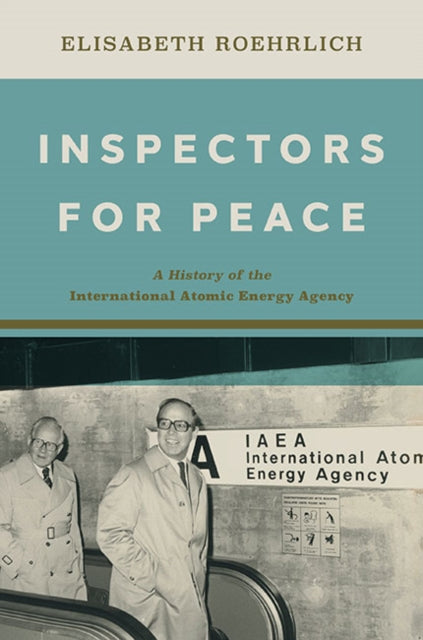
Inspectors for Peace: A History of the International Atomic Energy Agency
Inspectors for Peace: A History of the International Atomic Energy Agency
💎 Earn 221 Points (£2.21) on this item.
YOU SAVE £5.75
- Condition: Brand new
- UK Delivery times: Usually arrives within 2 - 3 working days
- UK Shipping: Fee starts at £3.89. Subject to product weight & dimension
Bulk ordering. Want 15 or more copies? Get a personalised quote and bigger discounts. Learn more about bulk orders.
Couldn't load pickup availability
- More about Inspectors for Peace: A History of the International Atomic Energy Agency
The International Atomic Energy Agency (IAEA) has a paradoxical mission of sharing nuclear knowledge and technology while seeking to deter nuclear weapon programs. Inspectors for Peace, by Elisabeth Roehrlich, is the first comprehensive, empirically grounded, and independent study of the IAEA's history. It reveals how the agency developed from a small technical bureaucracy to a key organization in the global nuclear order. The book offers insight for students, scholars, and policy experts interested in the history of the nuclear age, the Cold War, and the role of international organizations in shaping our world.
Format: Hardback
Length: 344 pages
Publication date: 31 May 2022
Publisher: Johns Hopkins University Press
The International Atomic Energy Agency (IAEA) is a crucial organization in international security, responsible for preventing states from secretly developing nuclear bombs. It also serves as a global hub for the exchange of nuclear science and technology for peaceful purposes. However, the spread of nuclear materials and knowledge around the world poses the risk of aiding the emergence of new nuclear weapon states, which goes against the agency's mission. In her book, Inspectors for Peace, Elisabeth Roehrlich explores the IAEA's paradoxical mission of sharing nuclear knowledge and technology while seeking to deter nuclear weapon programs.
Founded in 1957 through an act of unprecedented cooperation between the Cold War superpowers, the IAEA has evolved from a small technical bureaucracy in war-torn Vienna to a key organization in the global nuclear order. Roehrlich argues that the IAEA's dual mandate, which combines scientific and technical responsibilities with verification and inspection duties, has been crucial in ensuring the organization's legitimacy, acceptance, and success.
For its first decade of existence, the IAEA focused primarily on scientific and technical matters. It was not until the Treaty on the Non-Proliferation of Nuclear Weapons entered into force in 1970 that the agency took on the critical role of verifying and inspecting nuclear weapons programs. While the Fukushima nuclear disaster and the Iran negotiations have brought the IAEA to the forefront of public attention, its remarkable history remains largely unknown.
Inspectors for Peace is a comprehensive and empirically grounded study of the IAEA's history. Drawing on extensive archival research, including firsthand access to newly opened records at the IAEA Archives in Vienna, Roehrlich provides a detailed account of the organization's development, achievements, and challenges. The book sheds light on the IAEA's role in promoting nuclear safety, security, and disarmament, as well as its efforts to address the global nuclear threat.
One of the book's key findings is that the IAEA's success in fulfilling its mission has been largely due to its ability to adapt and evolve. The agency has faced numerous challenges throughout its history, including the proliferation of nuclear weapons, the development of nuclear energy, and the emergence of new technologies. However, the IAEA has been able to adapt to these challenges by developing new policies, procedures, and technologies to ensure the safe and peaceful use of nuclear energy.
Another important aspect of the IAEA's history is its role in promoting international cooperation and dialogue. The agency has played a key role in facilitating the peaceful resolution of nuclear disputes, such as the Iran nuclear negotiations, and has worked to build trust and confidence between countries with nuclear programs. Roehrlich argues that the IAEA's ability to foster international cooperation is crucial in ensuring the long-term sustainability of the global nuclear order.
Despite its successes, the IAEA faces ongoing challenges. One of the most significant is the need to address the issue of nuclear proliferation. The spread of nuclear materials and knowledge around the world poses a significant risk to global security, and the IAEA must continue to work to prevent the emergence of new nuclear weapon states.
Another challenge is the need to ensure the safety and security of nuclear facilities and materials. The Fukushima nuclear disaster highlighted the risks associated with nuclear power, and the IAEA must continue to work to improve the safety and security of nuclear facilities and materials to prevent accidents and incidents that could harm the public and the environment.
In conclusion, Inspectors for Peace is a valuable contribution to the study of the IAEA's history. By exploring the organization's paradoxical mission of sharing nuclear knowledge and technology while seeking to deter nuclear weapon programs, Roehrlich provides a comprehensive and insightful account of the IAEA's development, achievements, and challenges. The book sheds light on the IAEA's role in promoting nuclear safety, security, and disarmament, as well as its efforts to address the global nuclear threat. The IAEA's ability to adapt and evolve, as well as its role in promoting international cooperation and dialogue, are key factors in ensuring the long-term sustainability of the global nuclear order. However, the agency faces ongoing challenges, such as nuclear proliferation and the need to ensure the safety and security of nuclear facilities and materials. As the world continues to grapple with the risks and benefits of nuclear energy, the IAEA will remain a crucial organization in international security.
Weight: 626g
Dimension: 163 x 236 x 35 (mm)
ISBN-13: 9781421443331
UK and International shipping information
UK and International shipping information
We deliver throughout the United Kingdom and to 128 countries and territories worldwide, including the United States, Australia, Canada, Germany, Spain and France.