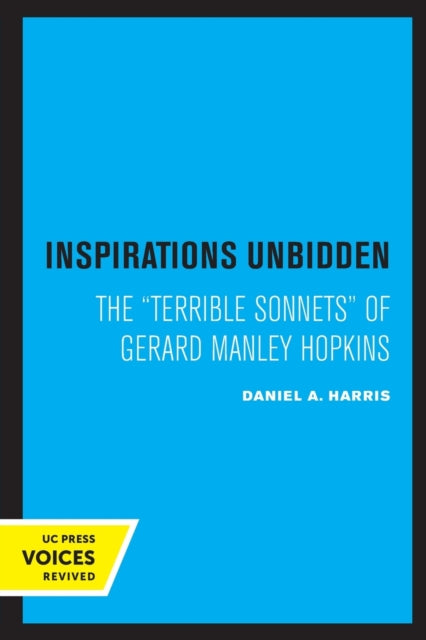
Daniel A. Harris
Inspirations Unbidden: The Terrible Sonnets of Gerard Manley Hopkins
Inspirations Unbidden: The Terrible Sonnets of Gerard Manley Hopkins
💎 Earn 137 Points (£1.37) on this item.
YOU SAVE £6.49
- Condition: Brand new
- UK Delivery times: Usually arrives within 2 - 3 working days
- UK Shipping: Fee starts at £2.39. Subject to product weight & dimension
Bulk ordering. Want 15 or more copies? Get a personalised quote and bigger discounts. Learn more about bulk orders.
Couldn't load pickup availability
- More about Inspirations Unbidden: The Terrible Sonnets of Gerard Manley Hopkins
Inspirations Unbidden explores the paradoxical greatness of Gerard Manley Hopkins's terrible sonnets, examining their divergence from his earlier works and their unique place in Victorian poetry. It situates the sonnets within Hopkins's broader poetic evolution and considers their broader significance in the development of Victorian literature.
Format: Paperback / softback
Length: 192 pages
Publication date: 13 May 2022
Publisher: University of California Press
Gerard Manley Hopkins's terrible sonnets, written during his anguished years in Dublin in 1885, stand as some of the most compelling yet perplexing works of Victorian poetry. These six sonnets, though brief, have earned a place of profound significance in literary history, rivaling the acclaim of The Wreck of the Deutschland and The Windhover. Hopkins himself, however, viewed them as failures—not in their poetic merit but in their deviation from the imaginative and religious goals that defined his earlier works. Unlike his previous poems, which celebrated the inscape of Christ in nature and served a communal purpose, the terrible sonnets delve into personal torment and a fragmented vision of faith. Hopkins admitted they came to him like inspirations unbidden and against my will, reflecting a departure from his typical deliberate artistry and spiritual alignment. These sonnets, marked by raw emotional power and unsettling imagery, reveal an artistic evolution that Hopkins himself struggled to reconcile.
Inspirations Unbidden explores the paradoxical greatness of the terrible sonnets, examining their profound divergence from Hopkinss earlier works and their unique place in the trajectory of nineteenth-century poetry. While Hopkins lamented their lack of conformity to his religious and aesthetic ideals, he recognized their literary merit, revising them with an eye toward artistic excellence. The sonnets display a dark brilliance, characterized by heightened technical and emotional complexity, that has garnered enduring acclaim. Through a close analysis of their imagery, structure, and underlying despair, the book seeks to understand how these sonnets, which Hopkins saw as personal and spiritual failures, have achieved such lasting prominence. It also situates the sonnets within the broader context of Hopkinss life and work, highlighting the ways in which his personal struggles and artistic ambitions intertwined.
Hopkins himself was a complex and multifaceted figure, known for his intense devotion to God and his innovative approach to poetry. He was a master of language, using words to convey deep emotional and spiritual experiences. His poetry often explored themes of nature, religion, and the human condition, and he was particularly interested in the relationship between the individual and the divine.
The terrible sonnets, however, represent a departure from Hopkins's earlier work. They are characterized by a sense of despair, confusion, and disillusionment. Hopkins himself described them as "a kind of nightmare" and "a kind of hell." The sonnets are filled with images of death, decay, and destruction, and they often depict the speaker's struggle with faith and the loss of meaning in life.
One of the key themes of the terrible sonnets is the idea of the inscape of Christ in nature. Hopkins believed that Christ was present in all of nature, and he sought to express this presence through his poetry. However, in the terrible sonnets, the inscape of Christ is not a comforting or uplifting experience. Instead, it is a source of pain and suffering. The speaker of the sonnets is often confronted with the harsh realities of life, and he struggles to find meaning in the midst of it all.
Another theme of the terrible sonnets is the idea of faith. Hopkins believed that faith was essential for human happiness and well-being, but he also recognized that it was a difficult and challenging concept to grasp. In the terrible sonnets, the speaker's faith is tested and challenged, and he often finds himself questioning his beliefs. The sonnets explore the various aspects of faith, including doubt, fear, and hope, and they show how these emotions can shape a person's life.
Despite their dark and challenging nature, the terrible sonnets have been widely acclaimed by critics and readers alike. They have been praised for their technical and emotional complexity, and for their ability to convey the depth of human experience. Hopkins's use of language is particularly impressive, and he uses words to create vivid and evocative images that linger in the reader's mind long after the poem has been read.
One of the most striking features of the terrible sonnets is their use of imagery. Hopkins uses a wide range of imagery, including nature, religion, and the human body, to convey his message. He often uses images that are disturbing and unsettling, and he uses them to create a sense of tension and anxiety. For example, in the sonnet "The Wreck of the Deutschland," Hopkins describes the wreck of a ship as a symbol of the destruction of the human soul.
Another important feature of the terrible sonnets is their structure. Hopkins uses a variety of poetic forms, including ballads, sonnets, and quatrains, to create his poems. He often uses a strict rhyme scheme, and he uses a variety of poetic devices, such as alliteration, assonance, and metaphor, to create a sense of rhythm and flow.
Despite their dark and challenging nature, the terrible sonnets have been widely acclaimed by critics and readers alike. They have been praised for their technical and emotional complexity, and for their ability to convey the depth of human experience. Hopkins's use of language is particularly impressive, and he uses words to create vivid and evocative images that linger in the reader's mind long after the poem has been read.
In conclusion, Gerard Manley Hopkins's terrible sonnets are some of the most compelling yet perplexing works of Victorian poetry. These six sonnets, though brief, have earned a place of profound significance in literary history, rivaling the acclaim of The Wreck of the Deutschland and The Windhover. While Hopkins himself viewed them as failures, they have been widely acclaimed by critics and readers alike for their technical and emotional complexity, and for their ability to convey the depth of human experience. Hopkins's use of language is particularly impressive, and he uses words to create vivid and evocative images that linger in the reader's mind long after the poem has been read.
Weight: 272g
Dimension: 234 x 156 x 10 (mm)
ISBN-13: 9780520314351
This item can be found in:
UK and International shipping information
UK and International shipping information
UK Delivery and returns information:
- Delivery within 2 - 3 days when ordering in the UK.
- Shipping fee for UK customers from £2.39. Fully tracked shipping service available.
- Returns policy: Return within 30 days of receipt for full refund.
International deliveries:
Shulph Ink now ships to Australia, Belgium, Canada, France, Germany, Ireland, Italy, India, Luxembourg Saudi Arabia, Singapore, Spain, Netherlands, New Zealand, United Arab Emirates, United States of America.
- Delivery times: within 5 - 10 days for international orders.
- Shipping fee: charges vary for overseas orders. Only tracked services are available for most international orders. Some countries have untracked shipping options.
- Customs charges: If ordering to addresses outside the United Kingdom, you may or may not incur additional customs and duties fees during local delivery.