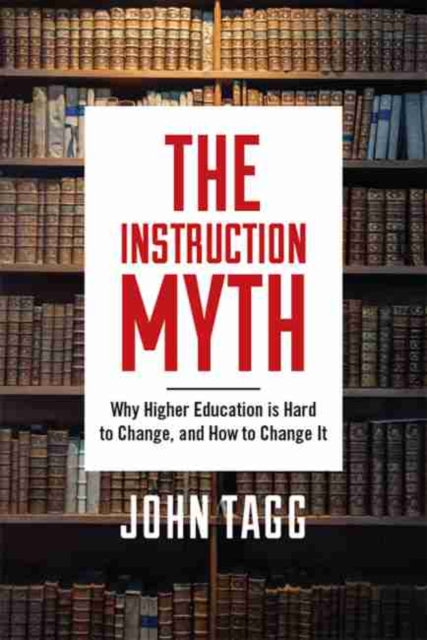
John Tagg
Instruction Myth: Why Higher Education is Hard to Change, and How to Change It
Instruction Myth: Why Higher Education is Hard to Change, and How to Change It
💎 Earn 151 Points (£1.51) on this item.
YOU SAVE £3.65
- Condition: Brand new
- UK Delivery times: Usually arrives within 2 - 3 working days
- UK Shipping: Fee starts at £2.39. Subject to product weight & dimension
Bulk ordering. Want 15 or more copies? Get a personalised quote and bigger discounts. Learn more about bulk orders.
Couldn't load pickup availability
- More about Instruction Myth: Why Higher Education is Hard to Change, and How to Change It
The Instruction Myth argues that higher education can be reformed and reinvigorated,but it will require universities to abandon their central operating principle and focus on student learning. Despite decades of research, few universities have implemented these suggestions. This book offers a powerful case for why higher education must undergo radical change and provides specific policy suggestions for how universities can break their harmful dependence on the instruction myth.
Format: Hardback
Length: 342 pages
Publication date: 30 April 2019
Publisher: Rutgers University Press
Higher education is in a state of crisis, and despite widespread dysfunction, it appears resistant to fundamental change. At this critical juncture, it is crucial to explore whether there are any viable solutions to salvage the system. The Instruction Myth, a thought-provoking book by acclaimed education scholar John Tagg, argues that higher education can be reformed and reinvigorated, but it will not be an easy task. Tagg challenges the prevailing belief that education revolves solely around instruction, which can be easily measured in terms of course syllabi, credits, and enrollments. He asserts that instruction alone is worthless and that universities should instead prioritize student learning, a more complex and challenging concept to quantify and standardize.
Despite decades of research highlighting the best practices for promoting student learning, Tagg notes that few universities have implemented these recommendations systematically. This book serves as a powerful indictment of the state of American higher education and provides a roadmap for its recovery. Tagg offers a compelling diagnosis of the issues afflicting higher education, including the commodification of education, the emphasis on standardized testing, and the lack of engagement and meaningful learning experiences for students. He also provides specific policy suggestions for how universities can break their harmful dependence on the instruction myth and foster a culture of student-centered learning.
One of the key arguments presented by Tagg is that universities should shift their focus from teaching to learning. He advocates for a more holistic approach to education that encompasses not only academic knowledge but also personal growth, critical thinking, and problem-solving skills. This shift requires universities to reevaluate their curriculum, teaching methods, and assessment practices to prioritize student-centered learning experiences. Tagg suggests that universities should adopt a more flexible and personalized approach to education, where students have the autonomy to choose their courses and learning paths based on their interests and goals.
Furthermore, Tagg argues that universities should prioritize the development of students' soft skills, such as communication, collaboration, and critical thinking, which are increasingly important in the modern workplace. He suggests that universities should provide opportunities for students to engage in real-world projects, internships, and community service, which not only enhance their learning experiences but also prepare them for the challenges of the 21st century.
In addition to advocating for a shift in focus, Tagg also offers specific policy suggestions for how universities can reform their systems. He calls for increased funding for higher education, particularly for institutions that serve underrepresented populations and provide access to education for low-income students. Tagg also advocates for the deregulation of higher education, which would allow universities to be more innovative and flexible in their approach to education.
Furthermore, Tagg suggests that universities should prioritize the hiring and retention of high-quality faculty members who are committed to student-centered learning and who are passionate about their field. He argues that faculty members should be given the autonomy to design their courses and teaching methods and should be rewarded for their contributions to student learning.
In conclusion, The Instruction Myth presents a compelling case for the reform of higher education. By challenging the prevailing belief that education revolves solely around instruction, Tagg advocates for a shift in focus towards student-centered learning. He provides specific policy suggestions for how universities can break their harmful dependence on the instruction myth and foster a culture of student-centered learning. This book is a must-read for educators, policymakers, and anyone interested in the future of higher education.
Weight: 578g
Dimension: 163 x 237 x 27 (mm)
ISBN-13: 9781978804456
This item can be found in:
UK and International shipping information
UK and International shipping information
UK Delivery and returns information:
- Delivery within 2 - 3 days when ordering in the UK.
- Shipping fee for UK customers from £2.39. Fully tracked shipping service available.
- Returns policy: Return within 30 days of receipt for full refund.
International deliveries:
Shulph Ink now ships to Australia, Belgium, Canada, France, Germany, Ireland, Italy, India, Luxembourg Saudi Arabia, Singapore, Spain, Netherlands, New Zealand, United Arab Emirates, United States of America.
- Delivery times: within 5 - 10 days for international orders.
- Shipping fee: charges vary for overseas orders. Only tracked services are available for most international orders. Some countries have untracked shipping options.
- Customs charges: If ordering to addresses outside the United Kingdom, you may or may not incur additional customs and duties fees during local delivery.