Shulph Ink
Insurgency, Terrorism, and Counterterrorism in Africa
Insurgency, Terrorism, and Counterterrorism in Africa
💎 Earn 477 Points (£4.77) on this item.
We can order this item for you. Delivery usually takes about 4 to 6 weeks.
This item is not held in our immediate stock. We will order it for you after checkout.
Estimated delivery: About 4 to 6 weeks
- Condition: Brand new
- UK Delivery times: Usually arrives within 2 - 3 working days
- UK Shipping: Fee starts at £2.39. Subject to product weight & dimension
Bulk ordering. Want 15 or more copies? Get a personalised quote and bigger discounts. Learn more about bulk orders.
Couldn't load pickup availability
- More about Insurgency, Terrorism, and Counterterrorism in Africa
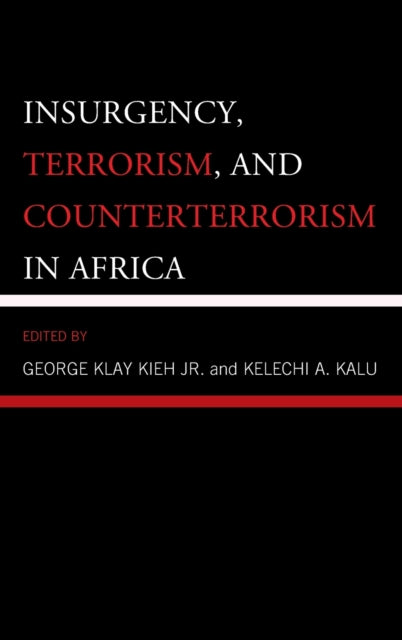
Insurgency, Terrorism, and Counterterrorism in Africa examines insurgent movements, terrorist organizations, and state policies that instigate intrastate conflicts, offering practical insights to policymakers to end insecurity and promote inclusive governance.
Format: Hardback
Length: 252 pages
Publication date: 15 February 2023
Publisher: Lexington Books
Insurgency, Terrorism, and Counterterrorism in Africa, edited by George Klay Kieh, Jr. and Kelechi A. Kalu, is a comprehensive examination of insurgent movements, terrorist organizations, and state policies that contribute to intrastate conflicts in African states. The book explores the tactics used by anti-government forces, state counterterrorism responses, and the human security impacts of insecurity on citizens across various communities in Africa. The contributors employ extensive research methods, including case studies of terrorist organizations such as Al Shabaab, Al Qaeda, Boko Haram, and the Islamic State, to provide new and productive insights into counterterrorism strategies deployed by selected African states, the African Union, and the U.S. The book challenges existing literature on terrorism that primarily focuses on the actions of non-state entities and offers practical insights to policymakers seeking to end insecurity and promote inclusive governance in Africa.
The book begins by examining the historical roots of insurgency and terrorism in Africa, tracing the origins of these movements to colonialism, economic exploitation, and political repression. It highlights the role of state policies in instigating intrastate conflicts, such as the use of force, repression, and discrimination against certain groups. The authors argue that these policies have contributed to the perpetuation of insecurity and have hindered the development of African states.
One of the key themes of the book is the use of tactics by anti-government forces. The authors provide detailed case studies of terrorist organizations such as Al Shabaab, Al Qaeda, Boko Haram, and the Islamic State, examining their organizational structures, recruitment strategies, and tactics. They highlight the use of violence, propaganda, and social media to spread their message and recruit new members. The authors also discuss the challenges faced by state counterterrorism responses, including the need for effective intelligence gathering, the use of military force, and the protection of human rights.
The book also examines the human security impacts of insecurity on citizens across various communities in Africa. It highlights the impact of terrorism on social and economic development, human rights, and the rule of law. The authors argue that insecurity has led to the displacement of millions of people, the destruction of infrastructure, and the erosion of trust in government institutions. They also highlight the role of women and children in terrorism, noting that they are often targeted and exploited by terrorist organizations.
To address these challenges, the book proposes a range of counterterrorism strategies. These strategies include the use of intelligence-led policing, the development of community-based security programs, and the promotion of human rights and the rule of law. The authors argue that these strategies can be effective in reducing the threat of terrorism and promoting inclusive governance in Africa.
One of the strengths of the book is its extensive research methods. The authors employ a variety of research methods, including case studies, interviews, and surveys, to provide a comprehensive analysis of the issues. They also draw on a wide range of sources, including government documents, academic literature, and media reports. This allows the authors to provide a balanced and nuanced analysis of the issues.
However, the book also has some limitations. One of the main limitations is the lack of data on the impact of counterterrorism strategies in Africa. The authors acknowledge that there is limited data available on the effectiveness of these strategies, and they suggest that more research is needed to better understand the impact of these strategies on the ground.
Another limitation is the focus on African states. While the book provides insights into the challenges faced by African states, it does not provide a comprehensive analysis of the challenges faced by other countries in the region. This is a significant limitation, as terrorism is a global issue that requires a global response.
Despite these limitations, Insurgency, Terrorism, and Counterterrorism in Africa is a valuable resource for policymakers, researchers, and practitioners working in the field of terrorism and counterterrorism. The book provides a comprehensive analysis of the issues and offers practical insights to policymakers seeking to end insecurity and promote inclusive governance in Africa.
In conclusion, Insurgency, Terrorism, and Counterterrorism in Africa is a comprehensive examination of insurgent movements, terrorist organizations, and state policies that contribute to intrastate conflicts in African states. The book explores the tactics used by anti-government forces, state counterterrorism responses, and the human security impacts of insecurity on citizens across various communities in Africa. The book challenges existing literature on terrorism that primarily focuses on the actions of non-state entities and offers practical insights to policymakers seeking to end insecurity and promote inclusive governance in Africa. While the book has some limitations, it is a valuable resource for policymakers, researchers, and practitioners working in the field of terrorism and counterterrorism.
Dimension: 229 x 152 (mm)
ISBN-13: 9781793649362
This item can be found in:
UK and International shipping information
UK and International shipping information
UK Delivery and returns information:
- Delivery within 2 - 3 days when ordering in the UK.
- Shipping fee for UK customers from £2.39. Fully tracked shipping service available.
- Returns policy: Return within 30 days of receipt for full refund.
International deliveries:
Shulph Ink now ships to Australia, Belgium, Canada, France, Germany, Ireland, Italy, India, Luxembourg Saudi Arabia, Singapore, Spain, Netherlands, New Zealand, United Arab Emirates, United States of America.
- Delivery times: within 5 - 10 days for international orders.
- Shipping fee: charges vary for overseas orders. Only tracked services are available for most international orders. Some countries have untracked shipping options.
- Customs charges: If ordering to addresses outside the United Kingdom, you may or may not incur additional customs and duties fees during local delivery.