1
/
of
1
Robin Singhal
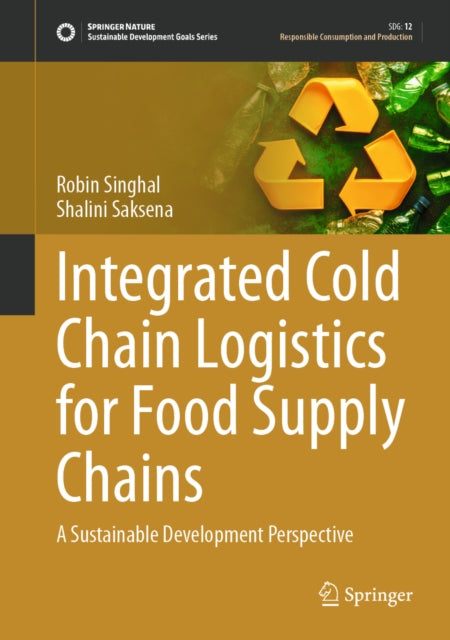
Integrated Cold Chain Logistics for Food Supply Chains: A Sustainable Development Perspective
Integrated Cold Chain Logistics for Food Supply Chains: A Sustainable Development Perspective
💎 Earn 467 Points (£4.67) on this item.
ORDERED FOR YOU
We can order this item for you. Delivery usually takes about 4 to 6 weeks.
This item is not held in our immediate stock. We will order it for you after checkout.
Estimated delivery: About 4 to 6 weeks
Regular price
£93.44 GBP
Regular price
£109.99 GBP
Sale price
£93.44 GBP
Unit price
/
per
Taxes included.
Shipping calculated at checkout.
YOU SAVE £16.55
- Condition: Brand new
- UK Delivery times: Usually arrives within 2 - 3 working days
- UK Shipping: Fee starts at £2.39. Subject to product weight & dimension
Bulk ordering. Want 15 or more copies? Get a personalised quote and bigger discounts. Learn more about bulk orders.
Couldn't load pickup availability
- More about Integrated Cold Chain Logistics for Food Supply Chains: A Sustainable Development Perspective
This volume focuses on food supply chains (FSCs), a vital component of the food system, establishing that integrated cold chain logistics (CCL) are essential for modernising FSCs of perishable commodities in low and middle income countries (LMICs). It argues that the future development of CCL should be envisioned not merely as a means to reduce food loss and waste to meet Target 12.3 of SDG12, but as an infrastructural service with the potential to enable a sustainable, resilient, and inclusive transformation of FSCs in LMICs. Towards this, the volume examines integrated CCL through its connections to: (a) cooling infrastructure as a developmental necessity rather than a luxury; (b) a critical component of food system transformation for both climate mitigation and adaptation; (c) reliable access to safe, nutritious, affordable food, thereby enhancing food and nutrition security; and (d) expanded agribusiness and livelihood opportunities by strengthening the farm-to-market link. This comprehensive approach broadens the discourse on CCL beyond engineering and management perspectives; promotes the integration of the three pillars of sustainability - economic, environmental, and social; and supports climate adaptation to foster climate-resilient and inclusive rural transformation in LMICs. Framed within a global context to capture evolving market dynamics, technological innovations, and emerging trends, the book offers an in-depth examination of the challenges and developmental aspects of CCL. It explores the nexus between integrated CCL and sustainable development. It presents a comprehensive 10S Dimensions-based analytical framework that emphasizes value integration and multidimensional policy coherence to support context-specific, evidence-based policymaking in LMICs, while drawing insights from high-income countries. The volume also highlights the role of policy instruments in incentivizing food loss abatement and contributes to the growing scholarship on food loss modelling by treating abatement levels as endogenous variables in agent-level decision-making across food supply chains. It enriches the discourse on CCL development from an LMIC perspective through an analysis of India’s historical trajectory, public policy evolution, persistent gaps, and investment patterns. A detailed assessment of organized cold chain operations in India introduces a country-specific performance framework, capturing indicators such as productivity, energy intensity, profitability, and risk, aimed at improving governance and informing national policy. Finally, the volume advocates reimagining investment strategies in light of disruptive trends in infrastructure, urging a renewed, long-term orientation to support systemic transformation amid the dual crises of climate change and the COVID-19 aftermath. Intended for post-harvest experts, industry practitioners, scholars, researchers, and policy-makers, this volume guides critical, policy-oriented analysis of CCL development, aligning it with SDGs, climate resilience, public health, and food system transformation. “This volume, Integrated Cold Chain Logistics for Food Supply Chains, offers insights. Drawing on interdisciplinary research and grounded in the realities of LMICs, the authors present a compelling case for why cold chains matter, what needs to change, and how to do it sustainably and inclusively. In doing so, they position cooling not as a luxury, but as an essential sustainable development investment for equitable and nutritious food access in a warming world.”Jessica Fanzo, Professor of Climate and Food, The Columbia Climate School, Columbia University, USA
- Publication date: 2 August 2026
- Page count: 240
- Dimensions: Height 254 mm; Width 178 mm
- Publisher: Springer Verlag, Singapore
- Format: Hardback
- ISBN-13: 9789819569021
UK and International shipping information
UK and International shipping information
UK Delivery and returns information:
- Delivery within 2 - 3 days when ordering in the UK.
- Shipping fee for UK customers from £2.39. Fully tracked shipping service available.
- Returns policy: Return within 30 days of receipt for full refund.
International deliveries:
Shulph Ink now ships to Australia, Belgium, Canada, France, Germany, Ireland, Italy, India, Luxembourg Saudi Arabia, Singapore, Spain, Netherlands, New Zealand, United Arab Emirates, United States of America.
- Delivery times: within 5 - 10 days for international orders.
- Shipping fee: charges vary for overseas orders. Only tracked services are available for most international orders. Some countries have untracked shipping options.
- Customs charges: If ordering to addresses outside the United Kingdom, you may or may not incur additional customs and duties fees during local delivery.