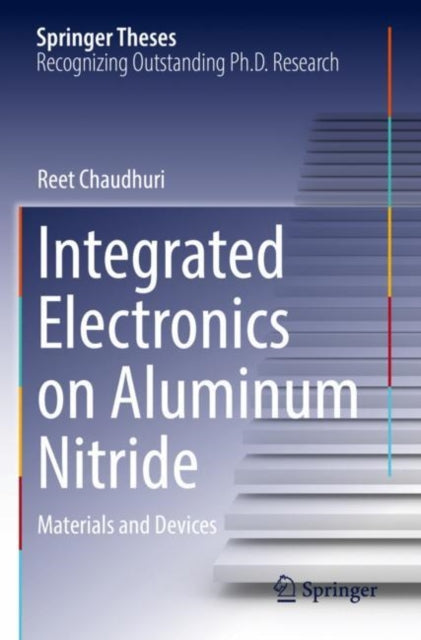
Reet Chaudhuri
Integrated Electronics on Aluminum Nitride: Materials and Devices
Integrated Electronics on Aluminum Nitride: Materials and Devices
💎 Earn 743 Points (£7.43) on this item.
We can order this item for you. Delivery usually takes about 4 to 6 weeks.
This item is not held in our immediate stock. We will order it for you after checkout.
Estimated delivery: About 4 to 6 weeks
YOU SAVE £31.32
- Condition: Brand new
- UK Delivery times: Usually arrives within 2 - 3 working days
- UK Shipping: Fee starts at £2.39. Subject to product weight & dimension
Bulk ordering. Want 15 or more copies? Get a personalised quote and bigger discounts. Learn more about bulk orders.
Couldn't load pickup availability
- More about Integrated Electronics on Aluminum Nitride: Materials and Devices
This thesis explores the principles, device physics, and technological applications of electronics based on aluminum nitride, highlighting its advantages for high performance transistors and monolithic integration of passive elements.
Format: Paperback / softback
Length: 255 pages
Publication date: 07 December 2023
Publisher: Springer International Publishing AG
Electronics based on the ultra-wide bandgap semiconductor aluminum nitride have gained significant attention in recent years due to their unique properties and wide range of technological applications. This thesis presents an overview of the principles, device physics, and technological applications of aluminum nitride-based electronics.
The first section of the thesis discusses the basic principles of electrostatics and transport properties of polarization-induced two-dimensional electron and hole channels in semiconductor heterostructures based on aluminum nitride. It explains how these channels can be used to create high-density two-dimensional hole gases in undoped heterojunctions, which are essential for high performance nFETs and pFETs. The thesis also shows how these high conductivity n- and p-type channels are used for high performance nFETs and pFETs, along with wide bandgap RF, mm-wave, and CMOS applications.
One of the key advantages of aluminum nitride is its high thermal conductivity, which enables efficient heat dissipation in electronic devices. This property is particularly important for high-power applications, such as power amplifiers and microprocessors. Aluminum nitride also has a high piezoelectric coefficient, which makes it useful for sensing and actuation applications.
The thesis also discusses the several material advantages of aluminum nitride, such as its high thermal conductivity and piezoelectric coefficient, which enable not just high performance of transistors, but also monolithic integration of passive elements such as high frequency filters. This enables a new form factor for integrated RF electronics, which can be used in a wide range of applications, including wireless communication, radar, and imaging.
In addition to its electrical properties, aluminum nitride also has excellent mechanical properties, making it suitable for use in high-frequency applications. It has a low coefficient of thermal expansion, which reduces the risk of thermal stress and cracking in electronic devices. Aluminum nitride also has a high hardness, which makes it resistant to wear and tear.
The thesis also discusses the challenges associated with the development of aluminum nitride-based electronics. One of the main challenges is the difficulty in growing high-quality aluminum nitride crystals. This is due to the high melting point of aluminum nitride, which makes it difficult to grow large crystals. However, recent advances in crystal growth techniques have made it possible to grow high-quality aluminum nitride crystals, which are essential for the development of high-performance electronic devices.
Another challenge is the high cost of aluminum nitride. This is due to the high cost of the raw materials used in its production, such as aluminum and nitrogen. However, recent advances in manufacturing techniques have made it possible to reduce the cost of aluminum nitride, which is expected to increase its adoption in the electronics industry.
In conclusion, electronics based on the ultra-wide bandgap semiconductor aluminum nitride have gained significant attention in recent years due to their unique properties and wide range of technological applications. This thesis presents an overview of the principles, device physics, and technological applications of aluminum nitride-based electronics, and discusses the several material advantages of aluminum nitride, such as its high thermal conductivity and piezoelectric coefficient, which enable not just high performance of transistors, but also monolithic integration of passive elements such as high frequency filters. While there are several challenges associated with the development of aluminum nitride-based electronics, recent advances in crystal growth techniques and manufacturing techniques have made it possible to reduce the cost of aluminum nitride, which is expected to increase its adoption in the electronics industry.
Dimension: 235 x 155 (mm)
ISBN-13: 9783031172014
Edition number: 1st ed. 2022
This item can be found in:
UK and International shipping information
UK and International shipping information
UK Delivery and returns information:
- Delivery within 2 - 3 days when ordering in the UK.
- Shipping fee for UK customers from £2.39. Fully tracked shipping service available.
- Returns policy: Return within 30 days of receipt for full refund.
International deliveries:
Shulph Ink now ships to Australia, Belgium, Canada, France, Germany, Ireland, Italy, India, Luxembourg Saudi Arabia, Singapore, Spain, Netherlands, New Zealand, United Arab Emirates, United States of America.
- Delivery times: within 5 - 10 days for international orders.
- Shipping fee: charges vary for overseas orders. Only tracked services are available for most international orders. Some countries have untracked shipping options.
- Customs charges: If ordering to addresses outside the United Kingdom, you may or may not incur additional customs and duties fees during local delivery.